If 2024 and 2025 taught online sellers anything, it’s that customer behavior can shift faster than product cycles.
In 2026, shoppers are still buying fashion online — but they are doing it more selectively, with higher expectations and less patience. They want products that feel worth the price, pages that answer questions quickly, and shopping experiences that reduce uncertainty before and after checkout. For print-on-demand sellers, that means the opportunity is still there, but the bar is higher. Public 2026 retail and fashion research points to a market shaped by value-seeking behavior, social-led product discovery, fit anxiety, and growing expectations around post-purchase communication.
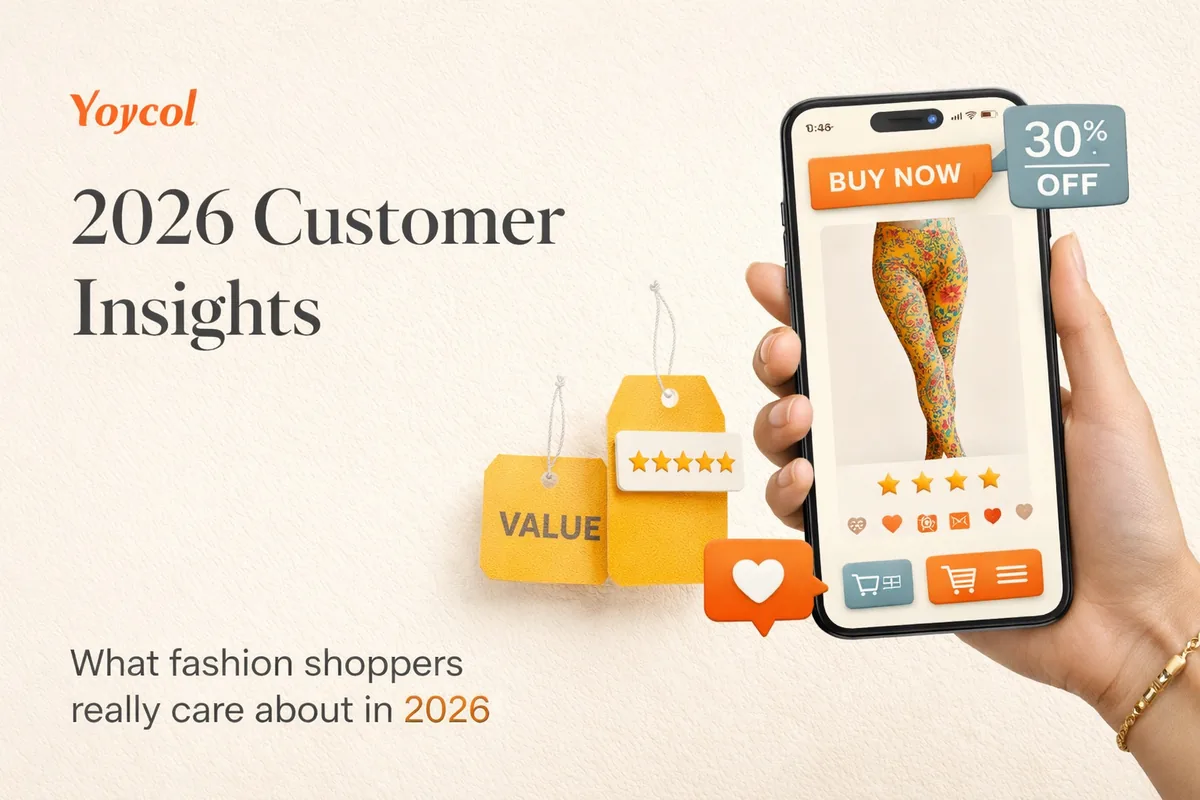
Shoppers are still buying, but they are comparing harder, scrolling faster, and hesitating more before checkout. Public retail and fashion data this year points to a clear pattern: customers want stronger value, faster clarity, lower risk, and more trust throughout the buying journey. Deloitte identifies value-oriented consumers as a defining retail force in 2026, while McKinsey reports that 70% of consumers plan to spend less and 80% are showing value-seeking behavior. At the same time, social commerce keeps growing fast, with TikTok Shop expected to reach $23.41 billion in US ecommerce sales this year.
For POD sellers, this changes more than marketing. It changes how products should be presented, how fit should be explained, and how trust should be built before and after purchase.
Customers are still spending — but they are judging value much harder
One of the clearest signals in 2026 is that shoppers have not stopped buying, but they are much more deliberate about what feels “worth it.” Deloitte’s 2026 retail outlook identifies value-seeking consumers as one of the defining forces reshaping retail this year, while McKinsey notes that macroeconomic pressure and low consumer sentiment continue to push fashion customers toward more value-conscious behavior.
For sellers, this matters because “cheap” is not the same thing as “good value.” A customer might still pay more for an item if the value is obvious. In fashion, that value usually comes from a combination of things: better-looking product photos, clearer fit information, stronger perceived versatility, more trustworthy reviews, and a product page that helps the customer imagine actual use.
This is especially relevant for POD sellers. Many print-on-demand products are not competing on rock-bottom price. They are competing on design, uniqueness, gifting value, style appeal, or niche relevance. In 2026, the winning listing is rarely the one shouting the loudest discount. It is the one that makes the customer feel: “I understand what this is, who it’s for, and why it’s worth buying.”
For Yoycol sellers, that means product pages should answer three quiet but important questions:
What problem does this solve?
Where would I actually wear or use this?
Why is this better than a random marketplace alternative?
If those answers are not visible in the first few seconds, customers move on.
Discovery is increasingly social, visual, and fast
The old path of “search, compare, read, buy” is no longer the only path — and in many cases, not even the main one. Social platforms are now doing much more than introducing trends. They are becoming direct shopping environments. EMARKETER forecasts that TikTok Shop will reach $23.41 billion in US ecommerce sales in 2026, up 48% year over year, while Facebook still leads in total US social buyers. Younger shoppers remain the strongest adopters: one-third of adults aged 18 to 34 have made a purchase on social media.
Shopify’s 2026 fashion industry analysis points in the same direction: social and video-first discovery now dominate product attention, and shoppers spend significant time each day on platforms like YouTube and TikTok. The same report also notes that nearly half of shoppers now rely on AI tools for discovery and inspiration, including help deciding what to buy next.
This changes how fashion sellers should think about content. A product image is no longer just for the product page. It is also a discovery asset. A short video is no longer just branding. It is part of the buying journey. A good listing title matters, but so does whether the first frame of a Reel or Shorts video can stop a scroll.
Products that are hard to explain visually will have a harder time scaling.
Fit anxiety is still one of the biggest conversion blockers in fashion
Fashion ecommerce has always had one stubborn problem: customers cannot try things on before they buy. In 2026, that remains one of the biggest points of hesitation.
PowerReviews reports that 89% of apparel and footwear shoppers consider size and fit when deciding whether to buy, and Shopify notes that online return pressure remains high, with projected online returns at 19.3% of all online sales in 2025, while some fast-fashion retailers report return rates approaching 29%, driven largely by fit and sizing issues.
This is where a lot of sellers still lose conversions. They spend time on mockups, ads, and creative — but leave the fit story vague. A size chart alone is not enough anymore. Customers want reassurance in human language:
Does it run tight or relaxed?
Is it true to size?
Is the fabric compressive, stretchy, soft, or structured?
Should I size up if I’m between sizes?
What does it look like on body types like mine?
That matters even more in categories like leggings, tights, fitted tops, bodycon dresses, sportswear, and shapewear-adjacent pieces.
The practical takeaway for Yoycol sellers is simple: if your product has any fit sensitivity, treat fit clarity as a conversion tool, not a support detail. Add garment measurements where possible. Add a short fit note. Use close-up fabric callouts. Show the product on body from more than one angle. And where possible, collect or display customer fit feedback. According to PowerReviews, size and fit information within reviews helps customers make better decisions and can reduce returns.
Customers do not stop evaluating you after checkout
A lot of sellers still think the hardest part is getting the order. In reality, 2026 data suggests the next challenge starts after the customer clicks “Buy.”
Shopify, citing Narvar’s 2025 State of Post-Purchase Report, says two-thirds of online shoppers feel anxiety after purchase, usually because they are uncertain about delivery, returns, or communication. Shopify’s guidance is blunt: post-purchase communication is one of the strongest drivers of long-term retail growth because it reduces anxiety, builds trust, and improves the odds of repeat revenue.
This is especially important for print-on-demand, where production times, customization expectations, and logistics windows are often different from marketplace-fast shipping expectations. If the customer does not understand what is happening, trust erodes quickly.
For Yoycol sellers, that means post-purchase messaging should not feel like an afterthought. The best stores in 2026 are doing more than sending an order confirmation. They are guiding the customer through the waiting period:
order received
in production
quality check
shipped
tracking updated
Even small touches matter. A clear order timeline, a gentle explanation of made-to-order production, and proactive shipping updates can lower refund pressure and improve repeat purchase confidence.
In other words, customer experience is no longer just pre-purchase persuasion. It is also post-purchase reassurance.
The middle of the market is getting squeezed — so positioning matters more
Another important 2026 signal is that generic positioning is getting weaker. EMARKETER predicts a widening gap between low-cost and luxury fashion, putting mid-tier brands under more pressure to explain why they matter. McKinsey also highlights strategic renewal, operational efficiency, and resale growth as major fashion themes in 2026, all of which point to a more competitive environment where vague branding gets ignored.
For smaller sellers, this is actually useful news.
Why? Because it means broad, forgettable positioning is losing power. Niche clarity is becoming more valuable.
Customers are more likely to respond when the product feels specific:
a gifting item for dog moms
a travel tote for beach weekends
a flattering pair of printed leggings for boutique shoppers
a creator-led cap design with a clear aesthetic
a themed home item tied to one interest group
In 2026, the advantage is not necessarily being bigger. It is being easier to understand.
For Yoycol sellers, this supports a practical strategy:
go narrower in message
get clearer in audience
show the use case faster
build small, connected collections instead of random SKUs
When products feel curated rather than scattered, customers trust the store more.
What this means for Yoycol sellers in practical terms
If we strip all of this down, 2026 customers are asking for five things:
1. Clear value
Not necessarily the lowest price, but a stronger reason to buy.
2. Faster understanding
They want to know what the product is, how it fits, and why it matters within seconds.
3. Lower risk
Anything that reduces doubt — better sizing, better reviews, better visuals, better shipping communication — can improve conversion.
4. Social-friendly presentation
Products need to work not only on product pages, but also in short-form discovery environments.
5. More specific positioning
Generic stores blend in. Specific products with a defined audience stand out.
That means the 2026 opportunity for POD is still very real. But it is not just about uploading more designs. It is about building better buying confidence around the products you choose to sell.
Final thoughts
The most useful customer insight for 2026 may be this: people are not buying less carefully because digital shopping is easier. They are buying more carefully because there is too much choice.
That puts more pressure on sellers — but it also creates a real edge for stores that communicate clearly.
The brands and sellers that grow this year will not just be the ones with more products. They will be the ones that:
present value more clearly
reduce fit uncertainty
treat content as commerce
communicate well after checkout
position products for a defined buyer instead of “everyone”
For Yoycol sellers, that is encouraging. These are not impossible changes. They are operational changes, merchandising changes, and content changes. And they are exactly the kind of improvements that can compound over time.
In 2026, customer insight is not just something you read in a report. It is something you translate into better product pages, better assortments, better messaging, and better retention.
That is where growth starts.