If you're selling print-on-demand products, you've probably heard that polyester is the best fabric for sublimation printing. But do you know why? And more importantly, do you know how to get the best results when sublimating on polyester?
Understanding the science behind sublimation on polyester isn't just academic — it directly impacts your profit margins, customer satisfaction, and return rates. Get it right, and you'll have vibrant, durable prints that keep customers coming back. Get it wrong, and you'll deal with faded colors, poor adhesion, and unhappy customers.
This guide covers everything you need to know about sublimation on polyester:
- The science of why sublimation works on polyester (and not other fabrics)
- Best practices for vibrant, durable prints
- Temperature, time, and pressure settings
- Common mistakes that kill your prints
- How to choose the right polyester products for your POD business
If you're new to sublimation, our best fabric for sublimation guide covers fabric selection. And if you want to understand the full sublimation process, our dye sublimation guide explains everything from start to finish.
Why Sublimation Works on Polyester (The Science)
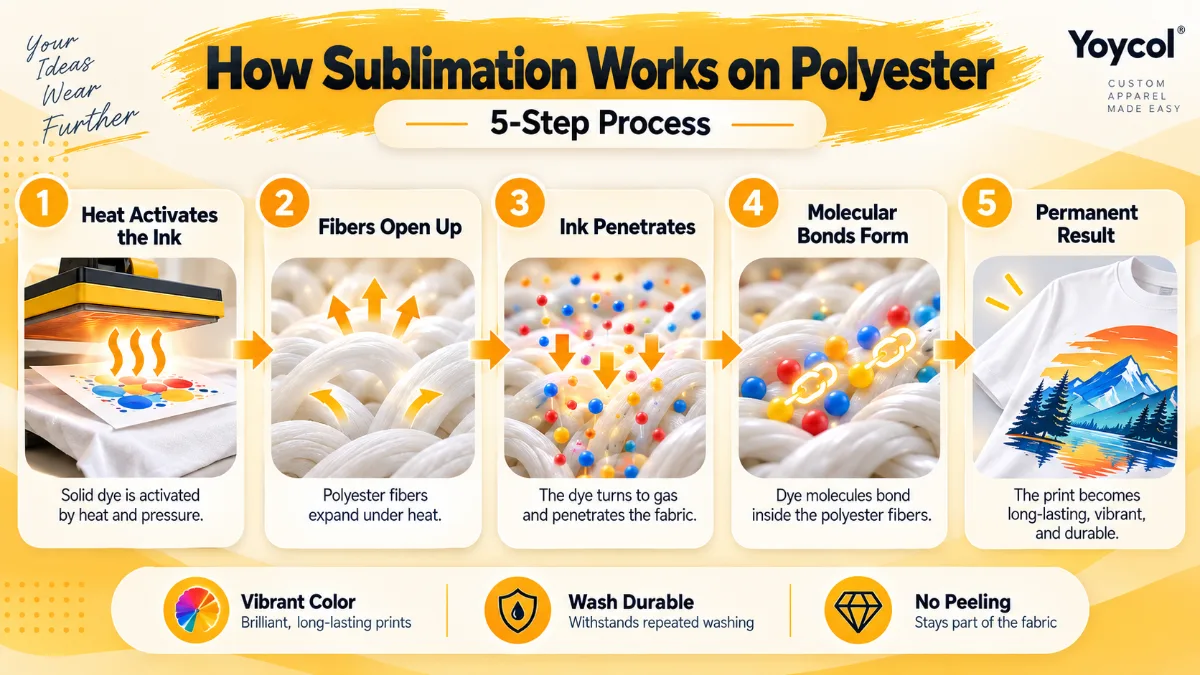
Before we dive into best practices, let's understand why sublimation works so well on polyester.
The Molecular Bond
Sublimation ink is made of disperse dyes — special dyes that can turn from solid to gas without passing through a liquid phase (that's what "sublimation" means). When you heat-press sublimation ink onto polyester fabric, here's what happens:
- Heat activates the ink — At 380-400°F, the sublimation ink turns into gas
- Polyester fibers open up — Heat causes polyester fibers to expand and open their molecular structure
- Ink penetrates fibers — The gaseous ink penetrates the open polyester fibers
- Molecular bond forms — As the fabric cools, the fibers close and trap the ink inside
- Permanent result — The ink becomes part of the fabric, not just sitting on top
This is why sublimation prints on polyester are:
- Vibrant — ink is inside the fibers, not on the surface
- Durable — won't crack, peel, or wash out
- Soft — no hand-feel (you can't feel the print)
- Stretch-resistant — print stretches with the fabric
Why Polyester Specifically?
Polyester is a synthetic polymer made from petroleum-based chemicals. Its molecular structure has tiny pores that open when heated, allowing sublimation ink to penetrate.
Natural fibers like cotton don't have this structure. Cotton fibers are cellulose-based and don't open up when heated. Sublimation ink can't penetrate cotton fibers, so it just sits on the surface and washes out quickly.
This is why you need at least 65% polyester content for acceptable sublimation results, and 90%+ polyester for best results.
For a deeper dive into fabric science, our best fabric for sublimation guide covers all fabric types.
The Best Polyester Products for Sublimation POD
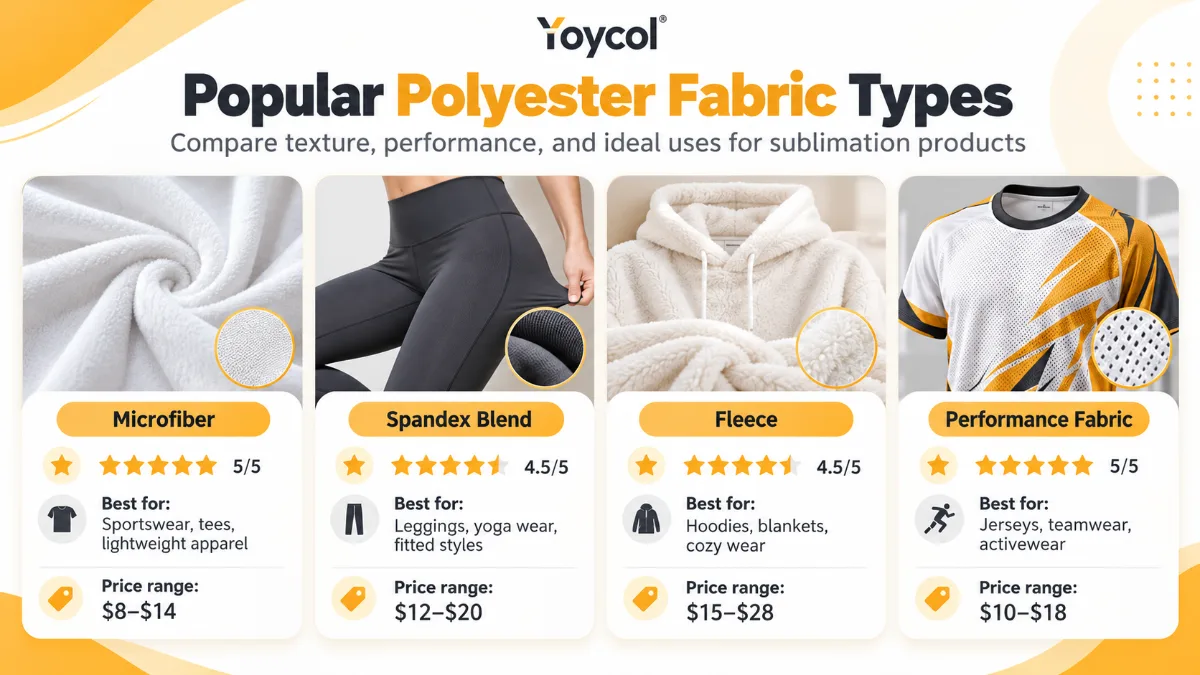
Not all polyester products are created equal. Here are the best polyester products for sublimation POD, ranked by performance and profit potential:
1. 100% Polyester Microfiber (Best Overall)
Performance: ★★★★★ Best for: All-over-print apparel, blankets, bags
Why it's the best:
- Maximum color vibrancy and sharpness
- Smooth, consistent surface for even ink distribution
- Excellent durability (prints last 100+ washes)
- Wide availability through POD suppliers
Common products:
- Polyester fleece blankets
- Performance t-shirts
- Athletic leggings
- Sports jerseys
Price range: $8-$15 base cost, $30-$50 retail
2. 95% Polyester / 5% Spandex Blend (Best for Stretch)
Performance: ★★★★☆ Best for: Leggings, fitted apparel, activewear
Why it's great:
- Excellent print quality (nearly as vibrant as 100% polyester)
- Added stretch and comfort from spandex
- Perfect for fitted garments that need to move with the body
Common products:
- All-over-print leggings
- Compression shirts
- Fitted dresses
- Swimwear
Price range: $8-$12 base cost, $35-$55 retail
3. Polyester Fleece (Best for Warmth)
Performance: ★★★★☆ Best for: Blankets, hoodies, robes
Why it's great:
- Soft, cozy texture customers love
- Excellent print quality on smooth side
- Thick material that feels premium
- Perfect for fall/winter products
Common products:
- Sherpa-lined blankets
- Fleece hoodies
- Bathrobes
- Throw blankets
Price range: $10-$18 base cost, $40-$65 retail
4. Performance Polyester (Moisture-Wicking)
Performance: ★★★★☆ Best for: Sportswear, activewear
Why it's great:
- Moisture-wicking properties
- Quick-drying
- UV protection (some varieties)
- Excellent for athletic applications
Common products:
- Performance t-shirts
- Sports jerseys
- Running shorts
- Workout leggings
Price range: $10-$15 base cost, $35-$55 retail
For more on choosing the right polyester products, our best fabric for sublimation guide compares all fabric types.
Sublimation Settings for Polyester: Temperature, Time & Pressure
Getting the settings right is critical for vibrant, durable prints on polyester. Here's the definitive guide:
Temperature
Recommended: 380-400°F (193-204°C)
- 380°F: Minimum temperature for proper ink transfer
- 400°F: Optimal temperature for vibrant colors
- Above 400°F: Risk of scorching or yellowing polyester
Why temperature matters:
- Too low = ink won't fully sublimate, colors appear faded
- Too high = polyester can scorch, yellow, or melt
Time
Recommended: 45-60 seconds
- 45 seconds: Minimum for lightweight polyester (100-150 GSM)
- 50-55 seconds: Ideal for medium weight polyester (150-250 GSM)
- 60 seconds: Best for heavyweight polyester (250-400 GSM)
Why time matters:
- Too short = incomplete ink transfer, dull colors
- Too long = risk of scorching, ink bleeding
Pressure
Recommended: Medium to firm pressure
- Light pressure: Ink won't fully penetrate fibers
- Medium pressure: Good for most polyester products
- Firm pressure: Best for heavyweight fabrics and textured surfaces
Why pressure matters:
- Ensures even contact between transfer paper and fabric
- Helps ink penetrate polyester fibers fully
- Prevents ghosting or blurred images
Settings by Product Type
| Product | Temperature | Time | Pressure |
|---|---|---|---|
| Lightweight t-shirt (150 GSM) | 400°F | 45-50 sec | Medium |
| Medium weight hoodie (250 GSM) | 400°F | 55-60 sec | Medium-Firm |
| Heavyweight blanket (350 GSM) | 400°F | 60-65 sec | Firm |
| Leggings (200 GSM) | 390°F | 50-55 sec | Medium |
| Performance wear (180 GSM) | 395°F | 45-50 sec | Medium |
Pro tip: Always test your settings on a sample piece before production. Different polyester blends may require slight adjustments.
Common Mistakes When Sublimating on Polyester
Avoid these costly mistakes:
Mistake #1: Using Low Polyester Content (<65%)
The problem: Ink won't bond properly, colors appear faded, prints wash out quickly.
The fix: Always check fabric composition. Stick to 90%+ polyester for best results, 65%+ minimum.
Mistake #2: Wrong Temperature
The problem: Too low = dull colors. Too high = scorched fabric, yellowing.
The fix: Use 380-400°F. Test on scrap fabric first. Use a heat press with accurate temperature control.
Mistake #3: Insufficient Press Time
The problem: Ink doesn't fully sublimate, colors appear weak and wash out.
The fix: Follow recommended times (45-60 seconds). Heavier fabrics need longer times.
Mistake #4: Using Dark Polyester
The problem: Sublimation ink is translucent. On dark fabrics, colors appear muted and dull.
The fix: Use white or light-colored polyester for vibrant results. If you must use dark fabrics, adjust your design (use lighter colors, increase contrast).
Mistake #5: Not Using Protective Paper
The problem: Ink bleeds through to the back of the fabric or onto the heat press.
The fix: Always use protective paper (parchment paper or Teflon sheet) between the fabric and heat press.
Mistake #6: Pressing Wrinkled Fabric
The problem: Wrinkles create uneven contact, causing blurred or incomplete prints.
The fix: Pre-press fabric for 5-10 seconds to remove wrinkles before applying transfer paper.
Mistake #7: Moving Fabric During Cooling
The problem: Moving fabric while hot can cause ink to shift or blur.
The fix: Let fabric cool completely (30-60 seconds) before removing transfer paper or handling.
How to Test Polyester Quality for Sublimation
Not all polyester is created equal. Here's how to test quality before committing to large orders:
The Burn Test (Identify Polyester)
Method: Burn a small fabric sample in a safe, controlled environment.
Polyester results:
- Melts and shrinks away from flame
- Burns with a sweet, chemical smell
- Leaves a hard, black bead that can't be crushed
Cotton results:
- Burns steadily with a yellow flame
- Smells like burning paper
- Leaves soft, gray ash
The Vibrancy Test (Check Quality)
Method: Sublimate a test design with a range of colors (including difficult colors like red and blue).
Good polyester results:
- Colors are bright and vibrant
- No color bleeding or blurring
- Design is sharp and detailed
Poor polyester results:
- Colors appear dull or muted
- Ink bleeds or spreads
- Design looks blurry or incomplete
The Wash Test (Check Durability)
Method: Wash the test print 5-10 times following care instructions.
Good polyester results:
- Colors remain vibrant
- No fading or cracking
- Print feels soft (no hand-feel)
Poor polyester results:
- Colors fade significantly
- Print cracks or peels
- Fabric feels stiff or rough
Sublimation on Polyester vs Other Fabrics
How does polyester compare to other fabrics for sublimation?
| Fabric | Sublimation Quality | Durability | Best For |
|---|---|---|---|
| 100% Polyester | ★★★★★ Excellent | ★★★★★ 100+ washes | All products |
| 90% Polyester / 10% Spandex | ★★★★☆ Very Good | ★★★★☆ 80+ washes | Stretch apparel |
| 65% Polyester / 35% Cotton | ★★★☆☆ Good | ★★★☆☆ 50-80 washes | Vintage look |
| 50% Polyester / 50% Cotton | ★★☆☆☆ Fair | ★★☆☆☆ 30-50 washes | Not recommended |
| 100% Cotton | ★☆☆☆☆ Poor | ★☆☆☆☆ <20 washes | Avoid for sublimation |
The bottom line: Polyester is the best fabric for sublimation. The higher the polyester content, the better the results.
Where to Source Polyester Products for POD
You don't need to source polyester fabric yourself — POD suppliers handle it. Here are the best options:
Print-on-Demand Suppliers
| Supplier | Polyester Products | Best For | Starting Price |
|---|---|---|---|
| Yoycol | 900+ AOP products, 100% polyester-focused | All-over-print apparel, blankets | $6-$15 |
| Printify | Wide range, multiple suppliers | Variety of products, competitive pricing | $8-$20 |
| Printful | Premium polyester fabrics, branded options | High-end apparel, quality focus | $12-$25 |
| JetPrint | Specialty polyester products | Shoes, accessories, unique items | $10-$30 |
Polyester-Specific Recommendations
For blankets: Yoycol's 100% polyester fleece blankets ($10-$15 base cost) are the best value.
For leggings: Printify's 95% poly / 5% spandex leggings ($8-$12 base cost) have excellent stretch and print quality.
For t-shirts: Yoycol's 100% polyester microfiber t-shirts ($6-$9 base cost) offer the best print vibrancy.
For hoodies: Printful's polyester fleece hoodies ($15-$20 base cost) are premium quality with excellent durability.
For a complete comparison of POD suppliers, our best AOP POD companies guide ranks every major platform.
Frequently Asked Questions
Can you sublimate on 100% polyester? Yes, 100% polyester is the best fabric for sublimation. It provides the brightest, most vibrant colors and excellent durability. Prints on 100% polyester last 100+ washes without significant fading.
What temperature do you need for sublimation on polyester? The optimal temperature for sublimation on polyester is 380-400°F (193-204°C). Use 400°F for best results, but don't exceed 400°F to avoid scorching the fabric.
How long do you press polyester for sublimation? Press time depends on fabric weight: 45-50 seconds for lightweight polyester (100-150 GSM), 50-55 seconds for medium weight (150-250 GSM), and 60 seconds for heavyweight polyester (250-400 GSM).
Can you sublimate on polyester-cotton blends? Yes, but results vary by polyester content. 65% polyester / 35% cotton blends give acceptable results with a vintage, muted look. For best results, use 90%+ polyester.
Why doesn't sublimation work on cotton? Cotton fibers don't have the molecular structure to accept sublimation ink. The ink needs synthetic fibers (like polyester) that open up when heated and trap the ink inside. On cotton, the ink just sits on the surface and washes out.
Does sublimation on polyester feel stiff? No. Sublimation on polyester has zero hand-feel because the ink becomes part of the fabric fibers. The print is soft and flexible, just like the rest of the fabric.
Can you sublimate on dark polyester? You can, but colors will be muted. Sublimation ink is translucent, so it works best on white or light-colored polyester. On dark polyester, expect 20-30% color reduction.
How do I prevent polyester from scorching during sublimation? Use accurate temperature control (don't exceed 400°F), don't press for too long (follow recommended times), and use a Teflon sheet or protective paper between the fabric and heat press.
Sublimation on polyester is the foundation of successful all-over-print POD products. By understanding the science, using the right settings, and avoiding common mistakes, you can create vibrant, durable prints that keep customers coming back.
Stick to 90%+ polyester for best results, follow the recommended temperature/time/pressure settings, and always test on samples before production.
Ready to start selling sublimation polyester products? Browse Yoycol's polyester fabric collection →
This guide is part of our sublimation printing series. Learn about the best fabric for sublimation, sublimation vs screen printing, or explore all our sublimation guides.