Starting a print on demand business without a plan is like building a house without a blueprint — you might get something standing, but it won't be sturdy, scalable, or profitable.
A print on demand business plan is your roadmap to success. It forces you to think through every aspect of your business: target market, product selection, pricing strategy, marketing approach, financial projections, and growth plans.
For aspiring POD entrepreneurs, creating a business plan is critical:
- Clarity — define your vision, mission, and goals
- Focus — prioritize actions that drive results
- Funding — attract investors or secure loans
- Risk mitigation — identify challenges before they happen
- Measurable progress — track KPIs and adjust strategy
This guide covers everything you need to know about creating a print on demand business plan: essential components, market research, financial projections, marketing strategy, operations planning, and how to adapt your plan as you grow.
If you're new to POD, our how to start a POD business guide covers the basics. And if you want to understand profitability, check our is print on demand profitable guide.
Why You Need a Print on Demand Business Plan
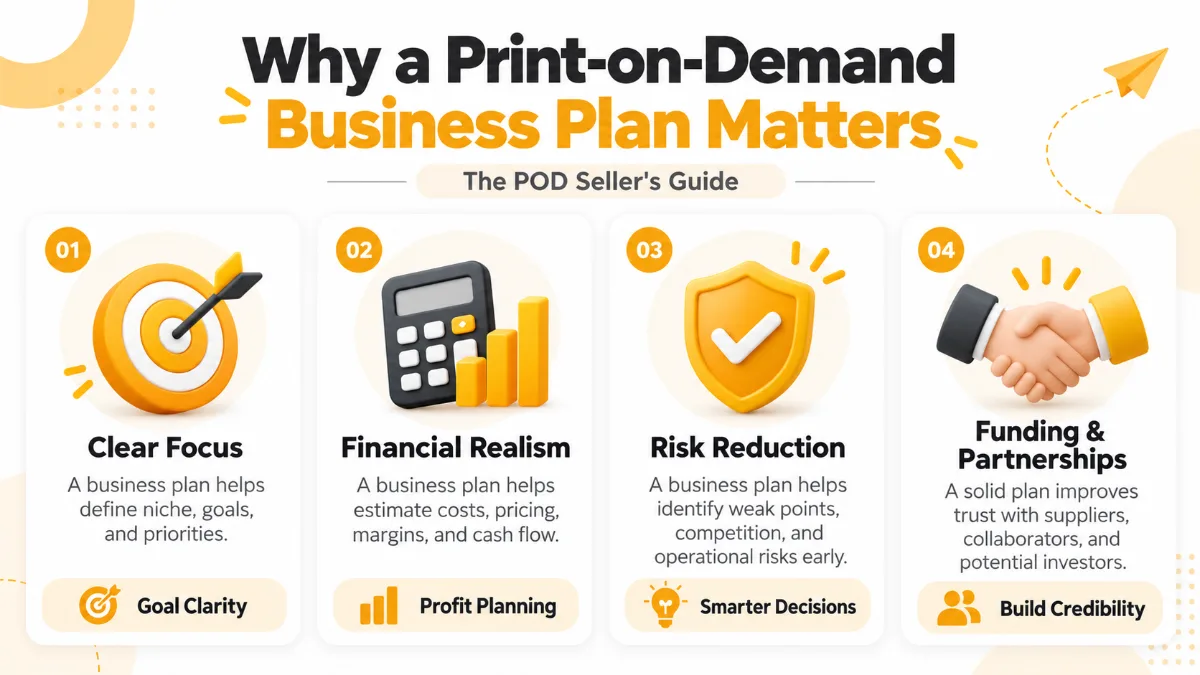
Before diving into the components, let's understand why a business plan matters:
1. Clarity and Focus
A business plan forces you to answer critical questions:
- What's your niche? — Who are you selling to?
- What's your value proposition? — Why should customers buy from you?
- What's your competitive advantage? — What makes you different?
- What are your goals? — What does success look like?
Without these answers, you're guessing. With them, you're strategic.
2. Financial Reality Check
A business plan includes financial projections that reveal:
- Startup costs — how much money do you need?
- Break-even point — when will you turn a profit?
- Cash flow — can you sustain the business?
- Profit margins — is the business viable?
Many POD businesses fail because founders don't understand the numbers. A business plan prevents this.
3. Risk Mitigation
A business plan helps you identify potential challenges:
- Market risks — is there demand for your products?
- Competition risks — who are your competitors?
- Operational risks — what if suppliers fail?
- Financial risks — what if sales are slower than expected?
Identifying risks early allows you to develop contingency plans.
4. Funding and Partnerships
If you need funding (investors, loans, grants), a business plan is non-negotiable:
- Investors — want to see your strategy and projections
- Banks — require business plans for loans
- Partners — need to understand your vision
- Suppliers — may offer better terms to serious businesses
Even if you're bootstrapping, a business plan keeps you accountable.
Essential Components of a Print on Demand Business Plan
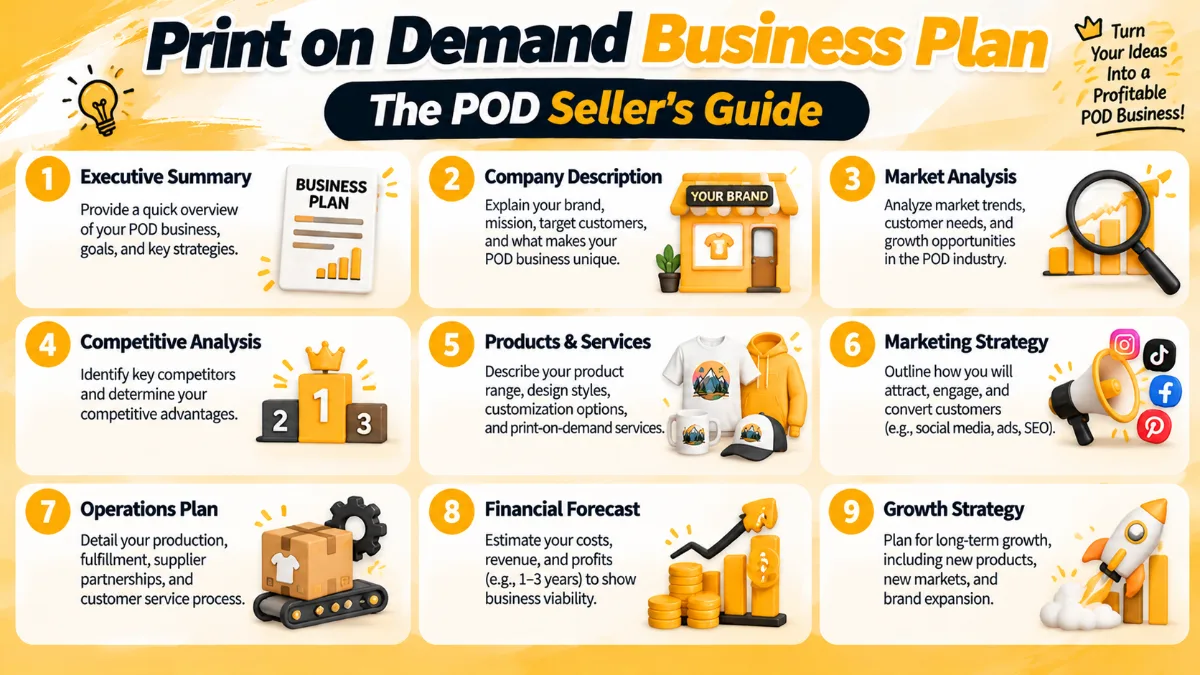
A comprehensive POD business plan includes these sections:
1. Executive Summary
The executive summary is a high-level overview of your entire business plan. Write it last, but place it first.
Include:
- Business name and mission — what's your business about?
- Products and services — what will you sell?
- Target market — who are your customers?
- Competitive advantage — what makes you different?
- Financial highlights — projected revenue and profit
- Funding needs — how much capital do you need?
Keep it concise: 1-2 pages max. Investors often read only the executive summary first.
2. Company Description
This section provides details about your business:
Include:
- Business structure — sole proprietorship, LLC, corporation?
- Location — where will you operate?
- Founders — who's running the business?
- Mission statement — what's your purpose?
- Vision statement — where do you see the business in 5 years?
- Values — what principles guide your decisions?
Example mission statement: "We create personalized, high-quality print on demand products that help customers express their unique identity while providing exceptional service and sustainable practices."
3. Market Analysis
This section demonstrates you understand your market:
Include:
- Industry overview — POD market size, growth trends
- Target market — demographics, psychographics, behavior
- Market needs — what problems are you solving?
- Market size — how many potential customers?
- Market trends — what's changing in the market?
4. Competitive Analysis
This section shows you understand your competition:
Include:
- Direct competitors — who sells similar products?
- Indirect competitors — who solves the same problem differently?
- Competitor strengths — what do they do well?
- Competitor weaknesses — where do they fall short?
- Your competitive advantage — how will you differentiate?
5. Products and Services
This section details what you'll sell:
Include:
- Product categories — t-shirts, mugs, phone cases, etc.
- Design approach — will you create designs or hire designers?
- Suppliers — who will fulfill orders?
- Pricing strategy — how will you price products?
- Quality control — how will you ensure quality?
6. Marketing and Sales Strategy
This section explains how you'll attract and convert customers:
Include:
- Branding — what's your brand identity?
- Website — Etsy, Shopify, or both?
- Traffic sources — SEO, social media, paid ads?
- Conversion optimization — how will you turn visitors into buyers?
- Customer retention — how will you keep customers coming back?
Marketing channels:
- SEO — optimize product pages for search engines
- Social media — Instagram, Pinterest, TikTok, Facebook
- Email marketing — build a list, send newsletters
- Paid advertising — Facebook Ads, Google Ads, Etsy Ads
- Influencer marketing — partner with niche influencers
- Content marketing — blog posts, videos, podcasts
7. Operations Plan
This section explains how your business will run day-to-day:
Include:
- Order fulfillment — how will orders be processed?
- Customer service — how will you handle inquiries and returns?
- Technology — what tools and software will you use?
- Team — will you hire employees or contractors?
- Processes — what are your workflows?
POD operations are simple:
- Customer places order on your website
- Order is automatically sent to your POD supplier
- Supplier prints, packs, and ships the product
- You handle customer service and marketing
8. Financial Projections
This section shows the financial viability of your business:
Include:
- Startup costs — website, branding, initial marketing
- Fixed costs — software subscriptions, hosting
- Variable costs — product costs, shipping, payment fees
- Revenue projections — monthly sales forecasts
- Profit and loss statement — projected income and expenses
- Cash flow statement — when money comes in and goes out
- Break-even analysis — when will you turn a profit?
Typical POD startup costs:
- Website setup: $0-$500 (Etsy is free, Shopify is $29/month)
- Branding: $0-$500 (DIY or hire a designer)
- Initial marketing: $100-$500 (ads, samples)
- Software tools: $50-$200/month (design, analytics, email)
- Total: $150-$1,700
Typical POD margins:
- Product cost: 40-60% of retail price
- Shipping: 10-15% of retail price
- Platform fees: 3-5% of retail price
- Profit margin: 20-40% of retail price
9. Growth Strategy
This section explains how you'll scale the business:
Include:
- Short-term goals — what will you achieve in 6 months?
- Medium-term goals — what will you achieve in 1-2 years?
- Long-term goals — what will you achieve in 3-5 years?
- Expansion plans — new products, new markets, new channels?
- Milestones — what are the key checkpoints?
How to Write Your Print on Demand Business Plan
Step 1: Research (1-2 weeks)
Before writing, gather information:
- Market research — understand your niche and customers
- Competitor analysis — study successful POD businesses
- Supplier research — evaluate POD suppliers
- Financial research — understand costs and pricing
Step 2: Draft (1-2 weeks)
Write each section of your business plan:
- Start with the easy sections — company description, products, operations
- Tackle the hard sections — market analysis, financial projections
- Write the executive summary last — summarize everything
Step 3: Review and Revise (1 week)
Refine your business plan:
- Check for clarity — is everything easy to understand?
- Check for consistency — do the numbers add up?
- Get feedback — ask mentors, advisors, or peers to review
- Revise — make improvements based on feedback
Step 4: Use Your Business Plan
Your business plan is a living document:
- Refer to it regularly — stay focused on your goals
- Update it quarterly — adjust projections based on actual performance
- Share it with stakeholders — investors, partners, team members
- Use it for decision-making — does this align with your plan?
Frequently Asked Questions
Do I really need a business plan for print on demand? Yes. A business plan provides clarity, focus, and a roadmap to success. It helps you avoid costly mistakes and make strategic decisions.
How long should a POD business plan be? 15-25 pages is typical. Keep it concise but comprehensive. Investors prefer shorter plans with clear, actionable information.
What's the most important section of a POD business plan? The financial projections section. It shows whether your business is viable and helps you understand costs, pricing, and profitability.
How do I estimate sales for my POD business plan? Research your niche, analyze competitors, and start with conservative estimates. It's better to under-promise and over-deliver.
What are typical startup costs for a POD business? $150-$1,700 depending on your approach. Etsy is free to start, Shopify costs $29/month. Add branding, initial marketing, and software tools.
How long does it take to write a POD business plan? 3-5 weeks for a comprehensive plan. You can create a simpler plan in 1-2 weeks.
Should I use a business plan template? Yes, templates provide structure and ensure you don't miss important sections. Customize the template to fit your specific business.
How often should I update my business plan? Quarterly. Review actual performance vs. projections and adjust your strategy accordingly.
Can I start a POD business without a business plan? Yes, but it's risky. You're more likely to make costly mistakes, waste time, and lose focus. A business plan increases your chances of success.
Where can I find examples of POD business plans? Search online for "print on demand business plan examples." Many resources provide free templates and sample plans.
A print on demand business plan is your roadmap to success — clarity, focus, financial reality, risk mitigation, and measurable progress.
Don't skip this step. Invest the time to create a comprehensive business plan, and you'll build a stronger, more profitable POD business.
Ready to start your POD business? Browse Yoycol's product catalog →
This guide is part of our POD business series. Explore our how to start a POD business guide, POD profit margins guide, or learn how much money you can make with POD.