"Is print on demand still profitable, or is it too saturated?" It's the question every aspiring seller asks in 2026 — and for good reason. The market is more crowded than it was five years ago, AI has flooded platforms with designs, and everyone seems to have a POD "side hustle."
So here's the honest answer, up front: Yes, print on demand is still profitable in 2026 — but only if you approach it strategically. The days of uploading 500 generic designs and getting rich are over. The sellers making real money today are doing something specific, and this guide will show you exactly what.
We'll look at the actual numbers — profit margins, costs, and market data — and give you a clear-eyed view of what it really takes to profit from POD today. No hype, no false promises.
For the complete picture of how POD income works, our full guide to making money with print on demand covers the entire model. This article focuses specifically on the profitability question.
The Short Answer: Yes, But the Game Has Changed
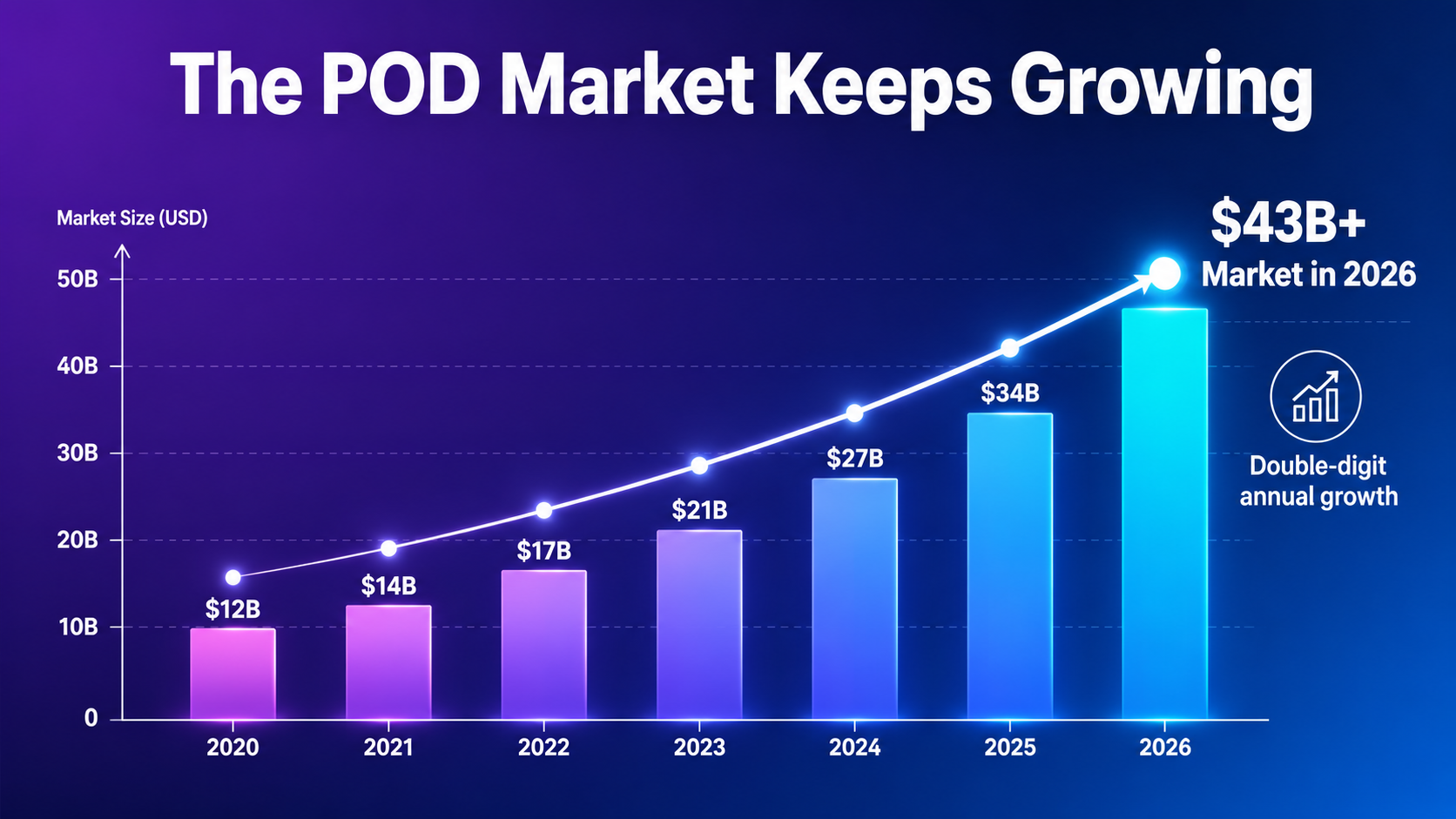
Print on demand is profitable in 2026. The global POD market is projected to exceed $43 billion and continues growing at double-digit rates. People are buying more custom products than ever.
But profitability isn't automatic. Here's what's changed:
In 2018–2020, you could succeed by uploading massive volumes of generic designs. Low competition meant even mediocre products found buyers.
In 2026, that approach is dead. The market rewards:
-
Specific niches over generic appeal
-
Quality designs over quantity
-
Premium products over commodity basics
-
SEO and marketing skill over blind luck
The opportunity is still there — arguably bigger than ever — but it goes to sellers who treat POD as a real business, not a lottery ticket.
Understanding Print on Demand Profit Margins
Let's talk real numbers. Profitability comes down to one equation:
Retail Price − Base Cost − Fees = Your Profit
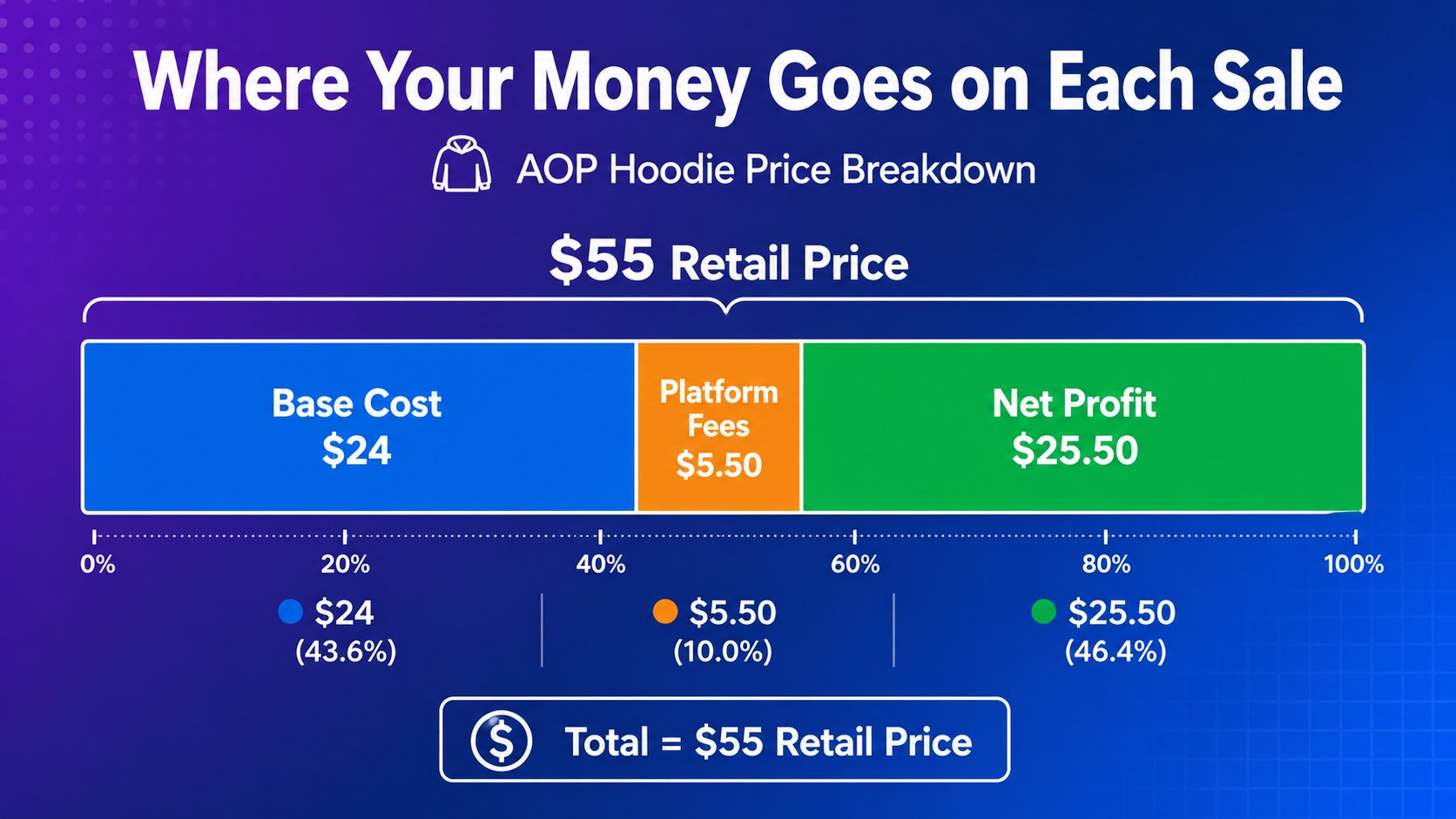
Here's a realistic breakdown for common products:
|
Product |
Base Cost |
Retail Price |
Platform Fees (~10%) |
Net Profit |
Margin |
|---|---|---|---|---|---|
|
Basic T-Shirt |
$10 |
$24 |
$2.40 |
$11.60 |
48% |
|
Standard Hoodie |
$22 |
$45 |
$4.50 |
$18.50 |
41% |
|
Mug |
$7 |
$16 |
$1.60 |
$7.40 |
46% |
|
AOP Hoodie |
$24 |
$55 |
$5.50 |
$25.50 |
46% |
|
AOP Leggings |
$18 |
$42 |
$4.20 |
$19.80 |
47% |
The key insight: margins are healthy across the board (40–50%), but the dollar amount of profit varies dramatically. An AOP hoodie nets $25.50 per sale — more than double a basic tee's $11.60. Same effort to make a sale, very different payoff.
This is why product selection matters so much for profitability. Which brings us to the biggest lever you can pull.
The Saturation Problem (and How to Beat It)
The #1 reason people doubt POD's profitability is saturation — the fear that the market is too crowded to break into.
Here's the truth: the generic market is saturated. The specific market is wide open.
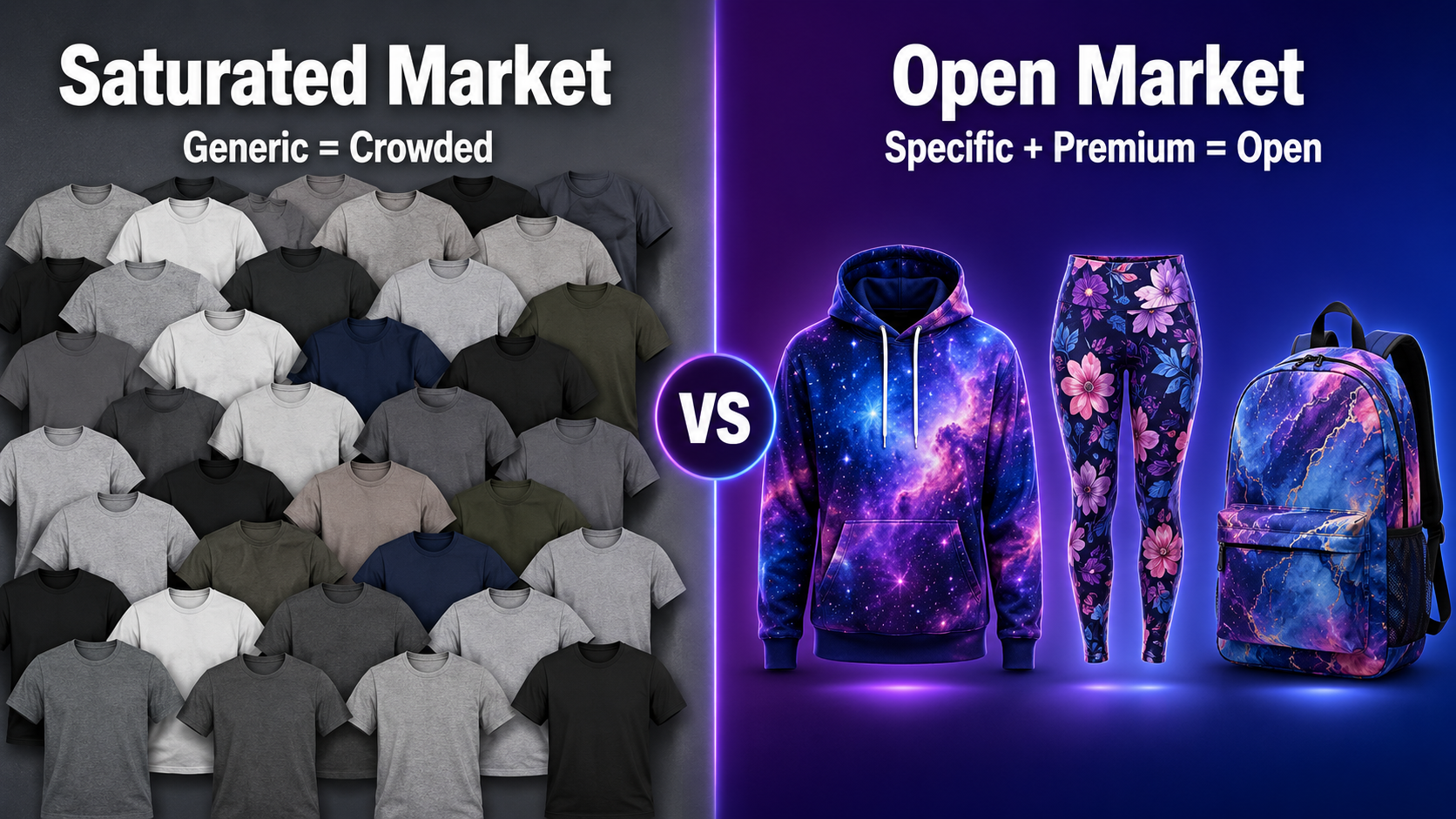
Consider these two approaches:
Saturated (avoid):
-
"Funny cat T-shirt" → millions of competitors
-
Generic motivational quote mug → endless identical listings
-
Plain logo hoodie → race to the bottom on price
Wide open (target):
-
"Sphynx cat owner anxiety T-shirt" → specific, passionate, underserved
-
All-over-print galaxy hoodie for astronomy students → premium, differentiated
-
Breed-specific AOP blanket for corgi owners → niche with buying intent
Two strategies beat saturation:
Strategy 1: Niche Down Hard
The narrower your niche, the less competition you face. "Dog lovers" is saturated. "Senior rescue greyhound adopters" is not. Specificity is your competitive moat.
Strategy 2: Sell Differentiated Products
Most POD sellers offer the same basic products. When you sell all-over-print products — where the design covers the entire garment — you're competing in a far less crowded space. Our beginner's guide to all-over-print explains why AOP is one of the least saturated, highest-margin categories in POD.
Combine both strategies — a specific niche and differentiated products — and saturation becomes almost irrelevant.
What Are the Real Costs of Print on Demand?
Profitability isn't just about margins — it's about understanding your true costs. The good news: POD has some of the lowest costs of any business model.
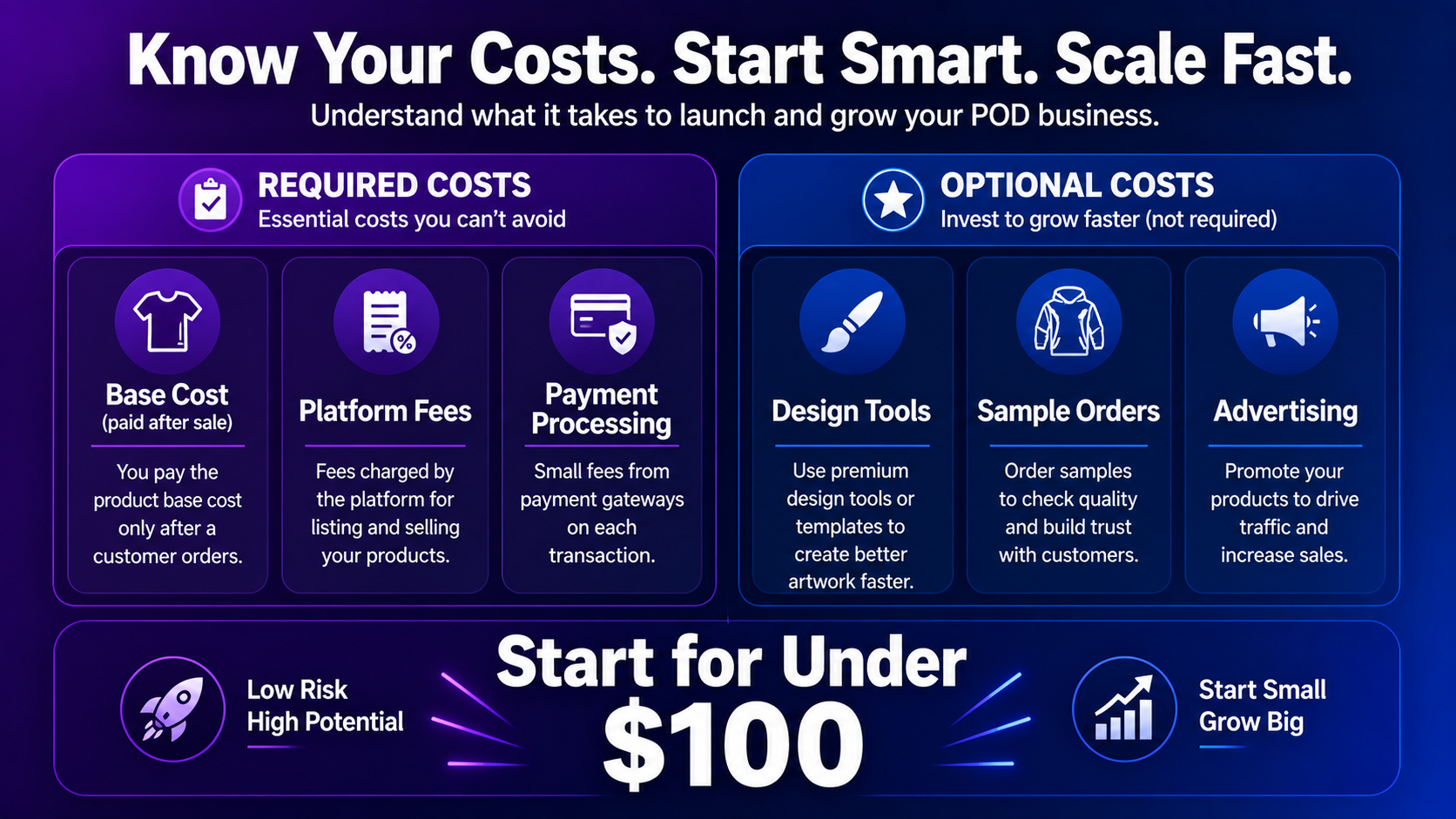
Required Costs
-
Product base cost — paid only when you make a sale (e.g., $24 for an AOP hoodie). $0 until then.
-
Platform fees — Etsy charges $0.20/listing + ~6.5% transaction fee. Shopify is ~$39/month.
-
Payment processing — ~3% per transaction.
Optional Costs
-
Design tools — Canva Pro (~$13/month) or free alternatives. AI tools vary.
-
Custom designs — $5–$100 if you hire a designer (or $0 if you DIY).
-
Sample orders — $20–$30 per product to check quality (highly recommended).
-
Advertising — optional; start at $1–$5/day on Etsy Ads once validated.
The Startup Reality
You can genuinely start with under $100 — or even $0 if you use free tools and a free marketplace. This is what makes POD uniquely low-risk: your only guaranteed cost is the base cost of products you've already sold. There's no inventory sitting in a garage, no bulk order gamble.
Compare this to Amazon FBA (which requires $2,000–$10,000+ in upfront inventory) and it's clear why POD remains the most accessible e-commerce model.
How Long Until Print on Demand Becomes Profitable?
Honesty time: most sellers don't profit in month one. Here's a realistic timeline.
|
Phase |
Timeframe |
Typical Result |
|---|---|---|
|
Setup & Learning |
Month 1–3 |
$0–$500/mo. Building catalog, testing designs. |
|
Traction |
Month 3–6 |
$500–$2,000/mo. Found what sells, optimizing. |
|
Growth |
Month 6–12 |
$2,000–$8,000/mo. Scaling winners. |
|
Established |
Year 2+ |
$8,000–$50,000+/mo. Real brand, multiple channels. |
The dropout trap: Most people quit in Month 2 — right before the learning curve pays off. They list 10 products, make no sales, and conclude "POD isn't profitable." The sellers who succeed are the ones who push through the slow early phase, learn from data, and keep iterating.
Profitability isn't a switch that flips — it's a curve that rewards persistence.
Who Makes Money with POD (and Who Doesn't)
After looking at thousands of sellers, clear patterns emerge.
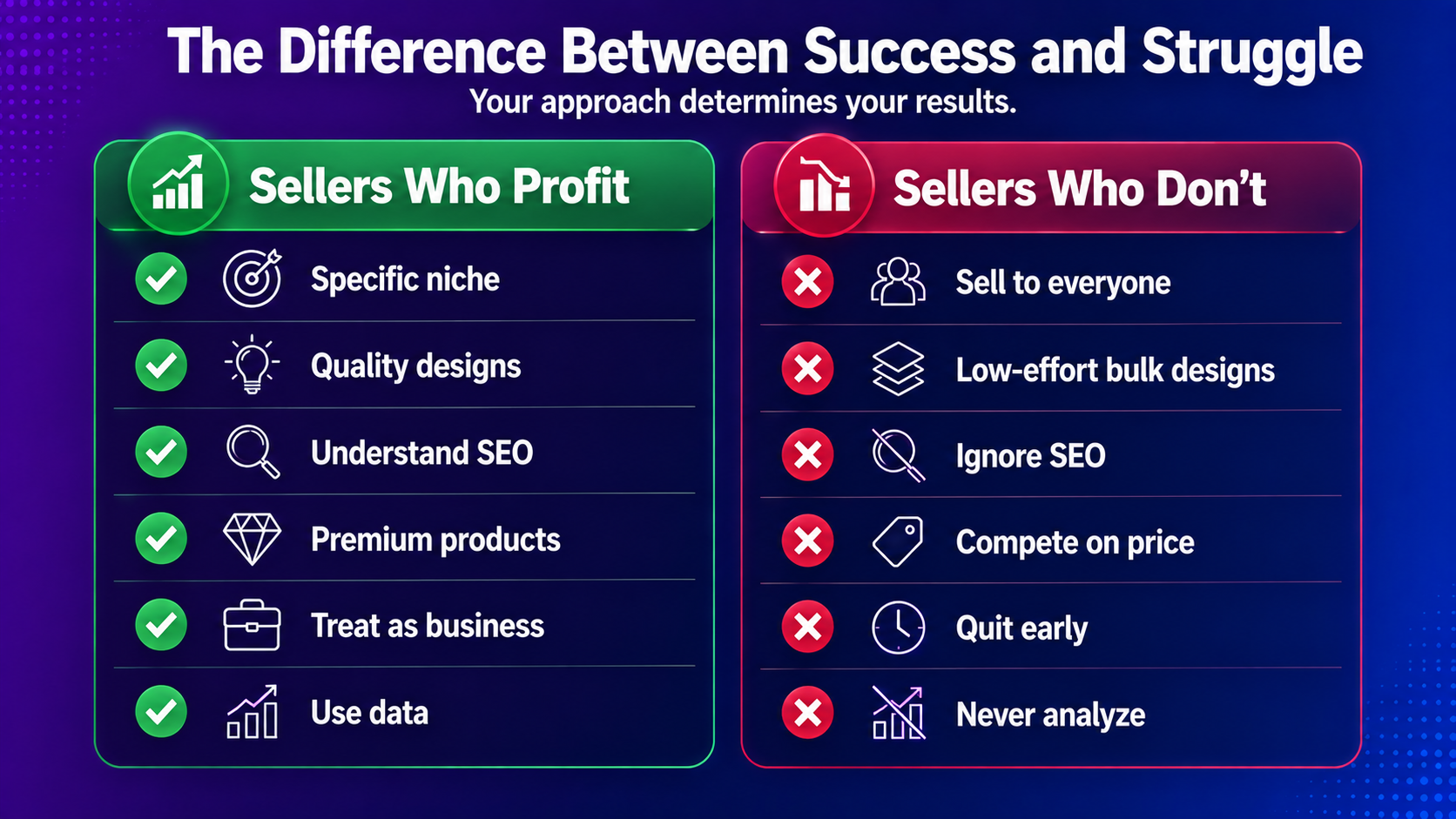
Sellers Who Profit
✅ Focus on one specific niche and go deep
✅ Invest in design quality (or curate good AI output carefully)
✅ Understand SEO — optimize titles, tags, descriptions
✅ Sell differentiated/premium products (like AOP) for higher margins
✅ Treat it as a business — consistent effort over months
✅ Use data to double down on winners and cut losers
Sellers Who Don't
❌ Try to sell everything to everyone
❌ Upload low-effort designs in bulk
❌ Ignore SEO and wonder why nobody finds them
❌ Compete only on price (race to the bottom)
❌ Quit after 4–8 weeks with no sales
❌ Never analyze what's working
The difference isn't luck or talent — it's approach. Everything on the "profit" list is learnable.
How to Maximize Your POD Profitability
If you want the best shot at profitability in 2026, here's what to prioritize:
1. Choose High-Margin Products
Basic tees have thin dollar-profits. Premium products like all-over-print hoodies, blankets, and leggings generate 2–3x the profit per sale. Our best-selling AOP products guide breaks down which items offer the best margins.
2. Price for Profit, Not for Volume
Underpricing is the #1 profit killer. Don't compete on being cheapest — compete on quality and specificity. A well-designed niche product at full price beats a generic product sold cheap. Learn the full framework in our POD pricing guide.
3. Master SEO
Organic search is free traffic that compounds. Optimizing your listings for the right keywords is the single highest-ROI skill in POD. It's the difference between products that get found and products that sit invisible.
4. Build on the Right Platform
Etsy for free marketplace traffic, Shopify for brand building. Many profitable sellers use both. If you choose a specialized POD supplier like Yoycol for premium AOP products, you get the widest product selection to maximize per-sale profit.
5. Reinvest and Scale
Once you find winning products, reinvest profits into more designs, better tools, and paid ads. Profitability compounds when you systematically scale what works.
The Bottom Line: Is It Worth It?
Yes — print on demand is still profitable in 2026, for sellers who do it right.
It's no longer a passive get-rich-quick scheme (it never really was). But as a legitimate business model with near-zero startup risk, unlimited scalability, and healthy margins, POD remains one of the best opportunities in e-commerce.
The sellers who profit share one trait: they treat POD as a real business that rewards strategy, consistency, and smart product selection. If that's you, the profit is absolutely there.
Your highest-leverage moves:
-
Niche down to beat saturation
-
Sell premium products (like AOP) for better margins
-
Master SEO for free, compounding traffic
-
Be patient — give it 6 months of real effort
Ready to start a profitable POD business? Create your free Yoycol account and access 1,600+ high-margin AOP products →
Frequently Asked Questions
Is print on demand still profitable in 2026?
Yes. The global POD market exceeds $43 billion and continues to grow. Profitability is very achievable, but it requires a strategic approach: choosing a specific niche, selling differentiated products, optimizing for SEO, and pricing for healthy margins. The "upload generic designs in bulk" approach no longer works.
What profit margins can you expect with print on demand?
Typical POD margins range from 40–60% gross. In dollar terms, basic products like T-shirts net $10–$15 per sale, while premium products like all-over-print hoodies net $25–$40 per sale. Product selection significantly impacts your per-sale profitability.
Is print on demand too saturated to make money?
The generic market is saturated, but specific niches and differentiated products are wide open. By niching down (e.g., "corgi owner gifts" instead of "dog lover shirts") and selling premium products like all-over-print items, you can easily avoid the most crowded, competitive segments.
How much money do you need to start print on demand?
You can start with under $100 — or even $0 using free design tools and a free marketplace like Etsy. Your only guaranteed cost is the base cost of products you've already sold. Optional costs include sample orders ($20–$30) and advertising. This makes POD one of the lowest-risk business models available.
How long does it take to make a profit with print on demand?
Most sellers see meaningful income within 3–6 months of consistent effort. The first few months are typically about setup, testing, and learning. Sellers who push through the slow early phase and iterate based on data are the ones who reach profitability.
What's the most profitable print on demand product?
All-over-print products — especially hoodies, blankets, and leggings — offer the highest per-sale profit ($25–$40) with less competition than basic items. High perceived value lets you charge premium prices while maintaining healthy margins.
This guide is part of our series on making money with print on demand. Explore our guides on pricing, product selection, and building a profitable POD store.