What is all-over-print? All-over-print (AOP) is a printing method that covers an entire garment — front, back, sleeves, seams, and edges — with a single continuous design. Unlike a standard T-shirt with a logo on the chest, an AOP hoodie or shirt looks like the pattern was woven into the fabric itself.
If you're a print-on-demand seller, understanding AOP matters for one simple reason: it's one of the few ways to make a product that doesn't look like everyone else's. In this guide, we'll break down exactly what all-over-print is, how it works, and how it stacks up against the two printing methods you'll hear about most — DTG and screen printing.
By the end, you'll know exactly when AOP is the right choice for your store.
What Does "All-Over-Print" Actually Mean?
The name says it all: the print goes all over the product, edge to edge, with no blank margins.
Think about the difference this way:
-
A standard printed tee has a design placed in one area — usually a rectangle on the chest or back. The rest of the shirt is a solid color.
-
An all-over-print tee has a design that runs across the whole surface. The pattern continues over the shoulders, down the sleeves, and across the seams — no gaps.
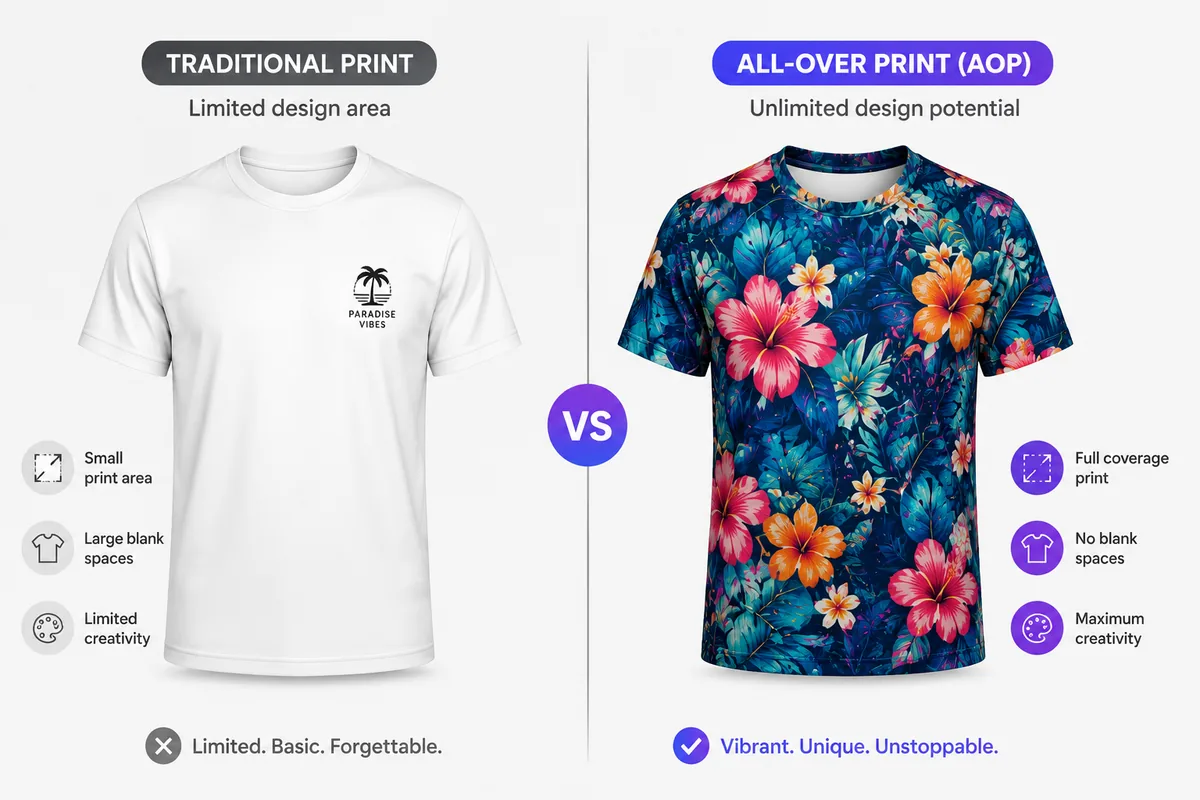
This "edge-to-edge" coverage is what makes AOP products feel premium. A galaxy pattern that wraps around an entire hoodie, a floral design that flows across leggings, a bold graphic covering a backpack — these are products you simply can't create with a chest-logo print.
AOP is also called sublimation printing or cut-and-sew printing, and there's a reason for that — which brings us to how it actually works.
How Does All-Over-Print Work?
Here's the key thing most beginners don't realize: true all-over-print isn't printed onto a finished shirt. It's printed onto fabric, and then the shirt is sewn together afterward.
The process, step by step:
-
Design — You create a seamless, high-resolution artwork sized to cover the full product template.
-
Print onto fabric — The design is printed onto large rolls of blank polyester fabric using dye-sublimation. Heat turns the ink into gas, which bonds directly into the fabric fibers.
-
Cut — The printed fabric is cut into the garment's pattern pieces (front, back, sleeves, hood).
-
Sew — The pieces are stitched together into the finished product.
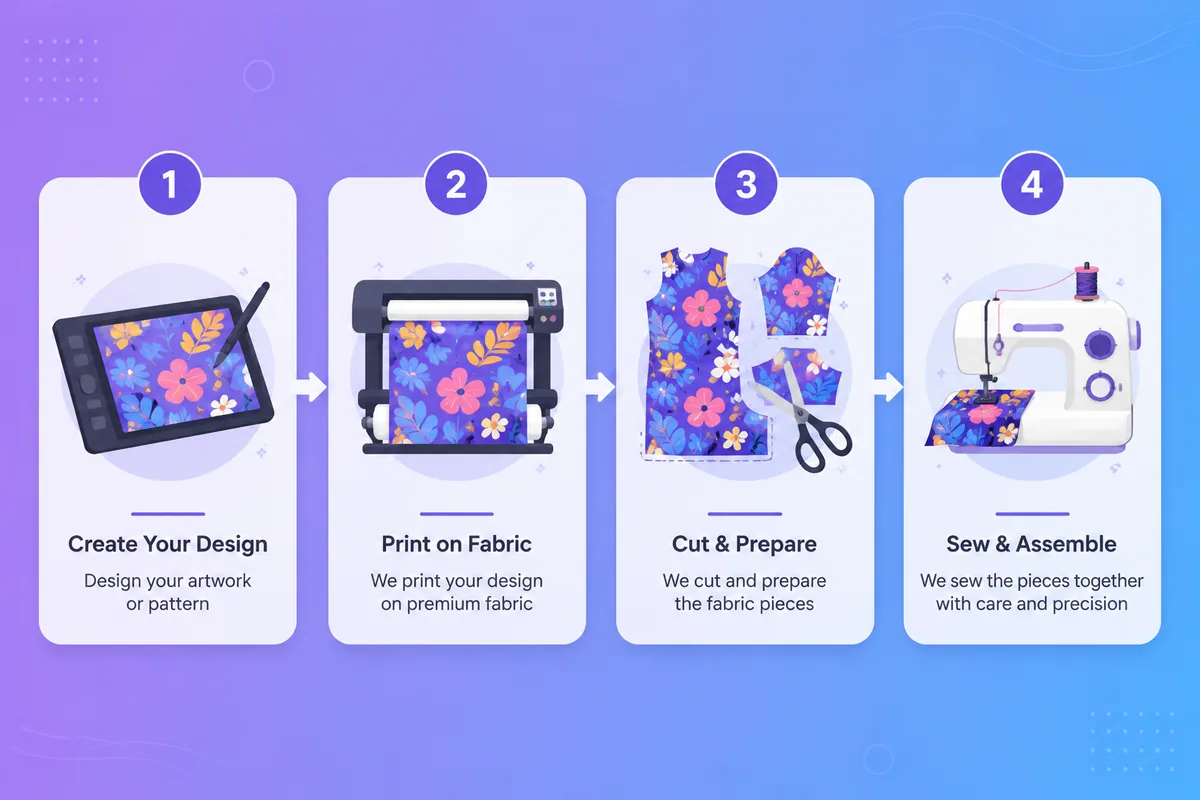
This "print first, sew later" approach — called cut-and-sew — is why AOP can cover seams and edges perfectly. There are no blank spots because every panel was printed before assembly.
It also explains why polyester is the go-to fabric for AOP. Dye-sublimation only bonds with synthetic fibers. On 100% cotton, the ink has nothing to bond with, so the colors come out faded and dull. That's an important limitation to keep in mind — and a key difference from the other methods we'll cover next.
AOP vs DTG vs Screen Printing: The Full Comparison
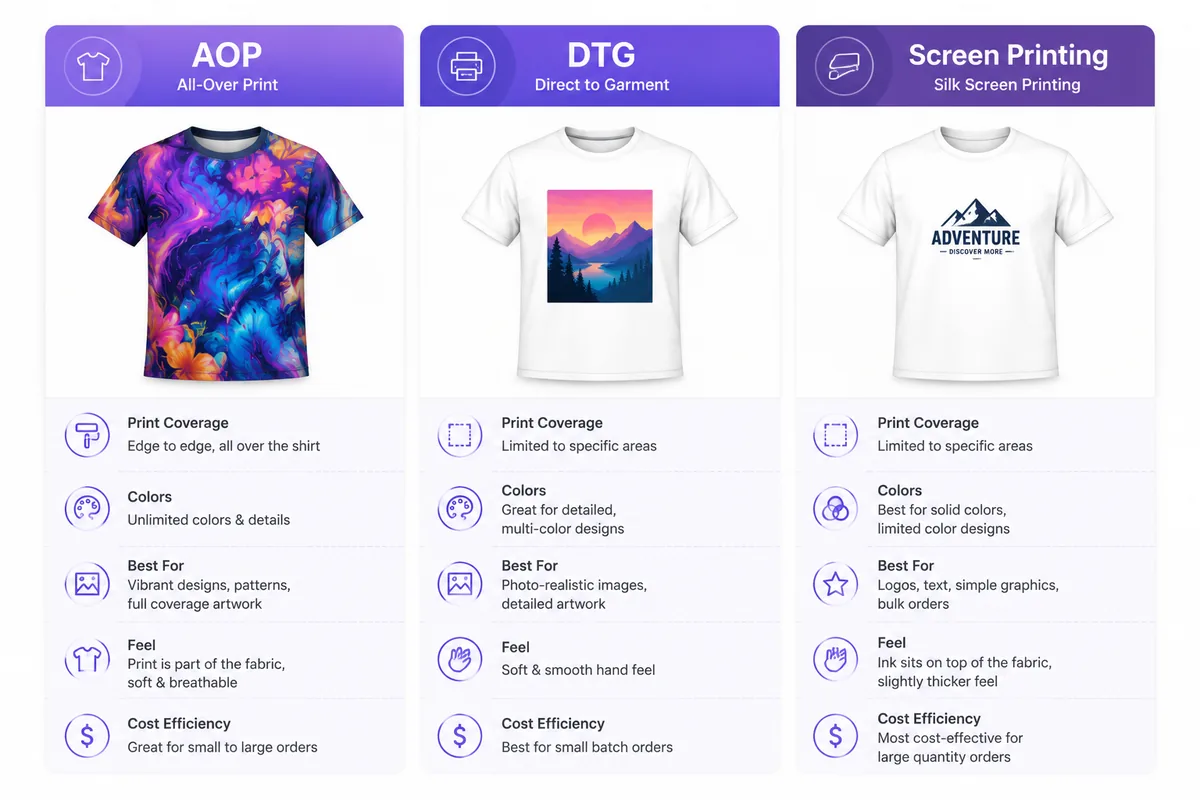
When people research printing methods, three names come up again and again: AOP, DTG, and screen printing. They're often confused, but they solve very different problems.
Here's the simplest way to understand each:
|
|
All-Over-Print (AOP) |
DTG (Direct-to-Garment) |
Screen Printing |
|---|---|---|---|
|
Coverage |
Entire garment, edge to edge |
One area (chest/back) |
One area, limited colors |
|
How it works |
Print on fabric, then sew |
Inkjet onto finished garment |
Ink pushed through stencils |
|
Best fabric |
Polyester |
Cotton |
Cotton |
|
Design freedom |
Unlimited colors & full coverage |
Unlimited colors, single placement |
Few colors, simple designs |
|
Best for |
Bold, full-coverage patterns |
Detailed graphics on cotton tees |
Bulk orders, simple logos |
|
Minimum order |
Low (great for POD) |
Low (great for POD) |
High (needs bulk to be worth it) |
|
Cost per unit |
Higher |
Medium |
Low at volume, high for small runs |
Let's break down each comparison in plain terms.
AOP vs DTG
DTG (Direct-to-Garment) works like an inkjet printer for clothes — it sprays ink directly onto a finished T-shirt. It's fantastic for detailed, photo-quality graphics, but it can only print on one flat area (like the chest). It can't wrap around seams or cover the whole garment.
-
Choose DTG when you want a detailed design in one spot on a cotton tee.
-
Choose AOP when you want the design to cover the entire product with no blank space.
The other big difference is fabric: DTG loves cotton, AOP needs polyester. So the two methods rarely compete — they're built for different products.
AOP vs Screen Printing
Screen printing is the classic method: ink is pushed through a stencil (one stencil per color) onto the garment. It's cheap and durable at high volume, but every color adds a stencil and cost, so it's limited to simple designs with few colors. It also requires large minimum orders to be economical — which makes it a poor fit for print-on-demand.
-
Choose screen printing for large bulk orders of simple, few-color designs.
-
Choose AOP for full-coverage, unlimited-color designs with no minimum order.
The bottom line: AOP is the only one of the three that covers the entire garment and lets you use unlimited colors with no bulk minimum — which is exactly why it's such a strong fit for print-on-demand sellers who want to stand out.
The Pros and Cons of All-Over-Print
Like any method, AOP has trade-offs. Here's an honest look.
Advantages:
-
Total design freedom — cover the whole product with any pattern or photo.
-
Premium look — products stand out and command higher prices (AOP items often sell for 40–60% more than plain printed tees).
-
Less competition — most sellers stick to basic tees, so the AOP space is far less crowded.
-
Vibrant, durable prints — because the dye bonds into the fabric, sublimation prints don't crack, peel, or fade after washing.
Limitations:
-
Polyester only — sublimation won't work on 100% cotton.
-
Higher cost per unit — the cut-and-sew process is more involved than a simple chest print.
-
Design skill required — creating seamless, edge-to-edge artwork takes more care than placing a single logo.
For most sellers chasing higher margins and a unique catalog, the advantages far outweigh the limitations.
When Should You Use All-Over-Print?
AOP is the right choice when:
-
You want products that look completely different from the sea of basic printed tees.
-
Your niche suits bold, expressive patterns — think galaxy prints, florals, abstract art, streetwear, activewear, or pet-themed designs.
-
You want higher profit margins and are targeting buyers who'll pay for a premium, statement piece.
-
You're selling items where full coverage shines — hoodies, leggings, swimwear, backpacks, socks, and sportswear.
It's not the best fit if your design is a simple one-color logo, or if your audience specifically wants 100% cotton basics. In those cases, DTG or screen printing may serve you better.
How to Start Selling All-Over-Print Products
The best part about AOP in 2026: you don't need a printer, an inventory investment, or a factory. With a print-on-demand platform, you design the product, and everything else — printing, cut-and-sew, and shipping to your customer — happens only after a sale is made.
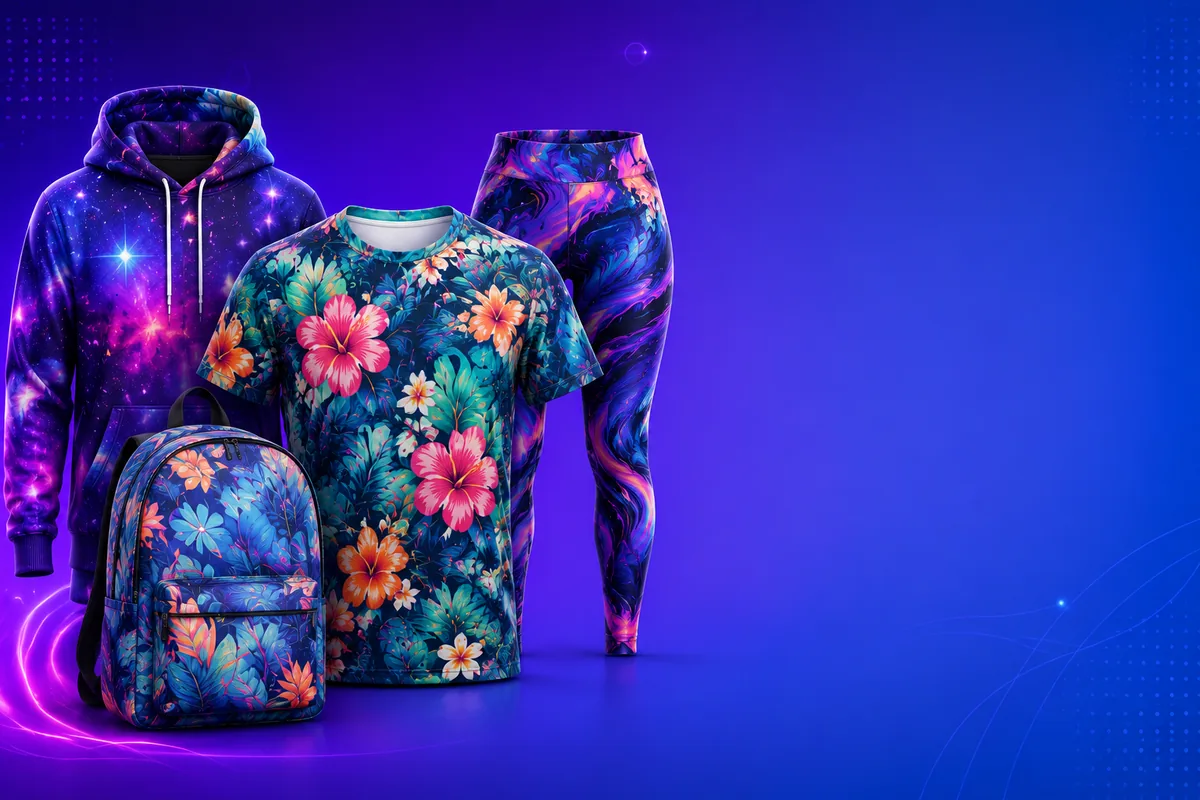
Yoycol specializes in all-over-print. You get:
-
1,600+ AOP-ready products — hoodies, tees, leggings, bags, and more
-
Free 3D design tools to preview your edge-to-edge designs before you sell
-
No minimum orders — start with a single product
-
Global dropshipping — we print and ship directly to your customers
You focus on the designs; we handle production and fulfillment.
Ready to create your first all-over-print product? Start for free with Yoycol →
Frequently Asked Questions
What is all-over-print (AOP)?
All-over-print is a printing method that covers an entire garment — including seams and edges — with a continuous design. The pattern is printed onto fabric using dye-sublimation, and the garment is then cut and sewn together, so there are no blank areas.
What's the difference between AOP and DTG?
AOP covers the whole garment and requires polyester fabric, while DTG (direct-to-garment) prints a detailed design onto one area of a finished garment, usually cotton. AOP is for full-coverage patterns; DTG is for single-placement graphics.
Does all-over-print work on cotton?
Not well. AOP uses dye-sublimation, which only bonds with polyester and synthetic blends. On 100% cotton, the colors come out faded. For vibrant, lasting AOP prints, polyester or high-polyester blends are recommended.
Is all-over-print more expensive?
AOP typically has a higher cost per unit than a simple chest print because of the cut-and-sew process. However, AOP products also sell at higher retail prices, often resulting in better profit margins.
Can I start an all-over-print business with no inventory?
Yes. With a print-on-demand platform like Yoycol, products are printed and shipped only after a customer orders. There's no upfront inventory, no equipment, and no minimum order required.
Want to go deeper? Read our complete All-Over-Print Clothing Guide for Print-on-Demand Sellers for everything on designing, pricing, and scaling AOP products.