Pricing your print-on-demand products is the single most important decision you'll make — and the one most sellers get wrong. Price too low and you're working for free. Price too high and nobody buys. The sweet spot? It's not a guess. It's math.
This guide gives you the exact formulas, real cost breakdowns, and worked examples you need to price every POD product profitably — whether you sell AOP hoodies on Shopify, DTG tees on Etsy, or matching sets across multiple platforms. We'll also show you how Yoycol's base costs stack up and how to use lower production costs to either boost margins or undercut competitors — your choice.
If you're looking for a POD pricing strategy that actually works in 2026, you're in the right place.
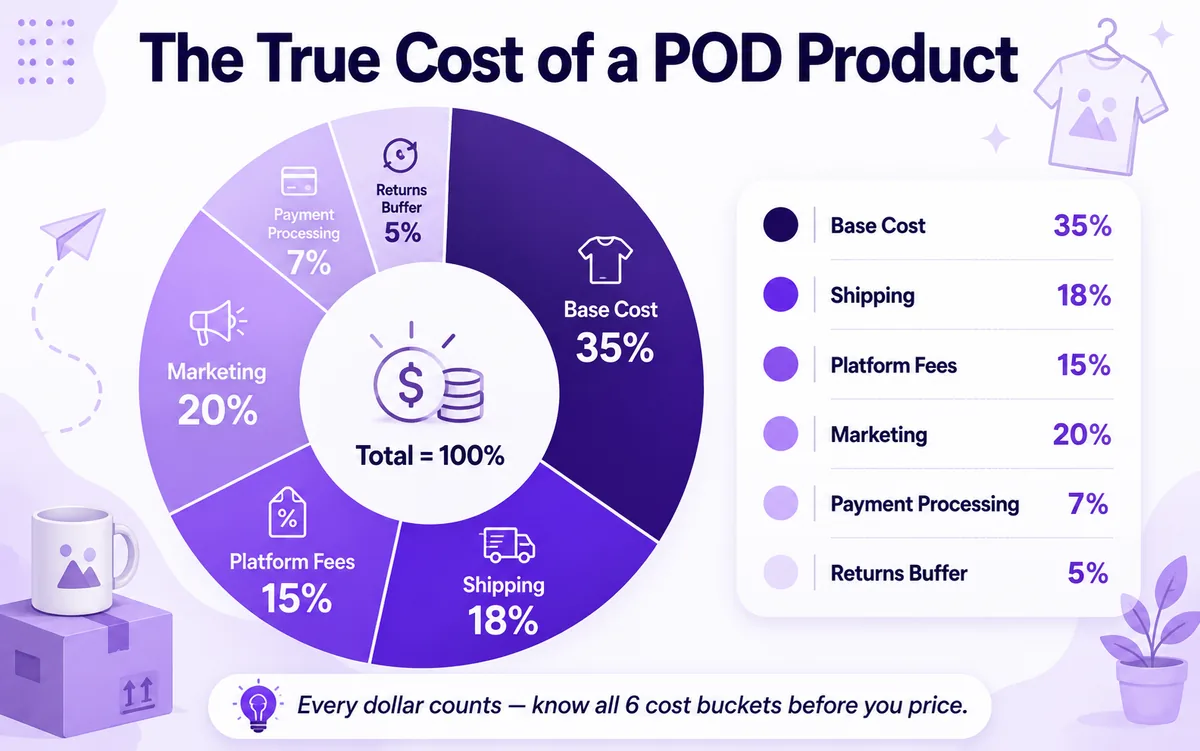
The Real Cost of a POD Product: What You're Actually Paying
Before you can price anything, you need to know your true landed cost per unit. This isn't just the base production cost. It's everything.
The 6 Cost Buckets
|
# |
Cost Bucket |
What It Includes |
Typical Range |
|---|---|---|---|
|
1 |
Base Production Cost |
What your POD supplier charges to make the product |
$8-$32 depending on product |
|
2 |
Shipping |
Cost to ship from supplier to customer |
$4-$15 depending on destination |
|
3 |
Platform Fees |
Shopify/Etsy/Amazon's cut of every sale |
3%-25% of retail price |
|
4 |
Payment Processing |
Credit card / PayPal fees |
~2.9% + $0.30 per transaction |
|
5 |
Marketing / CAC |
Cost to acquire one customer (ads, content, etc.) |
$3-$15 per order (paid); $0-$3 (organic) |
|
6 |
Returns & Buffer |
Refunds, replacements, chargebacks |
2-3% of revenue |
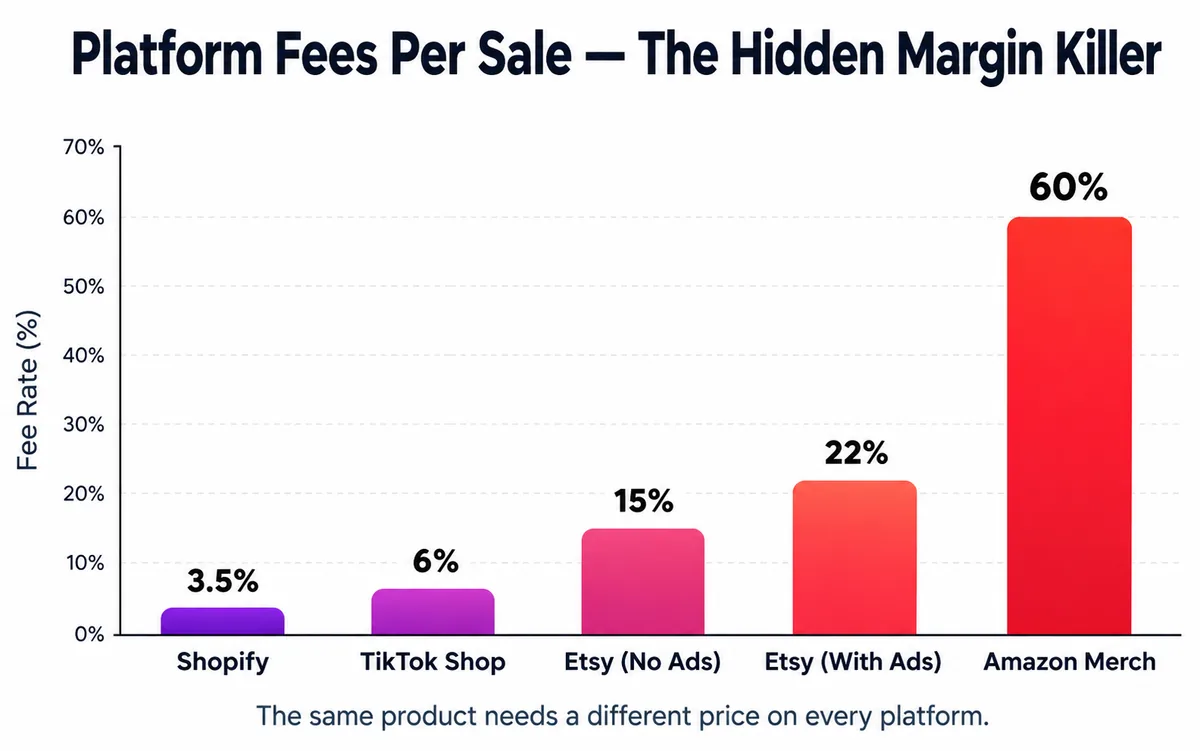
Platform Fees at a Glance
|
Platform |
Approximate Total Fees |
Monthly Cost |
Best For |
|---|---|---|---|
|
Shopify |
~3.5% of sale |
$39/mo (Basic) |
Brand building, highest margins long-term |
|
Etsy (no Offsite Ads) |
~15-18% of sale |
$0.20/listing |
Discovery, premium buyers, built-in traffic |
|
Etsy (Offsite Ads active) |
~22-25% of sale |
$0.20/listing |
High-volume sellers (>$10K/yr, mandatory) |
|
Amazon Merch |
~50-70% royalty model |
$0 |
Volume play, massive audience |
|
TikTok Shop |
~5-8% |
$0 |
Viral potential, younger audience |
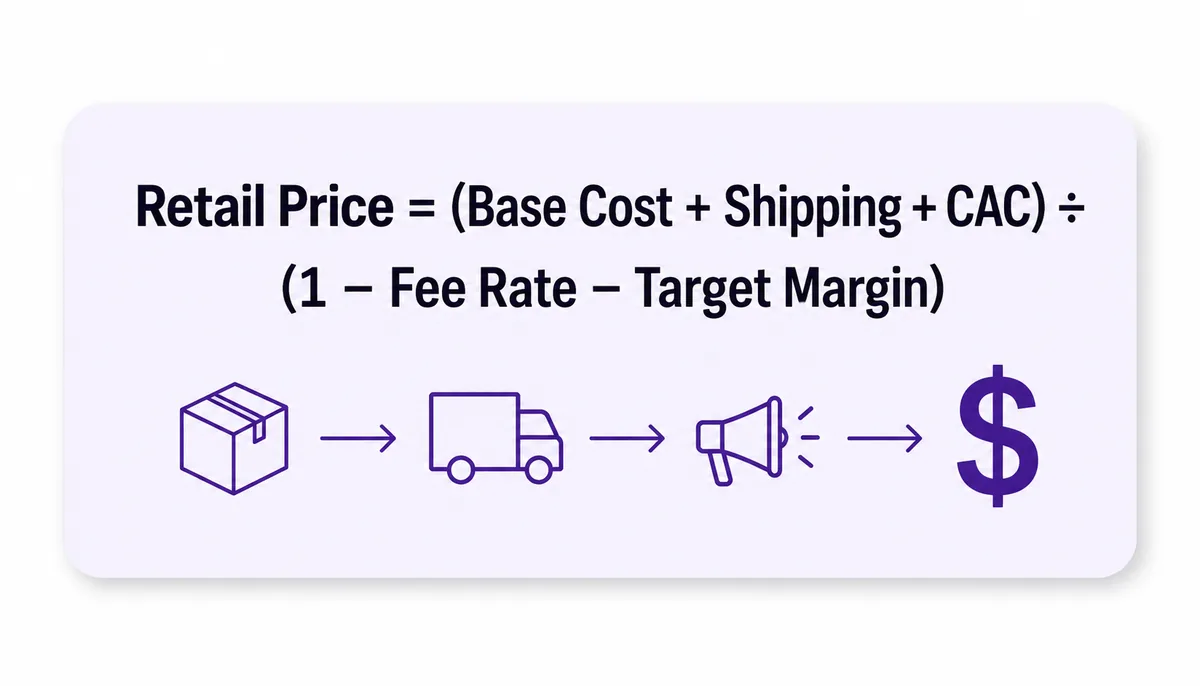
The POD Pricing Formula
Here's the formula that professional POD sellers use:
Retail Price = (Base Cost + Shipping + Marketing Budget Per Unit)
               ─────────────────────────────────────────────
               (1 − Platform Fee Rate − Target Profit Margin)
Simplified Cost-Plus Version
If math isn't your thing, use this 3-step version:
Step 1: Landed Cost = Base Production Cost + Average Shipping Cost
Step 2: Loaded Cost = Landed Cost × 1.15 (covers platform fees + payment processing buffer)
Step 3: Retail Price = Loaded Cost × Target Multiplier
Target Multipliers by Product Category
|
Product Category |
Target Multiplier |
Target Net Margin |
|---|---|---|
|
Competitive basics (standard tees, mugs) |
2.0× − 2.5× |
20-30% |
|
Mid-tier (hoodies, tote bags, phone cases) |
2.5× − 3.0× |
30-40% |
|
Premium / AOP (all-over print, personalized items) |
3.0× − 4.0× |
40-55% |
Worked Examples: Real POD Pricing with Yoycol
Let's run the numbers on real products. Base costs are Yoycol's; all prices in USD.
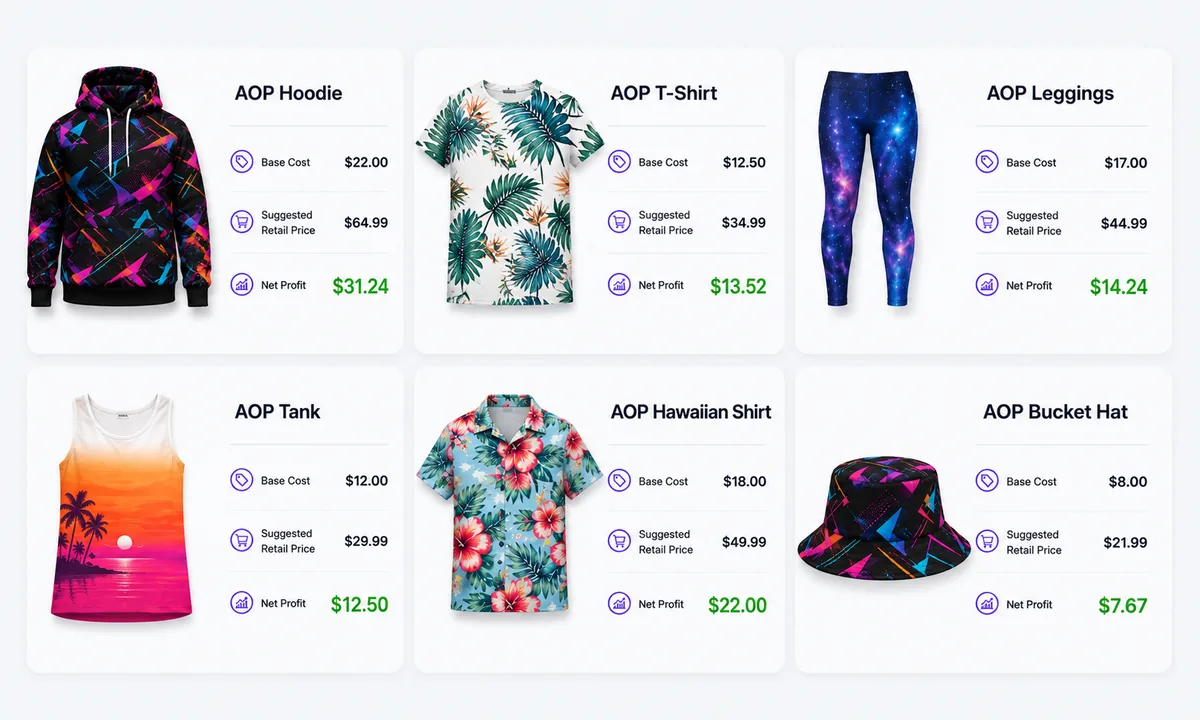
Example 1: AOP T-Shirt on Shopify
|
Line Item |
Amount |
|---|---|
|
Base production cost (Yoycol AOP tee) |
$12.50 |
|
Average shipping |
$5.00 |
|
Shopify Payments (2.9% + $0.30) |
~$0.97 |
|
Marketing budget per unit |
$3.00 |
|
True landed cost |
$21.47 |
|
Target multiplier: 2.8× |
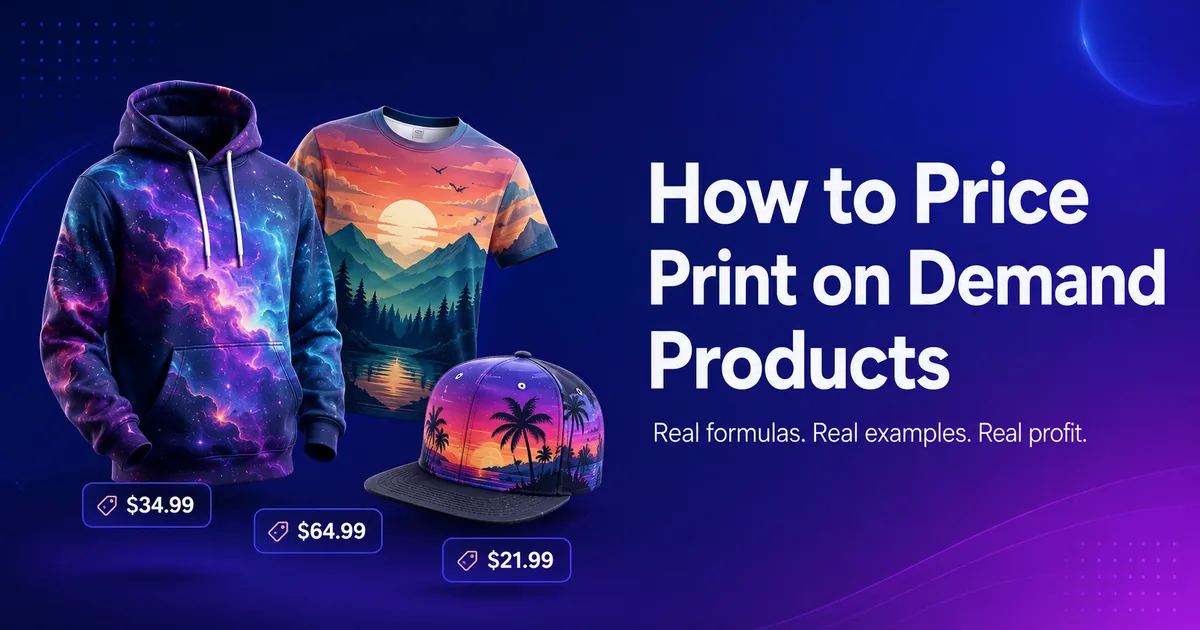
$34.99 retail |
|
Net profit per unit |
$13.52 |
|
Net margin |
38.6% |
Example 2: AOP Hoodie on Shopify
|
Line Item |
Amount |
|---|---|
|
Base production cost (Yoycol AOP hoodie) |
$22.00 |
|
Average shipping |
$6.00 |
|
Shopify Payments (2.9% + $0.30) |
~$1.75 |
|
Marketing budget per unit |
$4.00 |
|
True landed cost |
$33.75 |
|
Target multiplier: 2.3× |
$64.99 retail |
|
Net profit per unit |
$31.24 |
|
Net margin |
48.1% |
Example 3: AOP Leggings on Etsy
|
Line Item |
Amount |
|---|---|
|
Base production cost (Yoycol AOP leggings) |
$17.00 |
|
Average shipping |
$5.00 |
|
Etsy fees (~15% of retail) |
~$6.75 |
|
Marketing budget per unit |
$2.00 |
|
True landed cost |
$30.75 |
|
Target multiplier: 1.8× |
$44.99 retail |
|
Net profit per unit |
$14.24 |
|
Net margin |
31.7% |
Example 4: AOP Bucket Hat on TikTok Shop (volume play)
|
Line Item |
Amount |
|---|---|
|
Base production cost (Yoycol AOP bucket hat) |
$8.00 |
|
Average shipping |
$3.50 |
|
TikTok fees (~6% of retail) |
~$1.32 |
|
Marketing budget per unit |
$1.50 |
|
True landed cost |
$14.32 |
|
Target multiplier: 1.9× |
$21.99 retail |
|
Net profit per unit |
$7.67 |
|
Net margin |
34.9% |
Quick Reference: Suggested Retail Price by Product
|
Product |
Base Cost |
Shopify Price |
Etsy Price |
Profit Range |
|---|---|---|---|---|
|
AOP T-Shirt |
~$13 |
$32-$40 |
$28-$36 |
$12-$22 |
|
AOP Hoodie |
~$22 |
$55-$75 |
$48-$65 |
$22-$42 |
|
AOP Leggings |
~$17 |
$40-$55 |
$36-$48 |
$16-$32 |
|
AOP Tank Top |
~$12 |
$28-$38 |
$24-$34 |
$12-$22 |
|
AOP Hawaiian Shirt |
~$18 |
$45-$60 |
$38-$52 |
$20-$36 |
|
AOP Bucket Hat |
~$8 |
$20-$28 |
$18-$24 |
$8-$16 |
→ Check All AOP Product Base Costs
Yoycol vs. Competitors: Why Base Cost Changes Everything
A $10 difference in base cost isn't $10 — it's $25-$40 at retail. Here's why Yoycol's pricing structure matters:
|
Product |
Yoycol Base Cost |
Printful Base Cost |
Printify Base Cost |
Your Savings Per Unit |
|---|---|---|---|---|
|
AOP T-Shirt |
~$13 |
~$23 |
~$18 |
$5-$10 |
|
AOP Hoodie |
~$22 |
~$38 |
~$30 |
$8-$16 |
|
AOP Leggings |
~$17 |
~$26 |
~$22 |
$5-$9 |
|
AOP Tank Top |
~$12 |
~$20 |
~$16 |
$4-$8 |
|
AOP Hawaiian Shirt |
~$18 |
~$30 |
~$24 |
$6-$12 |
At a 2.5× retail multiplier, saving $10 on base cost = $25 more profit per unit — or the ability to undercut competitors by $15 and still make more money. That's the difference between a side hustle and a real business.
→ Competitor deep-dive: Best AOP POD Suppliers
5 Pricing Strategies to Maximize Profit
1. Charm Pricing Always Wins
Never use round numbers. $29.99 outsells $30.00 every time. The data consistently shows:
-
$.99 endings — Best for mass-market, Etsy, Amazon
-
$.95 endings — Best for premium/Shopify brands (signals quality without the obvious "discount" vibe)
-
$.00 endings — Only for luxury (and even then, reconsider)
2. Price Anchoring: Show the Expensive Option First
List your products in descending price order. The $75 AOP hoodie makes the $35 AOP tee feel like a deal — even though both are priced for profit.
3. Bundles = Higher AOV, Same Marketing Cost
Instead of discounting individual items, bundle them:
-
"Full AOP Set: Hoodie + Joggers = $99.99 (save $30 vs. buying separately)"
-
You make the same margin per item but save on shipping + payment processing
4. Free Shipping Built Into Price
Free shipping isn't free for you — but it converts 25-30% better than paid shipping listings. Build $5-8 into your retail price and display "FREE Shipping" on every product. On Etsy, free-shipping listings get algorithmic priority.
5. Test, Don't Guess
Run two prices simultaneously (A/B test on Shopify with different variants or duplicate listings on Etsy with $4-5 price differences):
-
If sales volume is identical at $39.99 and $34.99 → you just found $5 of pure profit
-
If $34.99 sells 30% more → the lower price wins on total profit
Common Pricing Mistakes That Kill Margins
🚩 Pricing backward from competitors. "Printful charges $25 so I'll charge $23.99." Congrats — you just built a business with 8% margins that can't survive a single ad campaign. Start with your costs, not their prices.
🚩 Ignoring platform fees in the calculation. Etsy takes 15-25%. If you didn't factor that into your price, you're not making what you think you're making.
🚩 "I'll make it up on volume." You won't. Low-margin POD doesn't scale — every order costs you time in customer service, returns, and platform management. Volume at 10% margin is just volume at burnout speed.
🚩 One price across all platforms. A product listed at $29.99 on both Etsy (~18% fees) and Shopify (~3.5% fees) means you're leaving $4-5 per unit on the table on Shopify. Price per platform.
🚩 Never updating prices. Supplier costs change. Shipping rates change. Platform fees change. Review your pricing every 30 days. A 5% cost increase on a $25 product that you don't adjust for = slowly bleeding your margin to zero.
FAQ
Q: What's a good profit margin for print-on-demand products?
A: Target 30-40% net margin (after all costs including ads). Below 20% is too thin to scale sustainably. Above 45% is excellent. AOP products can support 40-50% margins due to higher perceived value and less competition.
Q: How much should I mark up my POD products?
A: Use 2.0× − 2.5× for standard POD (DTG tees, mugs) and 3.0× − 4.0× for AOP / premium products (all-over print hoodies, personalized items). This gives you room for platform fees, marketing spend, and profit.
Q: Should I offer free shipping?
A: Yes — but build the cost into your retail price. Add $5-8 to every product and display "FREE Shipping." Free-shipping listings convert 25-30% better, and on Etsy they get algorithmic priority. Your customer pays the same — you just packaged it differently.
Q: How is Yoycol's pricing different from other POD suppliers?
A: Yoycol's base costs are typically 25-40% lower than Printful and Printify for AOP products — ~$13 for an AOP tee vs. $18-23 elsewhere. This means you can either price lower to compete or keep higher margins at standard market prices. Lower base cost = more pricing flexibility.
Q: How often should I review and update my prices?
A: Every 30 days minimum. Check your supplier's pricing page for cost changes. Recalculate on at least 2-3 products to make sure your margins haven't eroded. Also review after any platform fee change (Etsy and Shopify announce these ahead of time).
Q: Can I charge more for my designs than competitors?
A: Yes — if you justify it. Use lifestyle mockups, detailed product descriptions highlighting AOP quality ("never fades or cracks"), and brand storytelling. Perceived value can support 20-40% higher prices than generic listings. The same design on a better product page sells for more.
Q: What's the biggest pricing mistake new POD sellers make?
A: Pricing without accounting for all costs. They look at base cost ($13 tee) and think "I'll sell for $26 — 100% markup!" But after shipping ($5), platform fees (~15%), payment processing (~3%), and marketing, they're making $2-3 per unit. Run the full formula from this guide. Every single line item. No shortcuts.