"How many listings do I need before I start making sales?"
This is one of the first questions new print-on-demand sellers ask — and the internet gives terrible answers. Some people say "just list 10 products and you'll sell." Others claim you need 500+ listings before anything happens. The truth is somewhere in between, and it depends on factors most advice articles don't mention.
This article gives you a real, data-informed answer — not hype, not motivational fluff. We'll cover how many listings you need for your first sale, how many for consistent income, and what matters more than the raw number.
If you're just getting started and haven't set up your store yet, our complete store setup guide walks you through the entire launch process.
The Short Answer (Before We Go Deep)
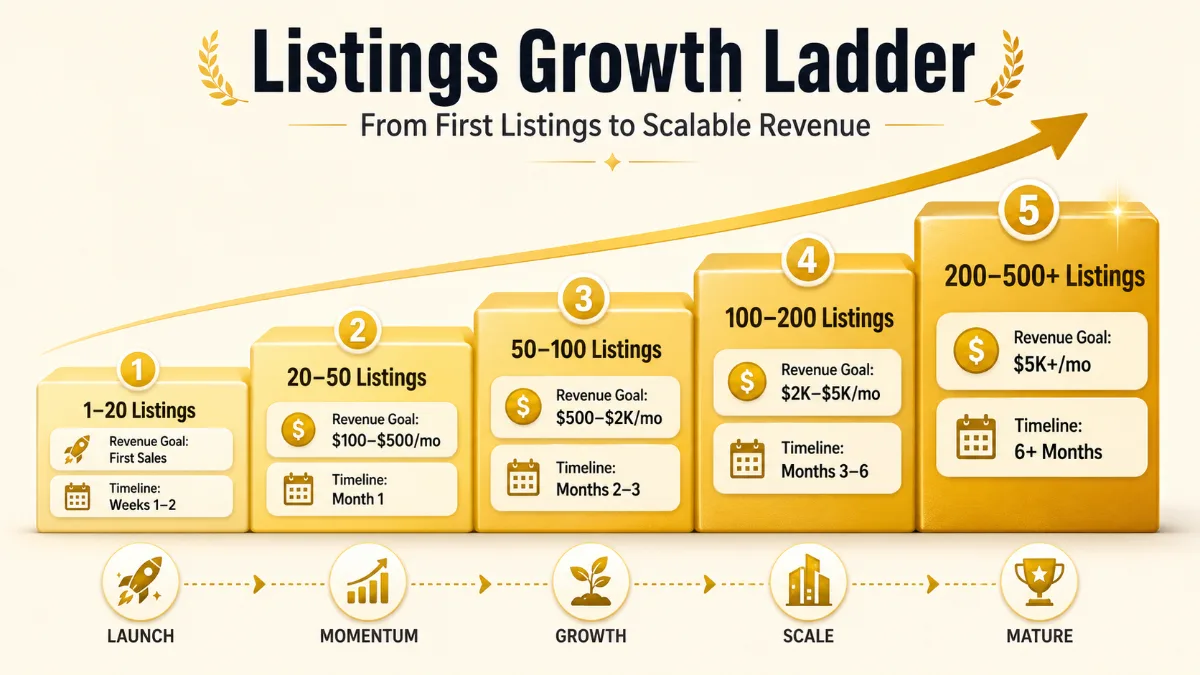
Here's the realistic range:
| Goal | Typical Listings Needed | Timeline |
|---|---|---|
| First sale (any platform) | 10–30 listings | 1–4 weeks after publishing |
| First $100/month | 30–50 listings | 1–3 months |
| $500/month consistent | 75–150 listings | 3–6 months |
| $1,000+/month | 150–300+ listings | 6–12 months |
| Full-time income ($3,000+/month) | 300–1,000+ listings | 12–24 months |
These aren't hard rules. Some sellers make their first sale with 5 listings. Others struggle with 200. The numbers above represent typical outcomes when listings are reasonably optimized.
The key word is optimized. A store with 50 well-researched, keyword-targeted listings will often outperform a store with 500 randomly designed products.
Why "Just List More" Is Incomplete Advice
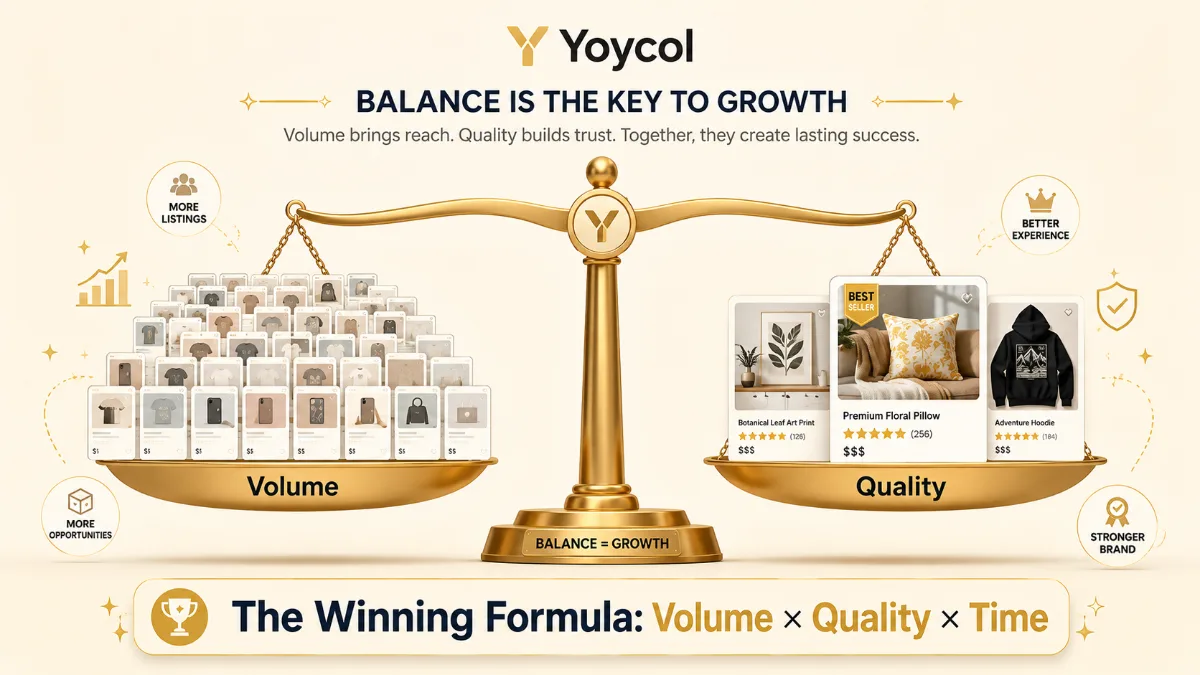
Many successful POD sellers say "volume wins" — and they're not wrong. But there's a catch.
The Volume Problem
Listing 1,000 products means nothing if:
- Your designs target oversaturated niches (generic motivational quotes, basic floral patterns)
- Your listing titles and tags don't match what buyers actually search for
- Your product photos or mockups look generic
- Your pricing is unrealistic (too high or too low)
1,000 bad listings = 0 sales. It's that simple.
The Quality Problem
On the other hand, 10 "perfect" listings also rarely generate meaningful income. Here's why:
- Each listing targets a narrow keyword
- Even a well-optimized listing may only get 5–20 views per day (on Etsy)
- Conversion rates are typically 1–3%
- 10 listings × 10 views/day × 2% conversion = 0.2 sales/day = ~6 sales/month
That's not full-time income. That's a few extra bucks.
The Real Formula
Successful POD sellers combine both volume and quality:
Income = (Number of Listings) × (Quality per Listing) × (Time in Market)
You need enough listings to generate consistent traffic. You need enough quality per listing to convert that traffic. And you need enough time in the market for SEO to compound.
Platform-Specific Listing Strategies
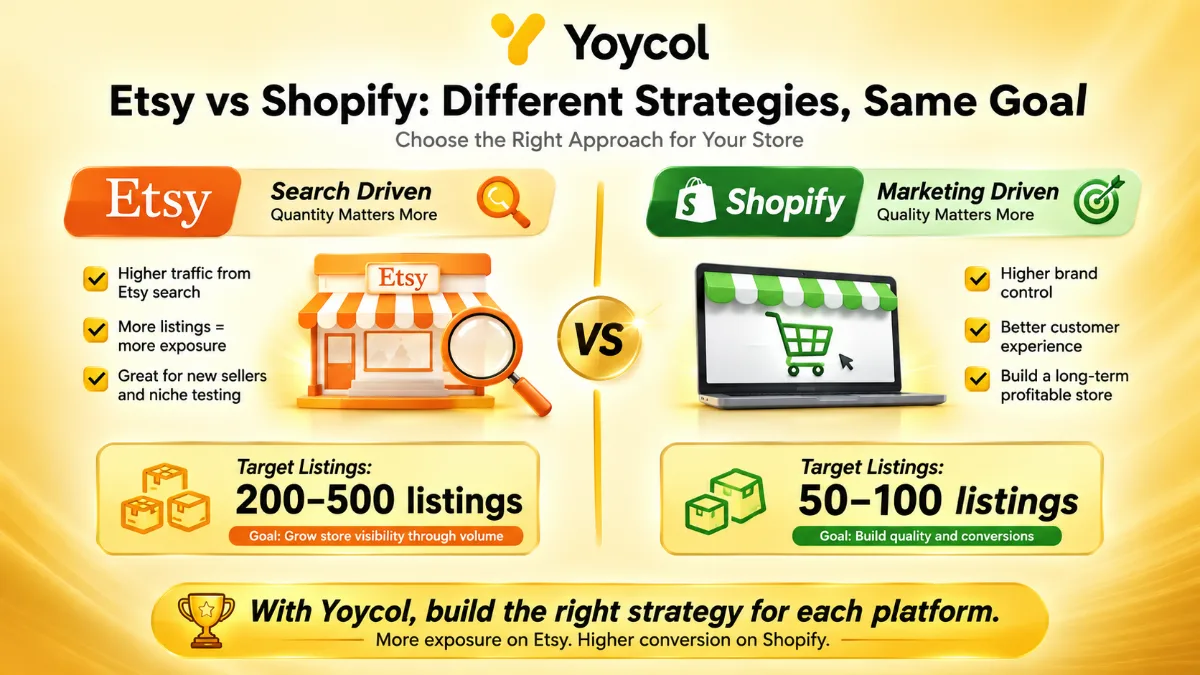
Etsy: Quantity Matters More Here
Etsy is a search-driven marketplace. Each listing is essentially a keyword-targeted asset that gets discovered through Etsy's search algorithm.
How Etsy listing discovery works:
- A buyer searches "custom cat mom shirt"
- Etsy's algorithm matches relevant listings based on title, tags, and attributes
- Your listing appears in search results
- The buyer clicks and potentially buys
Key insight: Each listing can rank for multiple keywords. A well-optimized "cat mom shirt" listing might also rank for "funny cat lover gift," "personalized cat t-shirt," and "cat mom birthday present."
Etsy listing strategy:
- Start with 20–30 listings targeting your top niches
- Add 5–10 new listings per week to build momentum
- Optimize existing listings based on what gets views (Etsy stats show this)
- Aim for 100+ listings within 3–4 months for meaningful organic traffic
Most successful Etsy POD sellers have 200–500+ active listings. The top sellers often have 1,000+.
For a deeper dive into Etsy strategy, our complete guide to starting a POD Etsy shop covers listing optimization in detail.
Shopify: Quality and Marketing Matter More
Shopify is different. You don't get free marketplace traffic — you drive traffic yourself. This changes the listing math.
How Shopify discovery works:
- You create a listing on your store
- You drive traffic to it through SEO (Google), social media, ads, or email
- The visitor decides whether to buy
Key insight: On Shopify, every listing needs a traffic strategy. Having 500 listings on your Shopify store means nothing if nobody visits.
Shopify listing strategy:
- Start with 15–25 carefully curated listings — these are your hero products
- Focus on product quality and marketing over pure listing count
- Build your catalog gradually as you identify what sells through analytics
- Aim for 50–100 listings in your first 6 months, adding based on data
Shopify sellers often make sales with fewer listings because they compensate with targeted marketing. But the ceiling is lower without volume.
If you're setting up Shopify, our Shopify POD setup guide covers the full process from theme to launch.
The Compound Effect: Why Early Listings Keep Paying
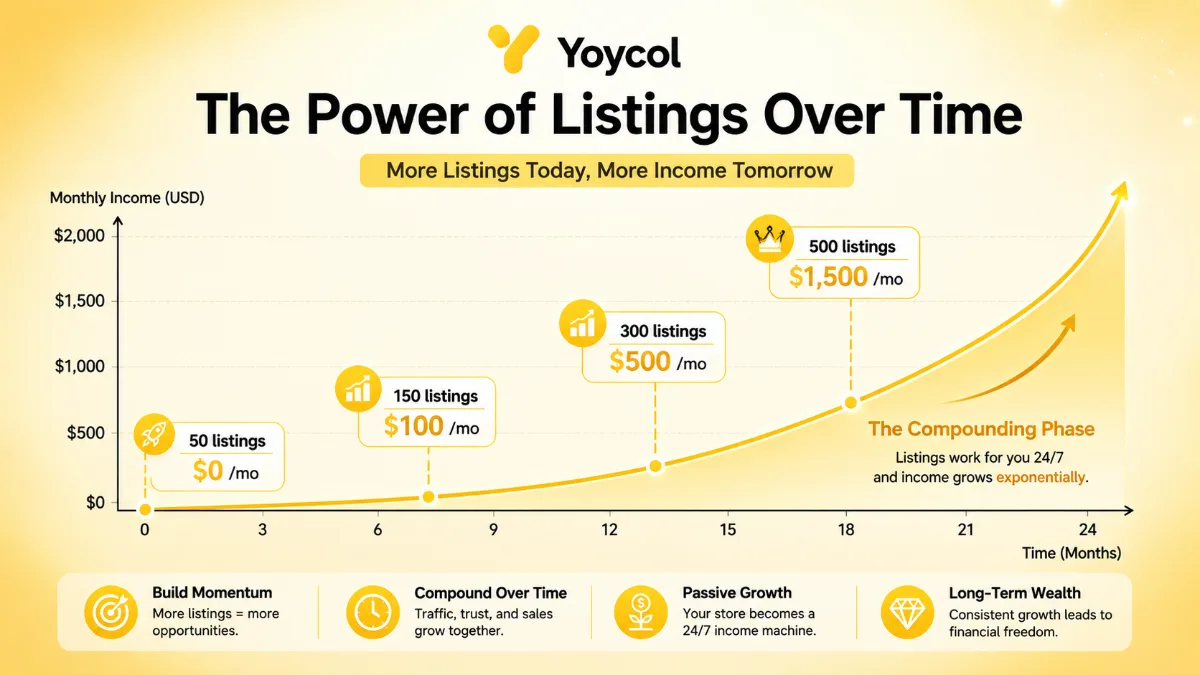
Here's what most new sellers don't understand: POD listings compound over time.
When you publish a listing on Etsy today:
- It gets some initial visibility (Etsy gives new listings a small boost)
- Over the next few weeks, it starts ranking for keywords
- Each week, it gets a few more views as SEO kicks in
- After 2–3 months, it's getting steady organic traffic
- In 6–12 months, it's a "set and forget" income source
This means every listing you publish today continues earning for months and years. Your 50th listing doesn't just add to your income — it compounds with the first 49.
What This Means for You
- Your first 50 listings will generate almost nothing. This is normal.
- Your listings 50–150 start generating their first sales.
- Your listings 150–300 start generating consistent income because the earlier listings are now also earning.
- Past 300+ listings is where meaningful income kicks in — not because of the new listings alone, but because the entire catalog is now compounding.
This is why POD is a long-term business model. The sellers who quit after 20 listings never reach the compounding phase. The sellers who keep building past 100 listings start seeing results that feel "sudden" — but it's really months of compounding finally visible.
Quality Checklist: What Makes a Listing "Good Enough"
Before adding more listings, make sure each one passes this checklist:
| Factor | What to Check |
|---|---|
| Keyword research | Does the title include a specific, searchable keyword? (Not "Cool Shirt" — "Custom Golden Retriever Dad T-Shirt") |
| Tags | Are all tag slots used? (Etsy allows 13 tags — use all 13) |
| Mockup quality | Does the product photo look professional? (Use Yoycol's 3D mockup tool for consistent results) |
| Description | Does it address the buyer's needs, include size info, and mention materials? |
| Pricing | Is it competitive? Check 5–10 similar listings on your platform |
| Niche specificity | Is it targeting a specific audience? (Not "everyone" — "nurses who love hiking") |
| Design quality | Is the design resolution high enough? No pixelation, no blurry edges? |
If a listing fails 3+ items on this checklist, fix it before adding more. A bad listing doesn't just fail to sell — it dilutes your store's overall quality signal (especially on Etsy).
For pricing strategy, our guide on how to price POD products for profit breaks down the math.
A Realistic Listing Timeline for New Sellers
Here's a practical week-by-week plan:
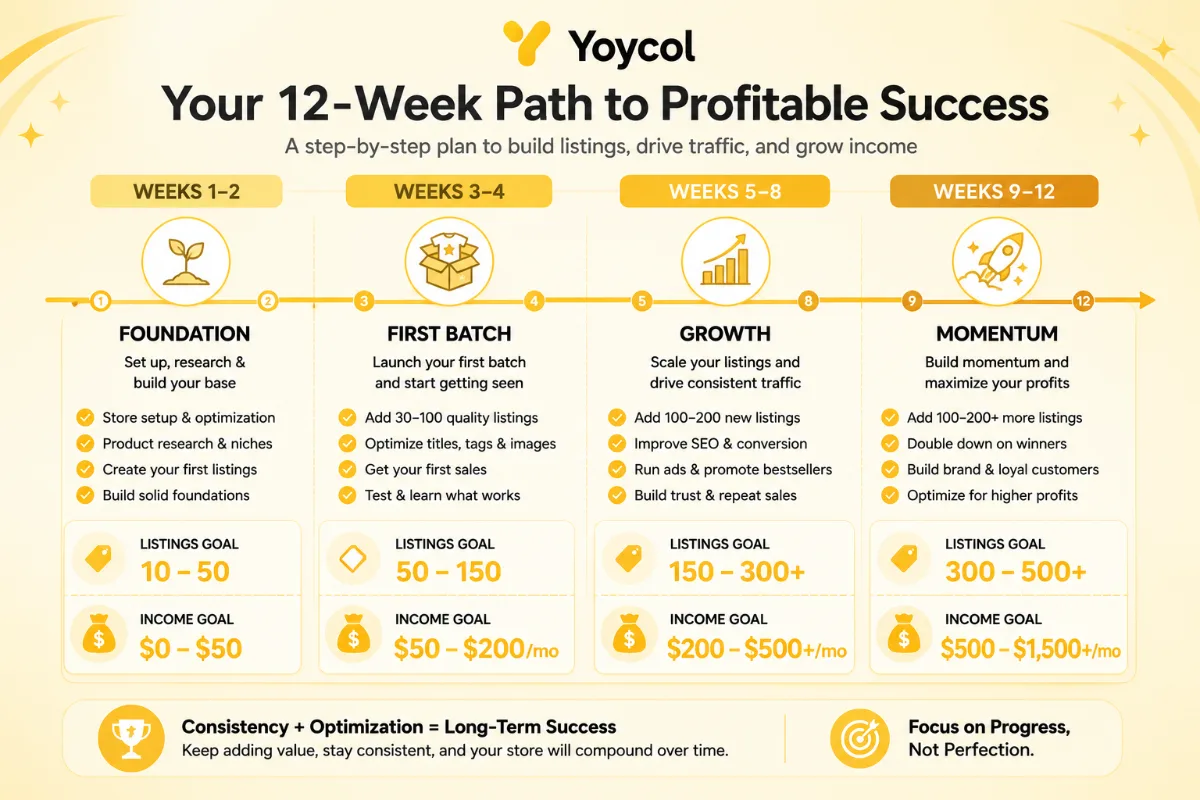
Weeks 1–2: Foundation (5–10 listings)
- Set up your store and connect Yoycol
- Research 3–5 niches with demand but low competition
- Create 5–10 listings targeting those niches
- Optimize each listing (title, tags, description, mockup)
Weeks 3–4: First Batch (15–20 listings)
- Analyze which early listings get views
- Double down on niches that show traction
- Add 10–15 new listings based on what's working
Weeks 5–8: Growth Phase (30–50 listings)
- Add 5–10 new listings per week
- Refine or remove listings that get zero views after 4+ weeks
- Start seeing your first sales (realistic: 1–5 sales/week)
Weeks 9–12: Momentum (50–100 listings)
- Continue adding 5–10 listings per week
- Identify your best-selling niches and create more products in those areas
- First $100–$300/month is realistic at this stage
Months 4–12: Compounding (100–300+ listings)
- Maintain 5–10 new listings per week
- Older listings start generating consistent traffic
- Monthly income grows gradually: $300 → $500 → $1,000+
- The business starts feeling less like a startup and more like a machine
Key takeaway: Don't obsess over the number. Focus on consistent weekly output (5–10 listings/week) and quality per listing. The numbers take care of themselves over time.
When to Add More Listings vs. Optimize Existing Ones
New sellers often ask: "Should I create new products or fix my old listings?"
Add more listings when:
- Your existing listings are already well-optimized (all checklist items pass)
- You've identified new niches with demand
- You have bandwidth to create quality designs
Optimize existing listings when:
- Some listings get views but no sales (fix mockups or pricing)
- Your tags or titles need updating based on search trends
- Seasonal opportunities require listing refreshes
The 80/20 rule applies: 20% of your listings will likely generate 80% of your sales. Once you identify those winners, create more variations of what works — same niche, different designs, different products.
If you're struggling to find profitable niches, our guide to finding profitable POD niches and list of low-competition niches can help.
Frequently Asked Questions
Can I make money with just 10 listings? It's possible but unlikely to generate meaningful income. 10 well-optimized listings might earn you $0–$50/month. You need volume to generate consistent traffic across multiple keywords. Think of listings as keywords — the more you target, the more opportunities to sell.
Is there a maximum number of listings I should have? On Etsy, there's no practical maximum. Top sellers have 5,000+ listings. On Shopify, you can have as many products as your plan allows. The "maximum" is whatever you can maintain quality across. 500 bad listings are worse than 200 good ones.
How fast should I add new listings? Aim for 5–10 new, quality listings per week. This is aggressive enough to build momentum but sustainable enough to maintain quality. Burning out by rushing to 100 listings in a week helps nobody.
Should I list the same design on multiple products? Yes — if the design works on a t-shirt, it often works on a hoodie, mug, or tote bag. Each product type is a separate listing that can rank for different keywords. Just make sure the design looks good on each product (check sizing and placement).
Do listings on Etsy ever "expire" or lose visibility? Etsy listings are active for 4 months before auto-renewing ($0.20 renewal fee per listing). Well-performing listings maintain or grow their visibility over time. Underperforming listings gradually lose visibility but don't disappear. You can deactivate listings that consistently underperform after 3+ months.
How many listings do I need to quit my job? Most full-time POD sellers report reaching sustainable full-time income at 300–500+ quality listings over 12–24 months. But "quit your job" depends on your income needs. $1,000/month might replace a part-time job; $4,000/month might replace a full-time salary. Focus on the income number, not just the listing count.
The number of listings matters — but it's not the only thing that matters. Consistency beats intensity. Five quality listings every week for six months will dramatically outperform 200 rushed listings in two weeks followed by burnout.
Start with 10–30 listings. Keep adding 5–10 per week. Focus on quality. Let the compound effect do its work. The sellers who win at POD aren't the ones who started with 500 listings — they're the ones who kept building for long enough to let compounding kick in.
Ready to start building your catalog? Create your free Yoycol account and browse 1,600+ products →
This guide is part of our print on demand store setup series. Next: learn how print on demand order fulfillment works from order placement to delivery.