Print on demand has created more independent entrepreneurs than almost any other e-commerce model in the last decade. No inventory. No warehouse. No upfront product investment. You design a product, list it in your store, and a third-party supplier prints and ships it only after a customer places an order.
In 2026, the global print-on-demand market is projected to exceed $43 billion — and it's still growing. That growth means opportunity, but it also means competition. The sellers who are actually making money with POD aren't just throwing random designs on T-shirts and hoping for the best. They're building real businesses with strategic product selection, smart pricing, and a clear understanding of who they're selling to.
This guide is your complete roadmap. We'll cover how print on demand works, how to get started, what products to sell, how to price for profit, and what kind of income you can realistically expect. Whether you're starting from zero or scaling an existing store, everything you need is here.
What Is Print on Demand (and How Does It Actually Work)?
Print on demand (POD) is a fulfillment model where products are printed and shipped only after a customer places an order. You never hold inventory, and you never pay for a product until it's already been sold.
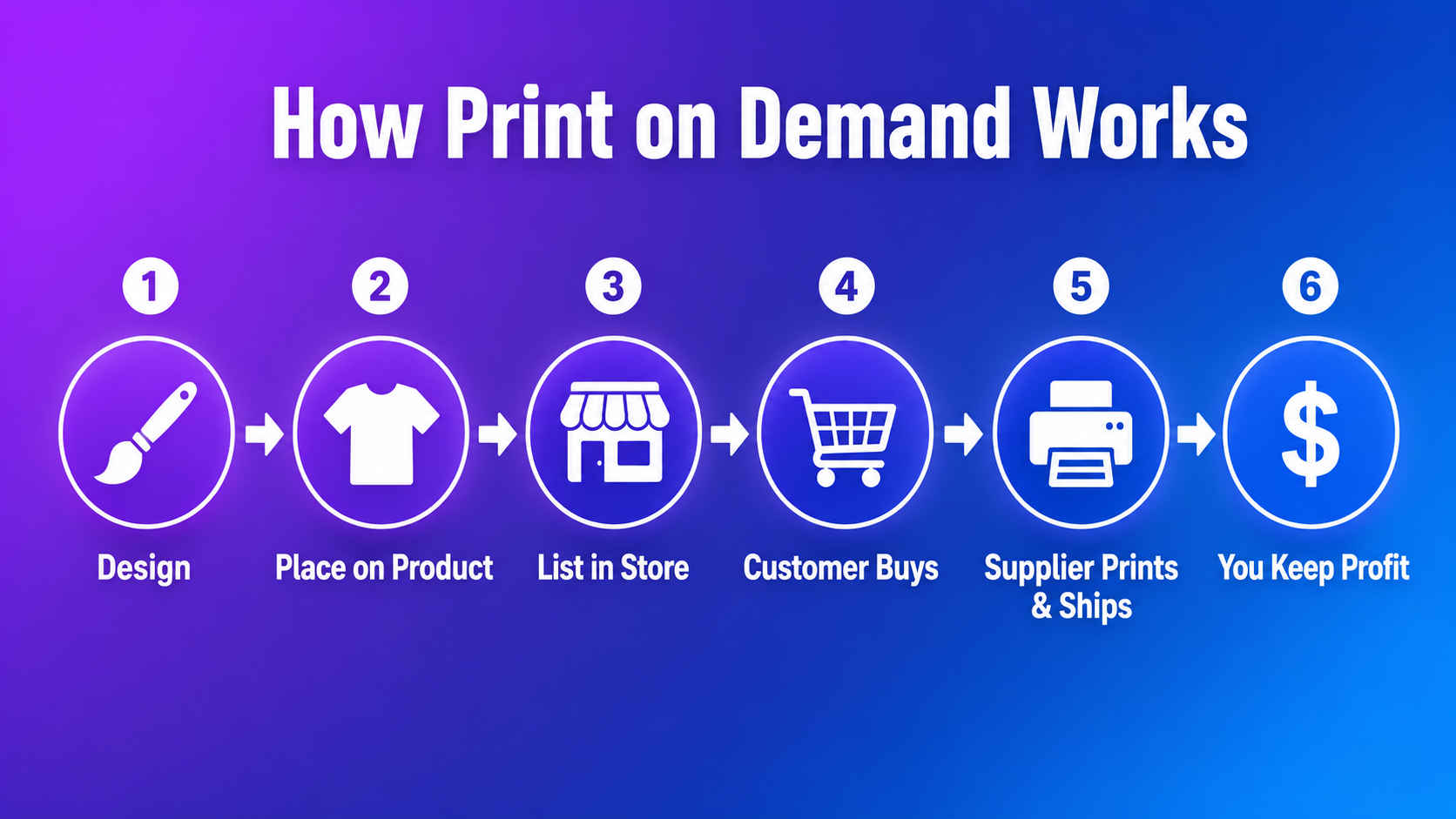
Here's the exact flow:
-
You create a design — artwork, pattern, text, or illustration.
-
You place the design on a product — T-shirt, hoodie, mug, poster, phone case, etc. — using your POD supplier's tools.
-
You list the product in your online store — on Shopify, Etsy, Amazon, or your own website.
-
A customer buys it — they pay your retail price (e.g., $35).
-
The order goes to your POD supplier — they print the product, package it, and ship it directly to your customer.
-
You keep the profit — the difference between your retail price and the supplier's base cost (e.g., $35 − $12 = $23 profit).
You never touch the product. You never stock a warehouse. You never ship a package. Your job is to design, list, and market. The supplier handles everything else.
Why Print on Demand Is So Popular in 2026
POD has exploded in popularity because it removes the three biggest barriers to starting an e-commerce business:
-
No inventory investment. Traditional e-commerce requires buying stock upfront — often thousands of dollars worth. POD requires $0 in inventory.
-
No fulfillment logistics. You don't need to pack boxes, buy shipping labels, or manage returns. The supplier does all of it.
-
No product risk. If a design doesn't sell, you've lost nothing except the time it took to create it. In traditional retail, an unsold product is a financial loss.
This makes POD one of the lowest-risk ways to start an online business — which is exactly why it's become the go-to model for first-time entrepreneurs, side hustlers, and creators looking to monetize their audience.
How to Start a Print on Demand Business (Step by Step)
Starting a POD business is straightforward, but doing it well requires more thought than most beginners realize. Here's the real process.
Step 1: Choose Your Niche
The biggest mistake new POD sellers make is trying to sell everything to everyone. A store with random designs across random niches has no identity, no audience, and no SEO advantage.
Instead, pick a specific niche — a well-defined audience with shared interests, passions, or identities. The best POD niches have:
-
Passionate buyers who spend freely on things they love (pet owners, fitness enthusiasts, hobby communities)
-
Design-friendly themes that work well on products (patterns, quotes, illustrations, graphics)
-
Year-round demand (not just a one-time trend that dies in 3 months)
-
Manageable competition (search Etsy or Amazon — if every listing looks the same, find a more specific angle)
Examples of strong niches: pet breed enthusiasts (corgi owners, Maine coon lovers), outdoor/hiking community, specific professions (nurses, teachers, engineers), fandoms (anime, gaming, sci-fi), and lifestyle movements (minimalism, cottagecore, van life).
Step 2: Choose Your Products
Once you have your niche, choose the products that fit it best. Not every product works for every niche.
Beginner-friendly products:
-
T-shirts (universal demand, easy to design)
-
Mugs (great for text-based designs and quotes)
-
Posters and art prints (simple design, high margins)
-
Phone cases (high volume, low cost)
Higher-margin products:
-
Hoodies (higher base cost, but much higher retail price)
-
All-over-print products (premium positioning, strong margins — learn more about what all-over-print is and why it's a game-changer for POD sellers)
-
Canvas prints (high perceived value)
-
Blankets and home decor
Niche-specific products:
-
Pet niche → breed-specific hoodies, mugs, and AOP blankets
-
Fitness niche → tank tops, leggings, water bottles
-
Profession niche → funny quote tees, desk mugs, laptop sleeves
For a data-backed breakdown of the top-performing AOP products specifically, our best-selling AOP products guide covers which items have the highest demand and margins.
Step 3: Choose Your POD Supplier
Your supplier is your business partner. The wrong one will cost you money, customers, and sleep. Here's what to evaluate:
|
Factor |
What to Look For |
|---|---|
|
Product range |
Enough variety to serve your niche and expand over time |
|
Base pricing |
Low enough to leave room for healthy margins (target 40-60%) |
|
Print quality |
Order samples — photos lie, physical products don't |
|
Shipping speed |
Faster is better; 3–7 day production + reasonable transit |
|
Integrations |
Direct connection to your sales platform (Shopify, Etsy, etc.) |
|
Reliability |
Read reviews, check fulfillment consistency |
For sellers interested in all-over-print products, Yoycol offers the industry's largest AOP catalog (1,600+ products) with competitive pricing and free 3D design tools. Browse the full product range →
Step 4: Set Up Your Online Store
You need a place to sell. The three most popular platforms for POD sellers in 2026:
Shopify — The most flexible option. Full control over branding, pricing, and customer experience. Monthly cost (~$39/month), but worth it for serious sellers. Best for building a standalone brand.
Etsy — Built-in marketplace traffic (millions of buyers already searching for products). No monthly fee for basic listings. Best for sellers who want traffic without paid ads. Downside: high competition and fees per sale.
Amazon Merch / KDP — The world's largest marketplace. Massive traffic potential but strict approval process and intense competition. Best as a supplementary channel.
Pro tip: Many successful POD sellers start on Etsy (for free traffic) and expand to Shopify (for brand building) once they've validated their niche.
Step 5: Create Your Designs
You don't need to be a professional designer. Here's how real POD sellers create their products:
-
Canva — Drag-and-drop design tool with templates. Free version is surprisingly capable.
-
AI tools — Midjourney, DALL-E, and similar tools can generate artwork from text prompts. Upscale with Topaz or similar software before printing.
-
Hire a designer — Fiverr, Upwork, or 99designs for custom artwork. Budget $20–$100 per design.
-
Photoshop / Illustrator — Professional tools for sellers who have design skills.
-
Yoycol's 3D tools — Free 3D mockup generator lets you preview designs on real products before you list them.
Design principles that sell:
-
Keep it simple — the most successful POD designs are often the simplest
-
Use bold, readable text (if your design includes words)
-
Test your design on a mockup before listing — what looks good on screen may not work on fabric
-
Study what's already selling in your niche (Etsy search is a free research tool)
Step 6: Price Your Products for Profit
Pricing is where most POD sellers leave money on the table. Here's the framework:
Base cost (what the supplier charges you) + your margin = retail price
A healthy POD margin target is 40–60% gross margin. Here's what that looks like in practice:
|
Product |
Base Cost |
40% Margin Price |
50% Margin Price |
60% Margin Price |
|---|---|---|---|---|
|
T-Shirt |
$10 |
$17 |
$20 |
$25 |
|
Hoodie |
$22 |
$37 |
$44 |
$55 |
|
Mug |
$7 |
$12 |
$14 |
$18 |
|
AOP Leggings |
$16 |
$27 |
$32 |
$40 |
Don't compete on price. The race to the bottom on Etsy and Amazon is brutal. Sellers who price at $15 for a T-shirt (with a $10 base cost) are making $5 per sale — which means they need hundreds of sales per month to earn anything meaningful.
Instead, compete on design quality, niche specificity, and brand experience. A well-designed, niche-specific hoodie at $55 with $30 profit per sale is a far better business than a generic tee at $18 with $5 profit.
For a complete pricing framework — including psychological pricing tactics, discount strategies, and how to test price points — our complete POD pricing guide covers everything in depth.
Step 7: Market Your Products
You can have the best products in the world, but if nobody sees them, you won't make a single sale. Here's how successful POD sellers drive traffic:
Organic (Free):
-
SEO — Optimize your listings with relevant keywords. On Etsy, this means your title, tags, and description. On Shopify, it means your product pages and blog content.
-
Social media — Instagram, TikTok, and Pinterest are visual platforms that work perfectly for POD products. Post mockups, lifestyle images, and behind-the-scenes content.
-
Pinterest — Underrated for POD. Pins have a long lifespan (months, not hours) and drive consistent traffic to product pages.
Paid:
-
Etsy Ads — Low-cost way to boost visibility within Etsy's marketplace. Start with $1–$5/day on your best-performing listings.
-
Facebook/Instagram Ads — More expensive but highly targetable. Best once you've validated your niche organically.
-
Influencer partnerships — Send free products to micro-influencers in your niche. A single post can drive dozens of sales.
Community:
-
Facebook Groups — Join niche communities (not to spam, but to build relationships and understand your audience).
-
Reddit — Participate in relevant subreddits. Share value first, mention your store when appropriate.
How Much Money Can You Actually Make with Print on Demand?
This is the question everyone asks, and the honest answer is: it depends on your effort, strategy, and timeline.
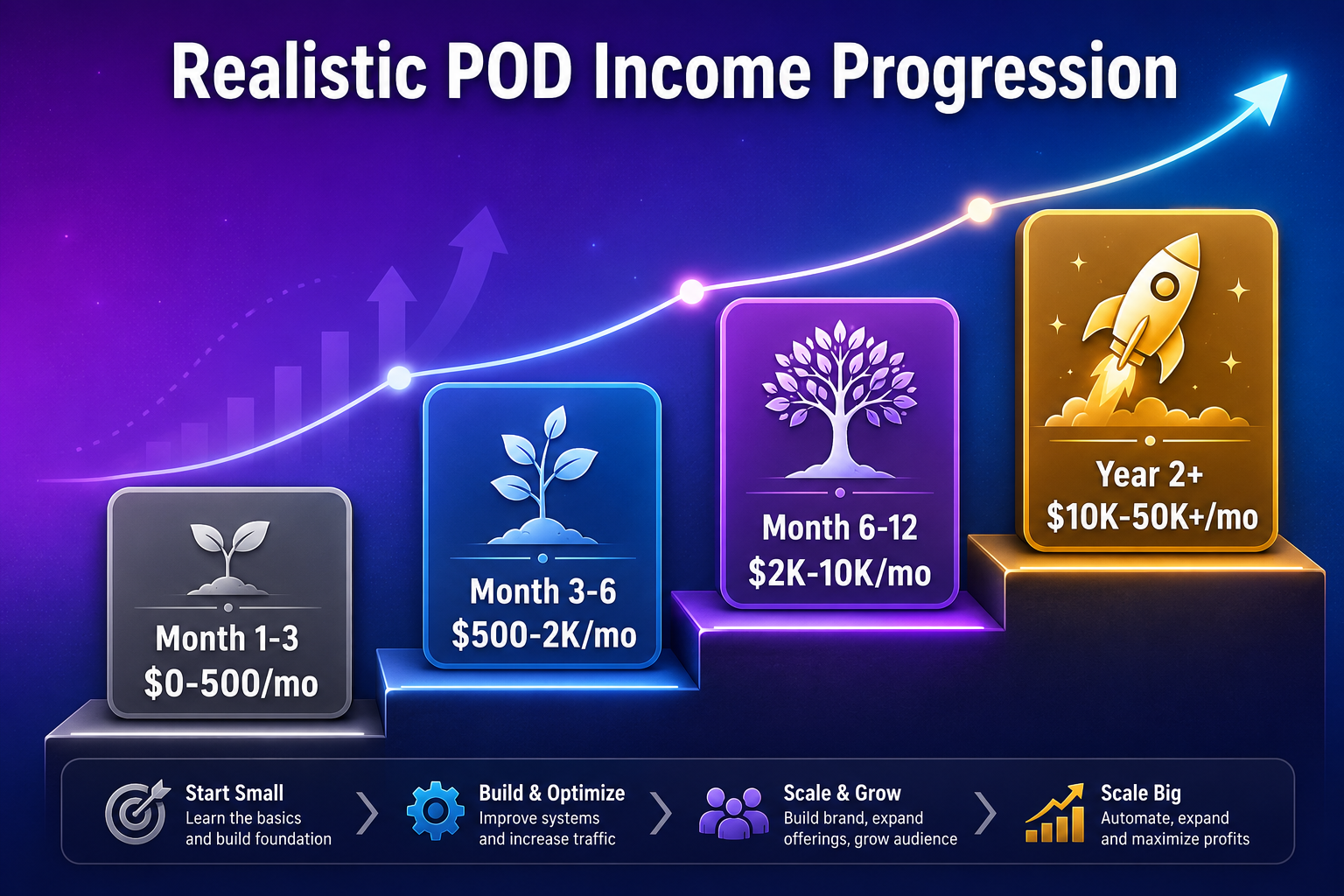
Here's a realistic breakdown based on real seller data:
Month 1–3: Building Phase
Typical income: $0–$500/month
You're setting up your store, creating designs, learning what sells, and building your listing catalog. Most sellers make very little in the first few months — this is normal. The key is consistency: listing new products regularly, testing designs, and learning from what gets clicks vs. what gets ignored.
What to focus on: List 20–50 products minimum. Don't judge results until you have enough data. One viral product can change everything.
Month 3–6: Growth Phase
Typical income: $500–$2,000/month
You've identified what sells in your niche. Your best products are getting consistent traffic. You're optimizing listings, improving designs, and possibly running small ad campaigns.
What to focus on: Double down on winning products. Create variations of what works. Expand into related products. Start building an email list.
Month 6–12: Scaling Phase
Typical income: $2,000–$10,000/month
Your store has traction. You have a proven niche, a catalog of products that sell, and a marketing system that works. This is where most full-time POD sellers live.
What to focus on: Systematize your workflow. Consider hiring a designer or VA. Expand to additional platforms. Invest more in paid advertising.
Year 2+: Established Business
Typical income: $10,000–$50,000+/month
Top POD sellers who've built real brands, multiple stores, and diversified traffic sources can earn well into six figures annually. These sellers often expand into custom products, wholesale, or their own manufacturing.
The reality check: The majority of POD sellers never reach this level — not because it's impossible, but because most people give up in Month 2 or never invest in learning the skills that actually drive sales (SEO, design, marketing).
Is Print on Demand Still Profitable in 2026?
Short answer: yes, absolutely. But the game has changed.
In 2018–2020, you could make money with POD by uploading hundreds of generic designs and hoping a few went viral. That approach barely works anymore. The market is more competitive, platforms have gotten smarter about quality, and customers have higher expectations.
In 2026, profitable POD sellers share these traits:
-
They have a specific niche. Not "funny T-shirts" — but "funny T-shirts for ICU nurses" or "motivational mugs for marathon runners." Specificity wins.
-
They invest in design quality. Mediocre designs don't sell in 2026. The bar has been raised by AI tools, Canva, and professional designers flooding the market.
-
They understand SEO. Whether on Etsy, Shopify, or Amazon, your products need to be found. Keyword optimization is not optional — it's the primary driver of organic sales.
-
They diversify products. Successful sellers don't rely on a single product type. They offer a range — tees, hoodies, mugs, posters, and premium items like all-over-print products — to serve different customer needs and price points.
-
They build brands, not just stores. A store sells products. A brand sells an identity. Customers who identify with your brand come back, refer friends, and pay premium prices.
If you want to dig deeper into the profitability question — including real cost breakdowns, margin analysis, and what separates profitable sellers from those who quit — our detailed profitability analysis covers the full picture.
Print on Demand vs Other Business Models
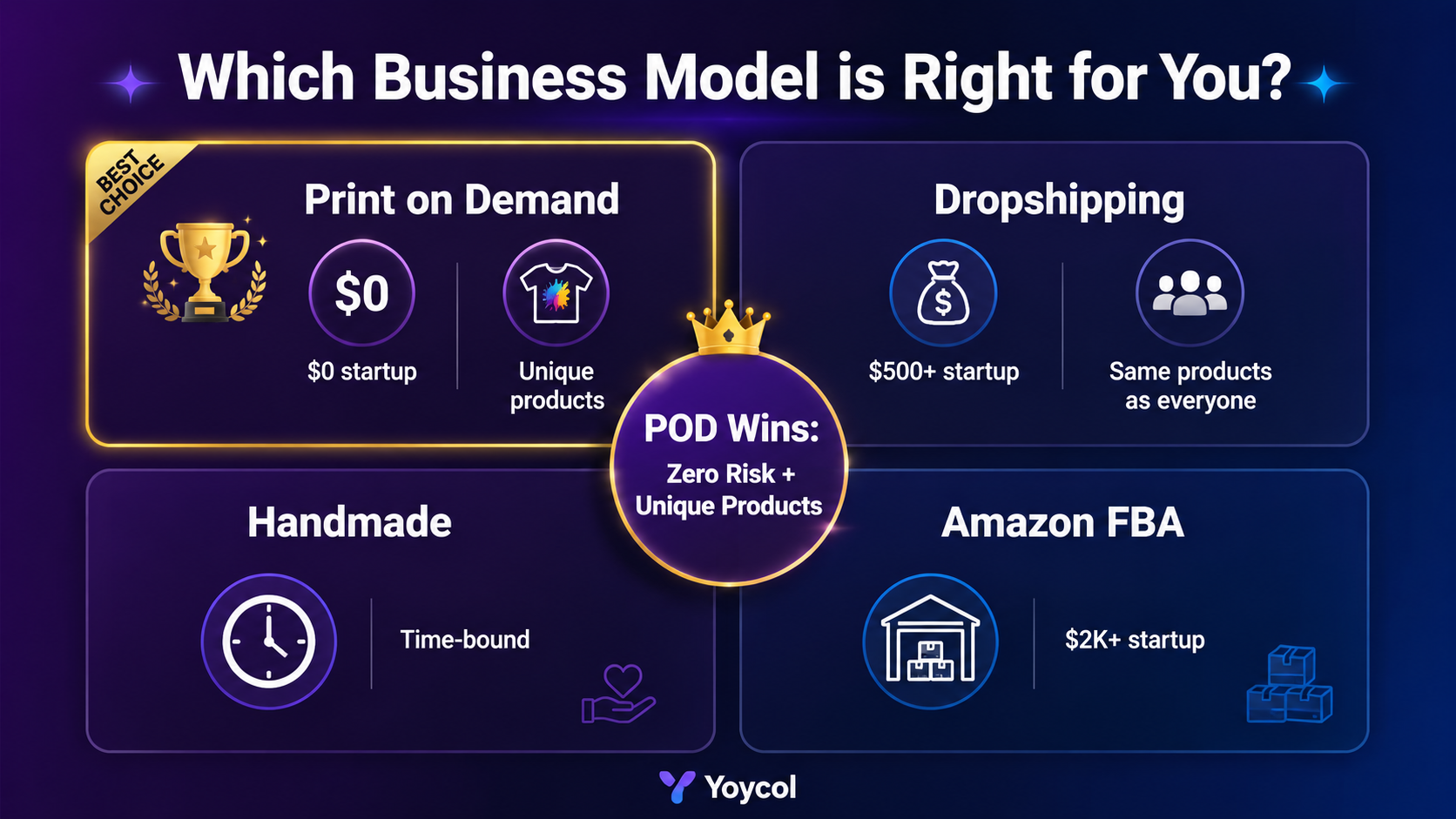
If you're evaluating POD against other e-commerce options, here's how it stacks up:
|
Factor |
Print on Demand |
Dropshipping (Generic) |
Handmade / Etsy |
Amazon FBA |
|---|---|---|---|---|
|
Startup cost |
$0–$500 |
$500–$2,000 |
$200–$1,000 |
$2,000–$10,000+ |
|
Inventory risk |
None |
Low |
Medium |
High |
|
Profit per sale |
$10–$35 |
$5–$15 |
$15–$50 |
$5–$20 |
|
Scalability |
Very high |
High |
Low (time-bound) |
High |
|
Time to first sale |
1–4 weeks |
1–4 weeks |
1–8 weeks |
2–8 weeks |
|
Competition |
Medium-High |
Very High |
Medium |
Very High |
|
Unique products |
Yes (your designs) |
No (same suppliers) |
Yes (handmade) |
No (same products) |
POD's biggest advantage over dropshipping: your products are unique. When you dropship generic products from AliExpress, thousands of other sellers have the exact same item. With POD, your designs are yours alone — nobody else can sell the same product.
POD's biggest advantage over Amazon FBA: zero inventory risk. FBA requires buying products in bulk, shipping them to Amazon's warehouse, and hoping they sell. If they don't, you've lost thousands. With POD, you pay nothing until a sale is made.
For a more detailed comparison of POD vs dropshipping — including which model makes more money and which is better for beginners — our POD vs Dropshipping breakdown goes much deeper.
Advanced Strategies: How Top Sellers Make More
Once you've got the basics working, here are the strategies that separate $2,000/month sellers from $20,000/month sellers:
1. Expand Into Premium Products
Most POD sellers stick to basic T-shirts and mugs. The top sellers expand into premium product categories where margins are higher and competition is lower.
All-over-print products are the perfect example. An AOP hoodie can sell for $50–$65 with $25–$40 profit per sale — compared to $10–$15 profit on a standard tee. The design effort is higher, but the payoff is significantly better. If you're ready to explore AOP, our complete AOP guide covers everything from how the process works to which products sell best.
2. Build Multiple Revenue Streams
Don't rely on a single platform. The top sellers have products on:
-
Their own Shopify store (brand control + higher margins)
-
Etsy (free marketplace traffic)
-
Amazon Merch or KDP (massive audience)
-
Redbubble or Society6 (passive marketplace income)
-
TikTok Shop (emerging channel with massive growth potential)
3. Use Data to Drive Decisions
Track which designs get clicks, which listings convert, and which products have the highest margins. Use this data to:
-
Create more of what works
-
Kill what doesn't
-
Identify seasonal trends early
-
Optimize pricing based on demand
4. Invest in SEO and Content
Paid ads are great, but organic traffic is free and compounds over time. The most successful POD sellers invest in:
-
Listing SEO — keyword-optimized titles, descriptions, and tags
-
Blog content — articles that drive traffic to their store (like the one you're reading right now)
-
Pinterest SEO — long-lifes pins that drive consistent traffic
5. Build an Email List
Your email list is the only audience you truly own. Social media algorithms change, platform policies shift, but your email list is yours forever. Offer a discount code in exchange for email signups, then nurture subscribers with new product launches and exclusive deals.
Common Mistakes That Kill POD Profits
Learn from others' failures. Here are the most common reasons POD sellers don't make money:
-
Too few listings. Listing 5 products and waiting for sales is not a strategy. Aim for 50–100 listings minimum in your first 3 months.
-
No niche focus. A store selling everything to everyone appeals to nobody. Pick a niche and go deep.
-
Competing on price. If your only advantage is being cheaper, you'll lose to someone who's willing to lose money longer than you.
-
Ignoring SEO. If your listings aren't optimized for search, you're invisible. Learn the basics of Etsy SEO, Shopify SEO, or Amazon SEO — whichever platform you're on.
-
Giving up too early. Most successful POD sellers took 3–6 months to see meaningful income. The sellers who make $10,000+/month today pushed through the early dry spell.
-
Skipping samples. Never run ads or promote a product you haven't held in your hands. One bad review about print quality can tank your listing.
-
Copying other sellers. The designs that are already selling on Etsy have thousands of competitors. Create something original for a specific audience.
Frequently Asked Questions
How much money can you make with print on demand?
Realistic income ranges from $500–$2,000/month in the first 6 months, $2,000–$10,000/month by year one, and $10,000+/month for established sellers. Income depends on niche selection, design quality, listing volume, and marketing effort. Most successful sellers treat POD as a real business, not a passive income shortcut.
Is print on demand still worth it in 2026?
Yes. The POD market is projected to exceed $43 billion globally in 2026 and continues to grow. While competition has increased, sellers who focus on specific niches, invest in quality designs, and optimize for SEO are still building profitable businesses. The barrier to entry is low, but the barrier to success is strategy and consistency.
How much does it cost to start a print on demand business?
The minimum cost to start is $0–$100. You can use free design tools (Canva), free marketplace listings (Etsy charges $0.20/listing), and free POD supplier accounts (Yoycol, Printful, Printify). A Shopify store adds ~$39/month. Most sellers invest $200–$500 in the first 3 months including sample orders and optional design tools.
Do I need design skills to start print on demand?
No. You can use AI tools (Midjourney, DALL-E), Canva templates, or hire affordable designers on Fiverr or Upwork. Many successful POD sellers aren't designers — they're marketers and niche experts who understand what their audience wants to buy.
What's the best platform to sell print on demand products?
For beginners, Etsy is the best starting point because it has built-in marketplace traffic and low costs. For building a long-term brand, Shopify offers the most control and flexibility. Many successful sellers use both — Etsy for organic discovery and Shopify for brand building.
How is print on demand different from dropshipping?
With print on demand, you sell products with your own unique designs — nobody else has the same product. With traditional dropshipping, you sell generic products from a supplier that thousands of other sellers also offer. POD products are unique; dropship products are commodities.
What print on demand products sell the best?
T-shirts, hoodies, mugs, and phone cases are the highest-volume POD products. For higher margins, all-over-print hoodies ($25–$40 profit per sale), canvas prints, and premium blankets offer the best per-product earnings. The best product depends on your niche and target audience.
Your Next Step
Print on demand isn't a get-rich-quick scheme. It's a real business model that rewards strategy, consistency, and patience. The sellers who succeed in 2026 are the ones who treat it like a business — not a lottery ticket.
Here's what to do next:
-
Pick your niche. One specific audience. Go deep.
-
Choose your platform. Etsy for free traffic, Shopify for brand control.
-
Create 20–50 listings. Don't stop at 5. Volume matters.
-
Optimize for search. Keywords in your titles, descriptions, and tags.
-
Be patient. Give it 6 months of consistent effort before judging results.
And if you're looking for a POD supplier with the widest product range, competitive pricing, and free design tools to get started:
Ready to start your print on demand business? Create your free Yoycol account →
This guide is part of our complete print on demand resource library. Explore our in-depth guides on starting a POD business, product selection, pricing, and scaling your store.