The difference between a successful POD store and a struggling one often comes down to one thing: print on demand niches.
Most beginners make the same mistake — they pick generic products (t-shirts, mugs, phone cases) with designs that appeal to "everyone." The result? They compete with millions of other sellers, prices race to the bottom, and profits vanish.
The smarter approach: niche down. Find specific audiences with passionate interests, underserved needs, and willingness to pay premium prices. Then create products that speak directly to them.
For POD sellers, mastering niche selection is critical:
- Less competition — target specific audiences, not everyone
- Higher margins — passionate customers pay premium prices
- Better marketing — easier to reach focused audiences
- Stronger brand loyalty — customers feel understood
- Sustainable business — less vulnerable to trends and price wars
This guide covers everything you need to know about print on demand niches: how to research them, how to validate demand, proven niche categories, tools and techniques, and how to position your store for success.
If you're new to POD, our how to start a POD business guide covers the basics. And if you want to understand the market, check our is print on demand profitable guide.
Why Niche Selection Is the #1 Factor in POD Success
Before diving into specific niches, let's understand why niche selection matters so much:
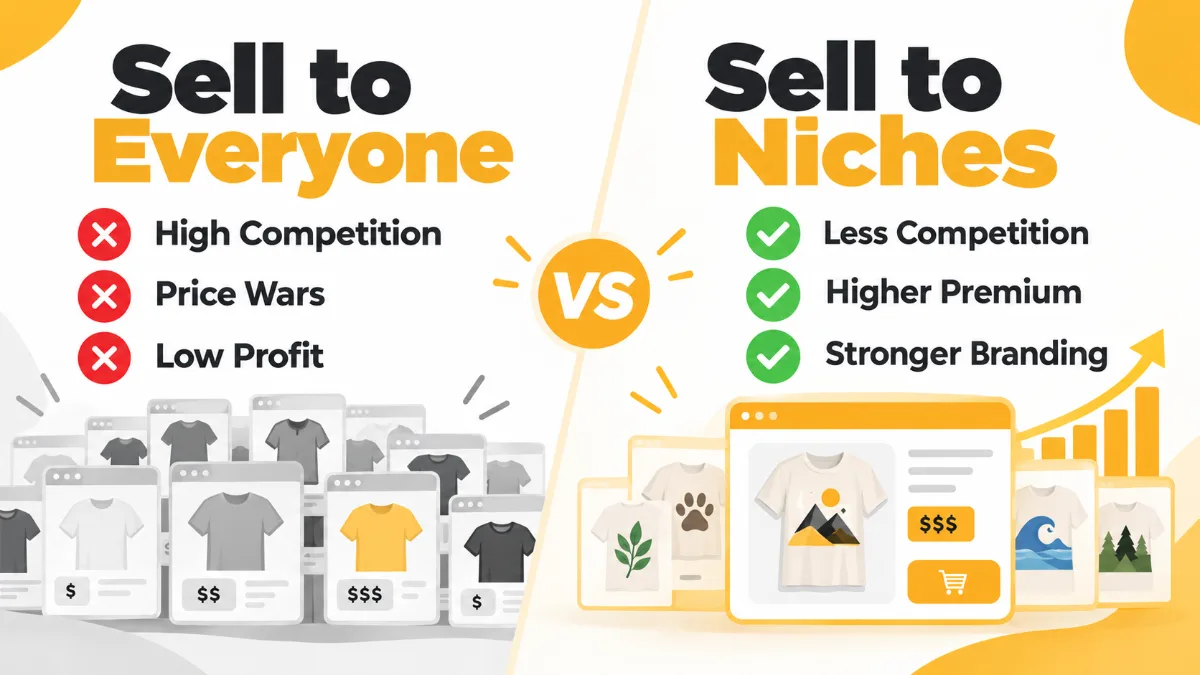
The Problem with "Selling to Everyone"
When you try to appeal to everyone, you appeal to no one:
- Generic designs — blend in with millions of competitors
- No clear message — customers don't feel a connection
- Price competition — only way to win is lowest price
- High ad costs — broad targeting is expensive and inefficient
- Low conversion rates — visitors don't feel understood
Example: A generic "funny t-shirt" store vs. a store that sells "funny t-shirts for nurses who love coffee." Which one resonates more?
The Power of Niching Down
When you target specific niches:
- Customers find you — they search for products that match their interests
- You stand out — fewer competitors serving the same audience
- Higher perceived value — products feel personalized and relevant
- Premium pricing — passionate customers pay more
- Easier marketing — you know exactly where your audience hangs out
Example niches:
- ❌ Generic: "Dog lovers"
- ✅ Specific: "Golden Retriever moms who hike"
- ❌ Generic: "Fitness enthusiasts"
- ✅ Specific: "CrossFit athletes who love tacos"
The more specific, the better.
How to Research Profitable Print on Demand Niches
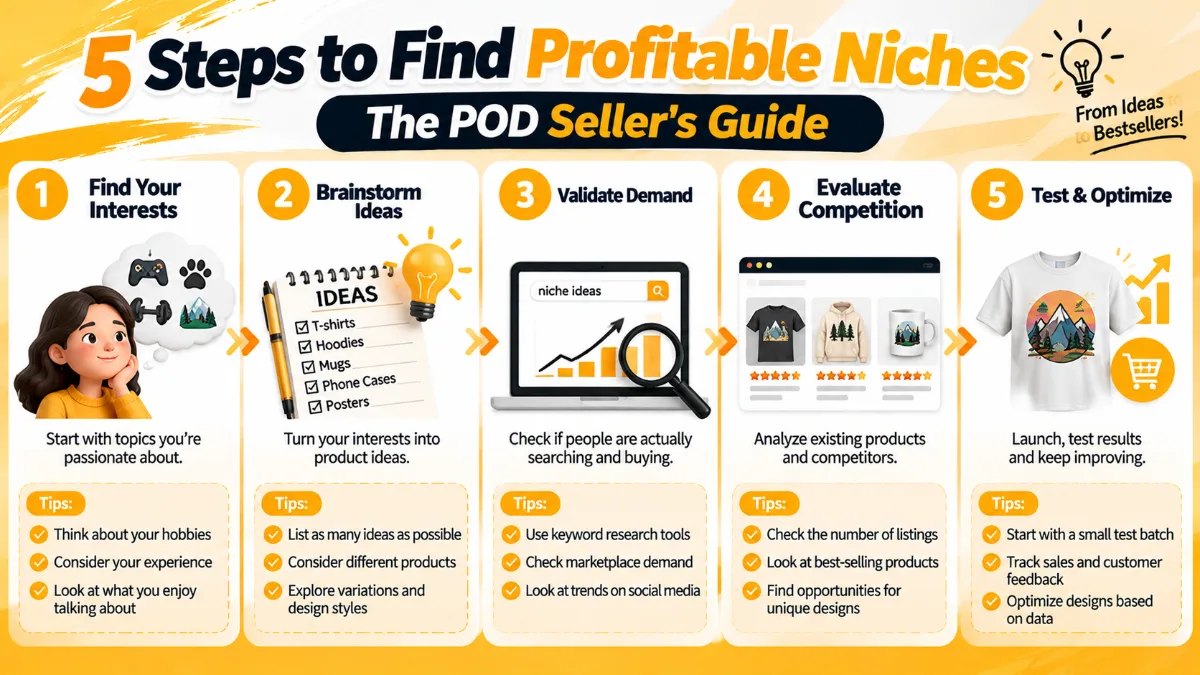
Finding profitable niches requires systematic research. Here's the process:
Step 1: Start with Your Interests and Expertise
The easiest niches to succeed in are ones you understand:
- Hobbies — what do you do in your free time?
- Professions — what's your background?
- Passions — what topics do you love learning about?
- Communities — what groups are you part of?
Example: If you're a teacher, you understand teachers' pain points, humor, and culture. You can create products that resonate deeply.
Step 2: Brainstorm Niche Categories
Start with broad categories, then narrow down:
Category 1: Hobbies & Interests
- Gaming (board games, video games, RPG)
- Outdoor activities (hiking, camping, fishing)
- Crafting (knitting, woodworking, pottery)
- Sports (yoga, running, cycling)
Category 2: Professions
- Healthcare (nurses, doctors, therapists)
- Education (teachers, professors, tutors)
- Tech (developers, designers, IT)
- Trades (electricians, plumbers, mechanics)
Category 3: Life Stages & Milestones
- New parents (mom, dad, pregnancy)
- Retirement
- Weddings (bride, groom, bachelorette)
- Graduation
Category 4: Identities & Values
- Pet owners (dog breeds, cat lovers)
- Environmentalists
- Fitness communities
- Cultural identities
Step 3: Validate Demand
Don't assume a niche is profitable — validate it:
Method 1: Amazon Best Sellers
- Search your niche on Amazon
- Check best seller rankings
- Look for products with 1000+ reviews (indicates high sales)
- Read reviews to understand customer needs
Method 2: Etsy Search
- Search your niche on Etsy
- Check number of results (fewer = less competition)
- Look at "bestseller" badges
- Read reviews for product ideas
Method 3: Google Trends
- Search your niche topic
- Check if interest is stable, growing, or declining
- Look for seasonal patterns
Method 4: Social Media Communities
- Search Facebook groups, Reddit, Instagram hashtags
- Check group size and engagement
- Look for common complaints, desires, inside jokes
Method 5: Keyword Research
- Use tools like Google Keyword Planner, Ubersuggest, or SEMrush
- Check search volume for niche-related terms
- Look for long-tail keywords with decent volume
Step 4: Assess Competition
High demand + low competition = sweet spot:
Signs of low competition:
- Few Etsy shops serving the niche
- Amazon products have low review counts (< 100 reviews)
- No dominant brand in the space
- Generic products, not specialized
Signs of high competition:
- Thousands of Etsy shops
- Amazon products with 10,000+ reviews
- Established brands with loyal followings
- Race to bottom on pricing
Ideal scenario: Moderate demand + low competition. You want enough customers to make sales, but not so many competitors that you can't stand out.
Step 5: Test Before Scaling
Don't commit to a niche without testing:
- Create 5-10 designs for the niche
- List products on Etsy or Shopify
- Run small ad campaigns ($5-$10/day)
- Track sales, conversion rates, customer feedback
- If profitable, scale. If not, pivot.
15 Profitable Print on Demand Niches for 2026
Here are proven niches with strong demand and manageable competition:
Hobbies & Interests
1. Pickleball Players
- Fastest-growing sport in the US
- Passionate community, willing to spend
- Products: t-shirts, hats, water bottles, towels
2. Board Game Enthusiasts
- Strong community, inside jokes
- Great for gifts and group events
- Products: t-shirts, mugs, posters, game mats
3. Gardening & Plant Lovers
- Year-round interest, seasonal spikes
- Passionate about plants, soil, tools
- Products: aprons, hats, mugs, tote bags
Professions
4. Nurses & Healthcare Workers
- Large community, strong identity
- Love humor, pride in their work
- Products: t-shirts, mugs, badges, stickers
5. Teachers
- Massive market, back-to-school spikes
- Love classroom humor, motivational quotes
- Products: t-shirts, mugs, tote bags, planners
6. Software Developers
- Tech-savvy, appreciate clever humor
- Programming jokes, code references
- Products: t-shirts, hoodies, mugs, mouse pads
Life Stages
7. New Moms & Dads
- Emotional milestone, gift-giving culture
- Sleep deprivation humor, baby milestones
- Products: onesies, mugs, t-shirts, blankets
8. Brides & Weddings
- High spending, emotional purchases
- Bachelorette parties, wedding parties
- Products: robes, t-shirts, tumblers, totes
9. Retirees
- Growing demographic, time to pursue hobbies
- Retirement humor, travel, relaxation
- Products: t-shirts, hats, mugs, signs
Identities & Values
10. Dog Breed Enthusiasts
- Specific breeds (Golden Retrievers, French Bulldogs)
- Passionate owners, proud of their breed
- Products: t-shirts, mugs, blankets, bandanas
11. Environmentalists & Sustainability Advocates
- Strong values, willing to pay premium
- Eco-friendly products resonate
- Products: tote bags, water bottles, t-shirts
12. Fitness Communities
- CrossFit, yoga, running, weightlifting
- Strong identity, motivational culture
- Products: tank tops, water bottles, towels, t-shirts
Seasonal & Trending
13. Christmas & Holiday
- Massive seasonal spike (Q4)
- Ugly sweaters, funny cards, decorations
- Products: sweaters, mugs, ornaments, cards
14. Back-to-School
- Annual spike (July-September)
- Teachers, students, parents
- Products: t-shirts, backpacks, lunch bags, planners
15. Tropical & Resort Wear
- Year-round demand, vacation culture
- Beach, pool, resort aesthetics
- Products: swimwear, cover-ups, hats, tote bags
Tools for Niche Research
Free Tools
1. Google Trends — Check interest over time, compare multiple terms, identify seasonal patterns.
2. Etsy Search — Check number of results, look for bestseller badges, read reviews for ideas.
3. Amazon Best Sellers — Browse categories, check review counts, read customer feedback.
4. Facebook Groups — Join niche communities, observe discussions, identify pain points and desires.
5. Reddit — Find niche subreddits, check post frequency and engagement, look for common themes.
Paid Tools
6. SEMrush / Ahrefs — Keyword research, search volume data, competition analysis.
7. eRank (for Etsy) — Etsy-specific keyword data, trend analysis, competition insights.
8. Merch Informer — POD-specific tool, niche research, design ideas.
Frequently Asked Questions
How do I choose a profitable print on demand niche? Start with your interests, research demand (Amazon, Etsy, Google Trends), assess competition, and test before scaling. Look for niches with passionate audiences and underserved needs.
What are the best print on demand niches for 2026? Top niches include pickleball, nurses, teachers, dog breed enthusiasts, new parents, brides, software developers, and environmentalists. Focus on specific sub-niches within broader categories.
How do I validate a POD niche? Check Amazon best sellers, Etsy search results, Google Trends, and social media communities. Look for high engagement, positive reviews, and manageable competition.
Can I sell to multiple niches? Yes, but start with one niche to build expertise and audience. Once profitable, expand to related niches gradually.
How specific should my niche be? The more specific, the better. "Dog lovers" is too broad. "Golden Retriever moms who hike" is specific enough to stand out and resonate.
What if my niche is too small? If search volume is too low (< 100 searches/month), the niche may not be profitable. Look for niches with moderate demand and low competition.
How do I find underserved niches? Look for niches with high demand but generic products. Read customer reviews to identify unmet needs. Check if customers are asking for specific designs or products.
Should I choose a niche I'm passionate about? Yes, but also validate demand. Passion helps you understand the audience and create better products, but the niche must be profitable.
How do I test a niche before committing? Create 5-10 designs, list products on Etsy or Shopify, run small ad campaigns ($5-$10/day), and track sales. If profitable after 2-4 weeks, scale. If not, pivot.
Can I change niches later? Yes. Many successful POD sellers start with one niche, learn the process, then expand to other niches. The skills transfer.
Print on demand niches are the foundation of a successful POD business — passionate audiences, underserved needs, premium pricing, and sustainable growth.
Stop trying to sell to everyone. Pick a niche, understand your audience deeply, create products that resonate, and build a brand they trust.
Ready to find your profitable POD niche? Browse Yoycol's product catalog →
This guide is part of our POD business series. Explore our how to start a POD business guide, POD profit margins guide, or learn how much money you can make with POD.