Profit margin is the single most important number in your print-on-demand business — and most sellers don't fully understand it. They price their products by guessing, copying competitors, or picking a number that "feels right," then wonder why they're barely breaking even.
Here's the reality: two sellers can make the exact same number of sales and end up with wildly different profits — simply because one understands margins and the other doesn't.
In this guide, we'll explain print-on-demand profit margins in plain terms: what they are, how to calculate them, what counts as a "good" margin, average margins by product type, and the proven strategies to increase your margins in 2026. By the end, you'll know exactly how much money each sale actually puts in your pocket.
For the bigger picture on POD income, our complete guide to making money with print on demand covers the full model. This article zooms in on the numbers.
What Is a Profit Margin in Print on Demand?
Your profit margin is the percentage of your retail price that you keep as profit after covering all costs.
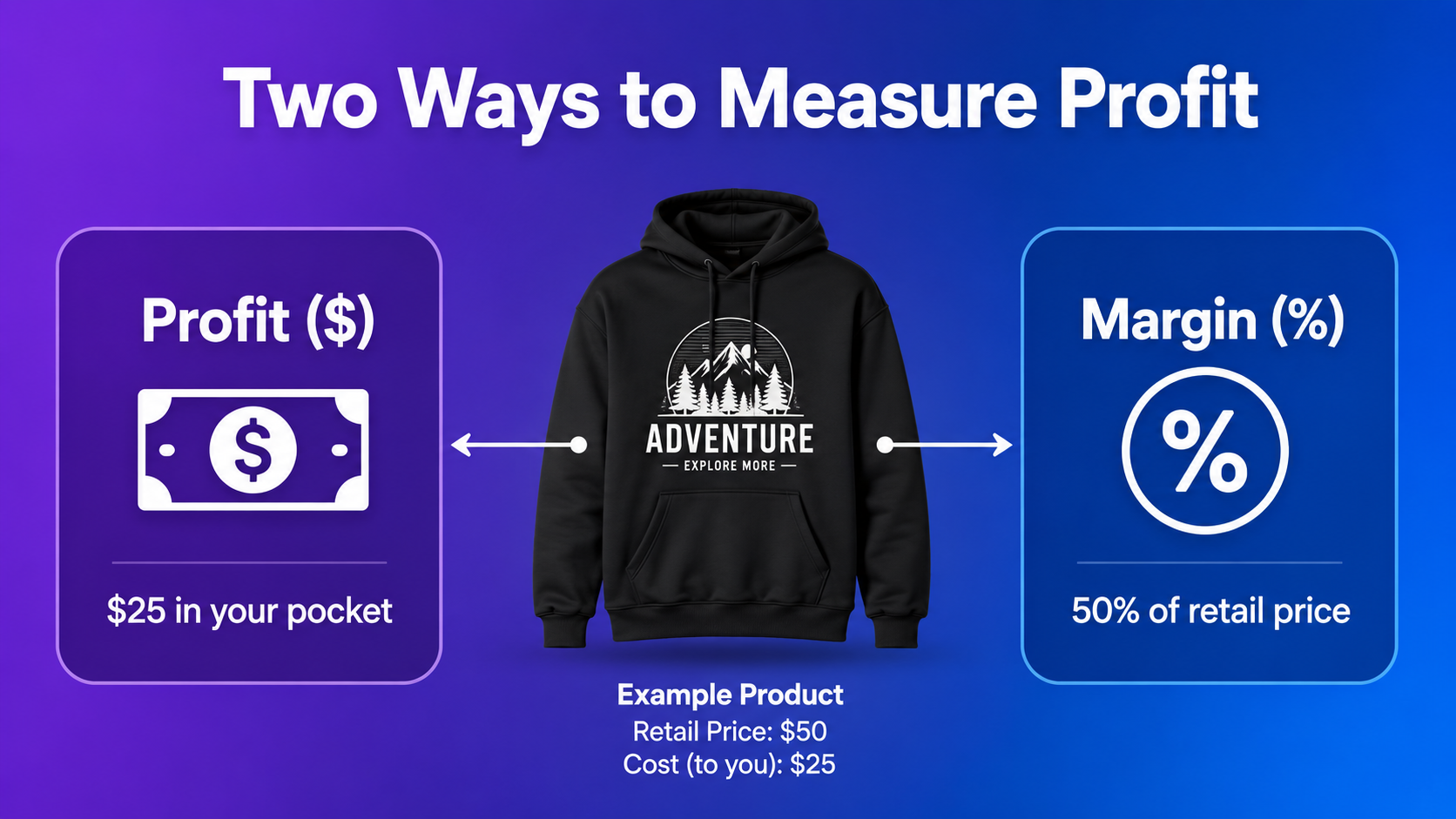
There are two ways to talk about profit, and it's important not to confuse them:
-
Profit (dollar amount) — the actual money you keep per sale. Example: sell a hoodie for $50 that costs you $25 → $25 profit.
-
Profit margin (percentage) — that profit expressed as a percentage of the retail price. $25 profit ÷ $50 retail = 50% margin.
Both matter. The percentage tells you how efficient your pricing is; the dollar amount tells you how much you actually earn per sale. A 50% margin on a $50 hoodie ($25) beats a 50% margin on a $20 tee ($10) — same percentage, very different payoff.
How to Calculate Print on Demand Profit Margins
Here's the formula every POD seller should know by heart:
Profit = Retail Price − Base Cost − Fees
Profit Margin = (Profit ÷ Retail Price) × 100
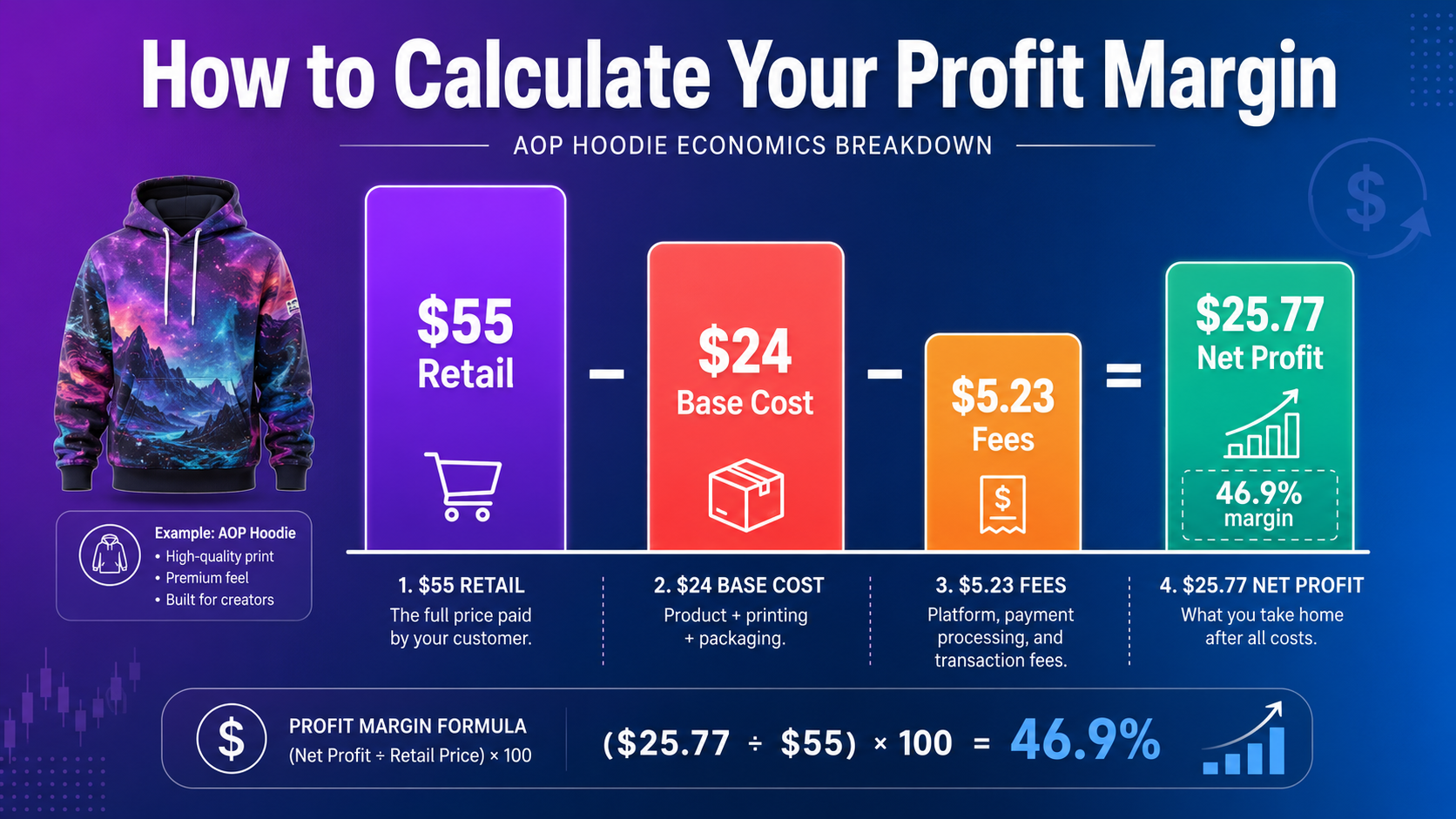
Let's walk through a real example with an all-over-print hoodie:
|
Line Item |
Amount |
|---|---|
|
Retail Price |
$55.00 |
|
Base Cost (supplier) |
−$24.00 |
|
Platform Fee (Etsy ~6.5%) |
−$3.58 |
|
Payment Processing (~3%) |
−$1.65 |
|
Net Profit |
$25.77 |
|
Profit Margin |
46.9% |
Notice how the fees eat into your margin. Many beginners forget to account for platform and payment fees — then wonder why their "50% margin" is actually closer to 40%. Always calculate your net margin, after all fees.
Reverse the Formula to Set Your Price
If you know your base cost and target margin, you can work backward to find the right retail price:
Retail Price = Base Cost ÷ (1 − Target Margin)
Example: A $24 hoodie at a target 55% margin:
$24 ÷ (1 − 0.55) = $24 ÷ 0.45 = $53.33 → round to $54.99
This is the fastest way to price a new product correctly from day one.
Average Print on Demand Profit Margins by Product
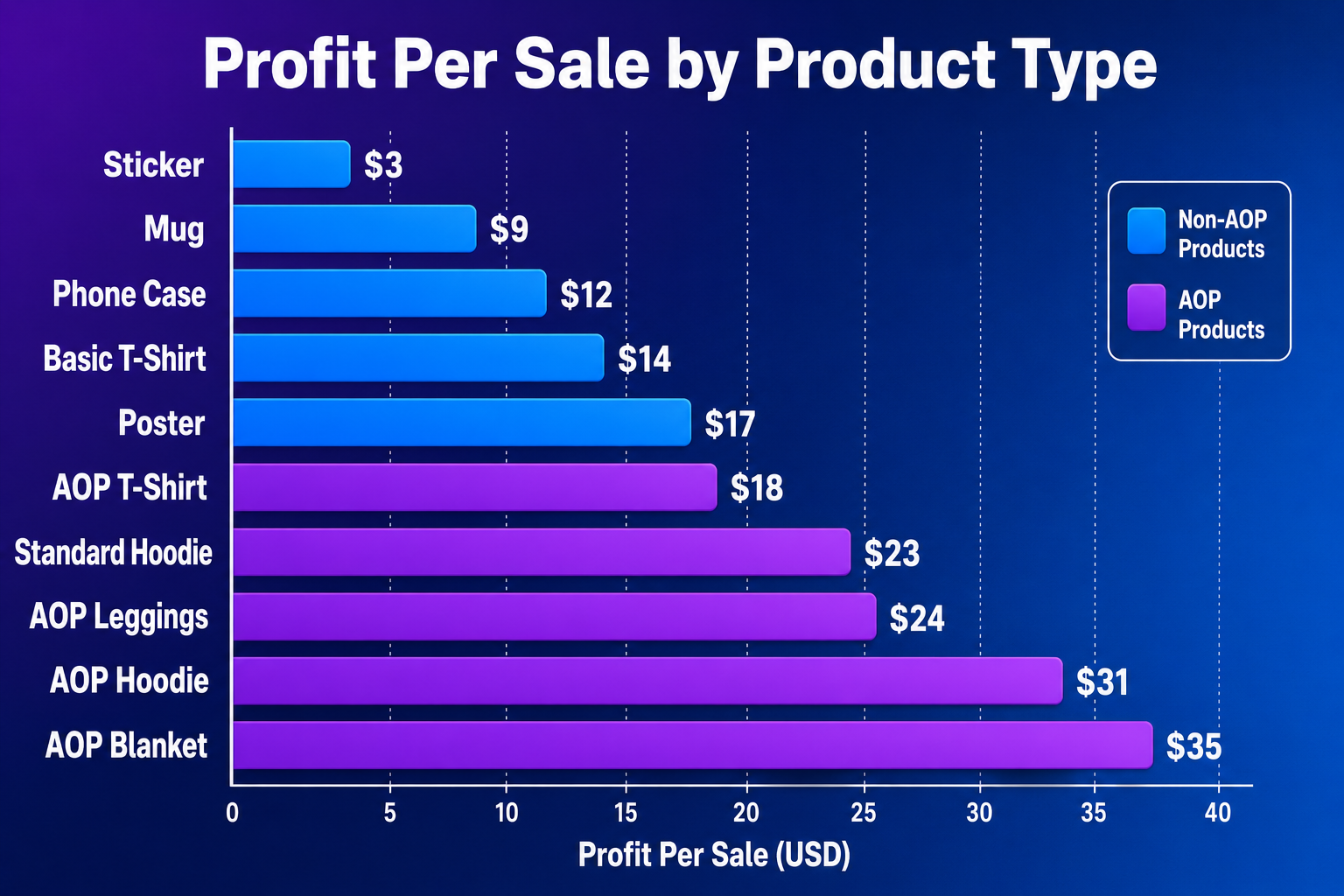
Margins vary significantly by product type. Here's what's typical in 2026:
|
Product |
Base Cost |
Typical Retail |
Gross Margin |
$ Profit/Sale |
|---|---|---|---|---|
|
Sticker |
$2 |
$5 |
60% |
$3 |
|
Mug |
$7 |
$16 |
56% |
$9 |
|
Basic T-Shirt |
$10 |
$24 |
58% |
$14 |
|
Phone Case |
$6 |
$18 |
67% |
$12 |
|
Standard Hoodie |
$22 |
$45 |
51% |
$23 |
|
Poster/Print |
$8 |
$25 |
68% |
$17 |
|
AOP T-Shirt |
$14 |
$32 |
56% |
$18 |
|
AOP Hoodie |
$24 |
$55 |
56% |
$31 |
|
AOP Leggings |
$18 |
$42 |
57% |
$24 |
|
AOP Blanket |
$25 |
$60 |
58% |
$35 |
The pattern to notice: Percentage margins are similar across most products (50–68%), but the dollar profit varies enormously. A sticker at 60% margin nets $3; an AOP blanket at 58% margin nets $35. That's nearly 12x the profit per sale for roughly the same percentage.
This is the single most important insight about POD margins: chase dollar profit, not just percentage. A high-percentage margin on a cheap product still leaves you needing hundreds of sales to earn real money.
What Is a "Good" Profit Margin for Print on Demand?
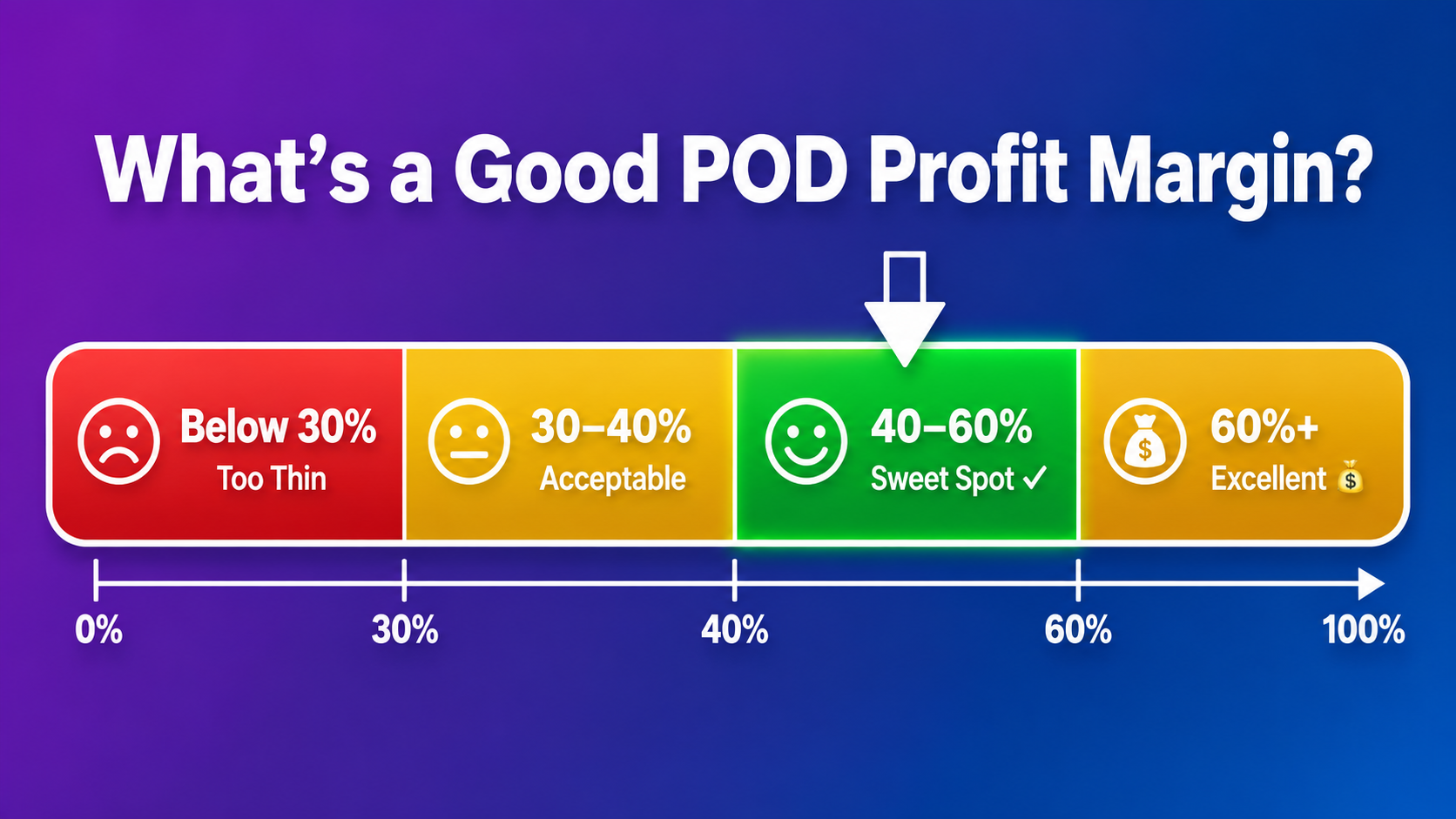
A healthy POD profit margin is 40–60% gross. Here's how to interpret where you land:
-
Below 30% ⚠️ — Too thin. After fees and the occasional refund, you're barely profitable. Usually a sign you're underpricing or competing on price.
-
30–40% — Acceptable for high-volume, low-cost items (stickers, mugs) but risky for apparel.
-
40–60% ✅ — The sweet spot. Healthy profit with room to absorb fees, refunds, and occasional discounts.
-
60%+ 💰 — Excellent, common with premium/differentiated products where perceived value is high (AOP, unique niche designs).
Important: margin isn't the whole story. A 45% margin on a product that sells 100 units/month beats a 65% margin on a product that sells 3 units/month. Always weigh margin against demand.
Why All-Over-Print Products Have Better Margins
If you look back at the product table, you'll notice AOP products consistently deliver the highest dollar profit per sale. There's a reason for that.
Standard printed products compete on price. When thousands of sellers offer the same blank tee with a chest print, buyers comparison-shop and prices get driven down. Thin margins are the result.
All-over-print products compete on uniqueness. A galaxy pattern wrapping an entire hoodie can't be price-compared to a plain tee — it's a different class of product. Customers perceive it as premium and pay accordingly. If you're new to this category, our beginner's guide to all-over-print explains exactly why AOP commands higher prices.
This is why margin-focused sellers gravitate toward premium products. It's not that basic tees can't be profitable — it's that AOP lets you earn 2–3x more per sale for comparable effort. For a breakdown of which AOP items offer the best returns, see our best-selling AOP products guide.
7 Ways to Increase Your Print on Demand Profit Margins
Your margins aren't fixed. Here are seven proven ways to widen them.
1. Sell Higher-Value Products
The fastest way to increase dollar profit is to sell products that support higher price points. Shifting your catalog toward hoodies, AOP items, blankets, and premium products instantly raises your per-sale profit.
2. Raise Your Prices (Strategically)
Most sellers underprice out of fear. Test a 10–15% price increase on your best-sellers — often, sales barely dip while profit jumps. Premium products especially can absorb higher prices because buyers associate price with quality.
3. Reduce Base Costs
Compare suppliers for the products you sell most. Even a $2 reduction in base cost, multiplied across hundreds of sales, adds up fast. Some suppliers also offer volume discounts as you scale.
4. Bundle Products
Selling a matching set (e.g., an AOP hoodie + leggings bundle) increases your average order value. Bundles also feel like a deal to customers while boosting your total profit per transaction.
5. Choose Lower-Fee Platforms
Platform fees directly reduce your margin. Selling on your own Shopify store (flat monthly fee) rather than a marketplace (per-sale percentage) can meaningfully improve margins at higher volumes.
6. Minimize Refunds
Refunds erase profit. Reduce them by ordering samples (so you know your product quality), setting accurate expectations in listings, and using clear size charts and mockups. Preview designs with a 3D mockup tool so customers know exactly what they're getting.
7. Master Your Pricing Strategy
Pricing is a skill, not a guess. Psychological pricing ($49 vs $50), strategic discounting, and understanding your customer's willingness to pay can all widen margins. Our complete POD pricing guide covers the full framework.
Profit Margin vs. Total Income: Don't Confuse Them
A high margin is great, but margin alone doesn't pay your bills — total profit does. Your total income depends on two things working together:
Total Profit = Profit per Sale × Number of Sales
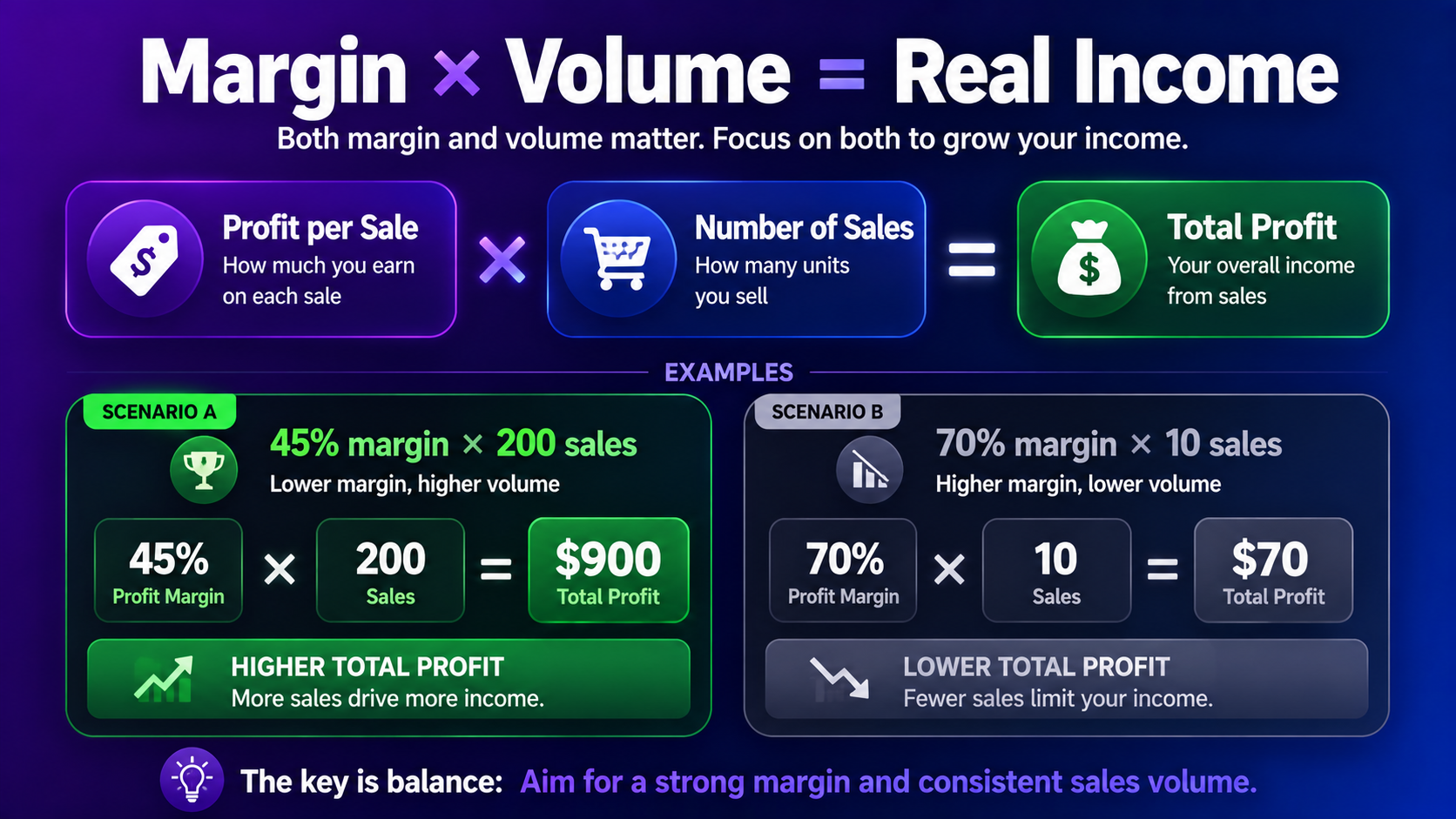
A seller with a modest 45% margin who makes 200 sales/month earns far more than a seller with a 70% margin who makes 10 sales/month. The goal is to optimize both margin and volume — not to maximize one at the expense of the other.
To understand how margins translate into real monthly income at different sales volumes, our companion guide on how much you can earn with print on demand breaks down realistic income scenarios.
Key Takeaways
Let's recap the essentials:
-
Profit margin = the percentage of your retail price you keep after all costs (base cost + fees).
-
Always calculate net margin — include platform and payment fees, not just base cost.
-
Aim for 40–60% gross margin as a healthy target.
-
Chase dollar profit, not just percentage — a 56% margin on an AOP hoodie ($31) beats 60% on a mug ($9).
-
Premium products like AOP deliver the best per-sale profit with less price competition.
-
Total profit = margin × volume — optimize both.
Understanding your margins transforms POD from guesswork into a real, predictable business.
Ready to sell high-margin products? Create your free Yoycol account and access 1,600+ premium AOP products →
Frequently Asked Questions
What is a good profit margin for print on demand?
A healthy print-on-demand profit margin is 40–60% gross. Below 30% is too thin after fees and refunds, while premium/differentiated products like all-over-print items often achieve 55–65%. Remember to calculate net margin after platform and payment fees, not just base cost.
How do you calculate print on demand profit margin?
Subtract your base cost and all fees (platform + payment processing) from your retail price to get net profit, then divide by retail price and multiply by 100. For example: a $55 hoodie with $24 base cost and ~$5 in fees yields ~$26 profit, or a ~47% net margin.
What are the average profit margins in print on demand?
Average POD margins range from 50–68% gross depending on the product. Stickers and phone cases have high percentage margins but low dollar profit ($3–$12), while hoodies and all-over-print products offer strong margins and much higher dollar profit ($23–$35 per sale).
Which print on demand products have the highest profit margins?
Phone cases, posters, and stickers have the highest percentage margins (60–68%). But all-over-print products (hoodies, blankets, leggings) offer the highest dollar profit per sale ($24–$35) with less price competition, making them the most profitable in practice.
Why are my print on demand margins so low?
The most common reasons are: underpricing out of fear, forgetting to account for platform and payment fees, competing on price against saturated products, and selling low-cost items with thin dollar profits. Switching to premium products and pricing strategically usually fixes low margins.
This guide is part of our series on making money with print on demand. Explore our guides on pricing, income potential, and product selection to grow your POD store.