Etsy or Shopify? It's the question every new print on demand seller faces — and the answer isn't as simple as "one is better than the other." They're fundamentally different platforms designed for different stages of a seller's journey.
Etsy gives you free marketplace traffic but limited control. Shopify gives you full control but requires you to drive your own traffic. The right choice depends on your experience level, budget, marketing skills, and long-term goals.
In this guide, we'll compare Etsy and Shopify for print on demand across every factor that matters — and give you a clear recommendation based on your situation.
For the complete picture of launching a POD business, our store setup guide covers the full process.
The Fundamental Difference
Before comparing features, let's understand what each platform actually is:
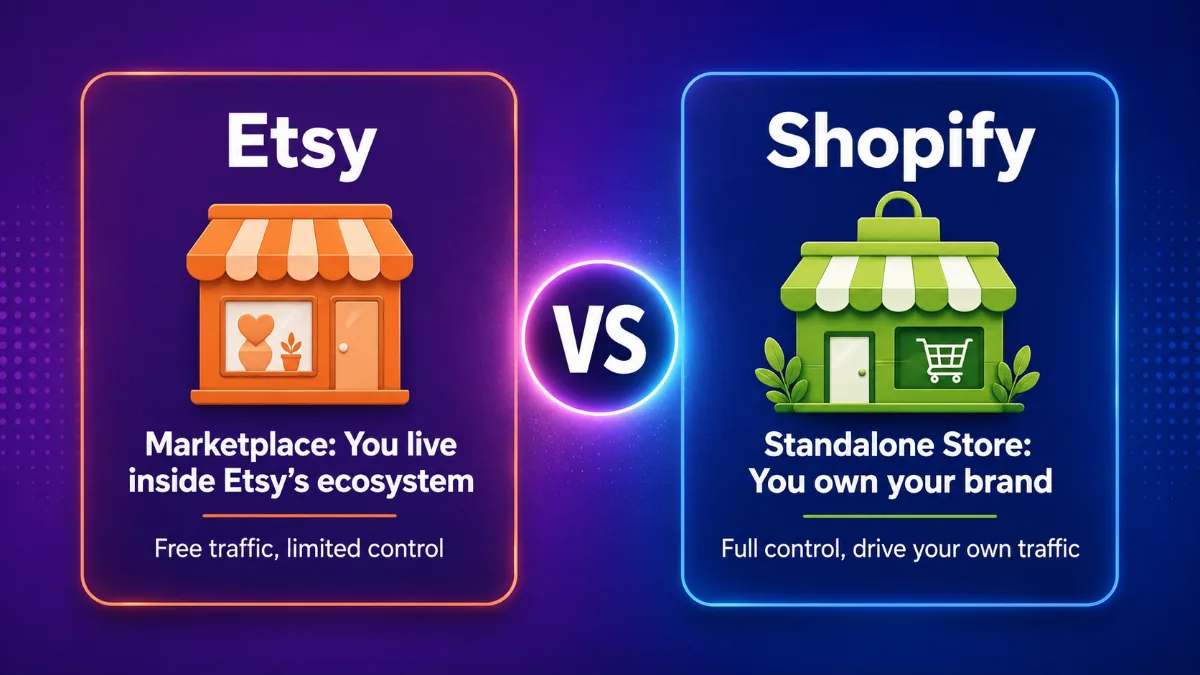
Etsy is a marketplace. Buyers come to Etsy specifically searching for unique, handmade, vintage, and custom products. Your store lives within Etsy's ecosystem — alongside millions of other sellers.
Shopify is a standalone e-commerce platform. You build your own independent store at your own domain. There's no built-in traffic — you drive customers yourself through SEO, ads, and social media.
This single difference — marketplace vs. standalone store — drives almost every other difference between the two platforms.
Here's a quick snapshot before we dive deep:
| Factor | Etsy | Shopify |
|---|---|---|
| Type | Marketplace | Standalone platform |
| Traffic | Built-in (90M+ buyers) | Drive your own |
| Startup cost | $0.20/listing | ~$39/month |
| Branding control | Limited | Full |
| Customer ownership | Etsy owns relationship | You own everything |
| Fees per sale | ~10% (transaction + processing) | ~3% (Shopify Payments) |
| Best for | Beginners, validating niches | Long-term brand building |
| Scalability | Good | Excellent |
Factor 1: Startup Cost
Etsy Costs
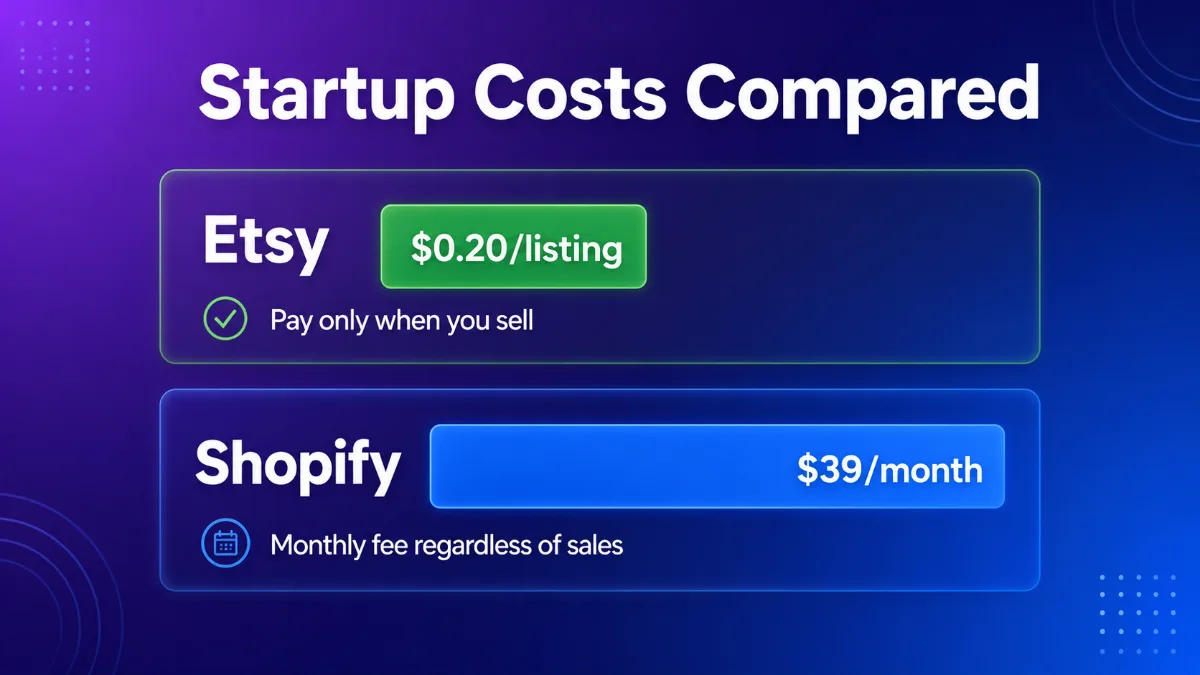
- $0.20 per listing (each listing lasts 4 months or until sold)
- No monthly fee (unless you upgrade to Etsy Plus at $10/month)
- 6.5% transaction fee on each sale
- 3% payment processing fee on each transaction
- Total startup: $0.20–$10 for your first listings
Shopify Costs
- ~$39/month (Basic plan; free trial available, then $1/month for 3 months)
- Custom domain ~$14/year
- 2.9% + $0.30 payment processing (Shopify Payments)
- 0% transaction fee on Basic plan with Shopify Payments
- Apps $0–$50/month (optional, for additional features)
- Total startup: ~$53+ for the first month
The Verdict
Etsy wins on cost for beginners. You can list 10 products for $2 and only pay fees when you sell. Shopify requires monthly commitment regardless of sales.
Winner: Etsy (for low-budget starters)
Factor 2: Traffic
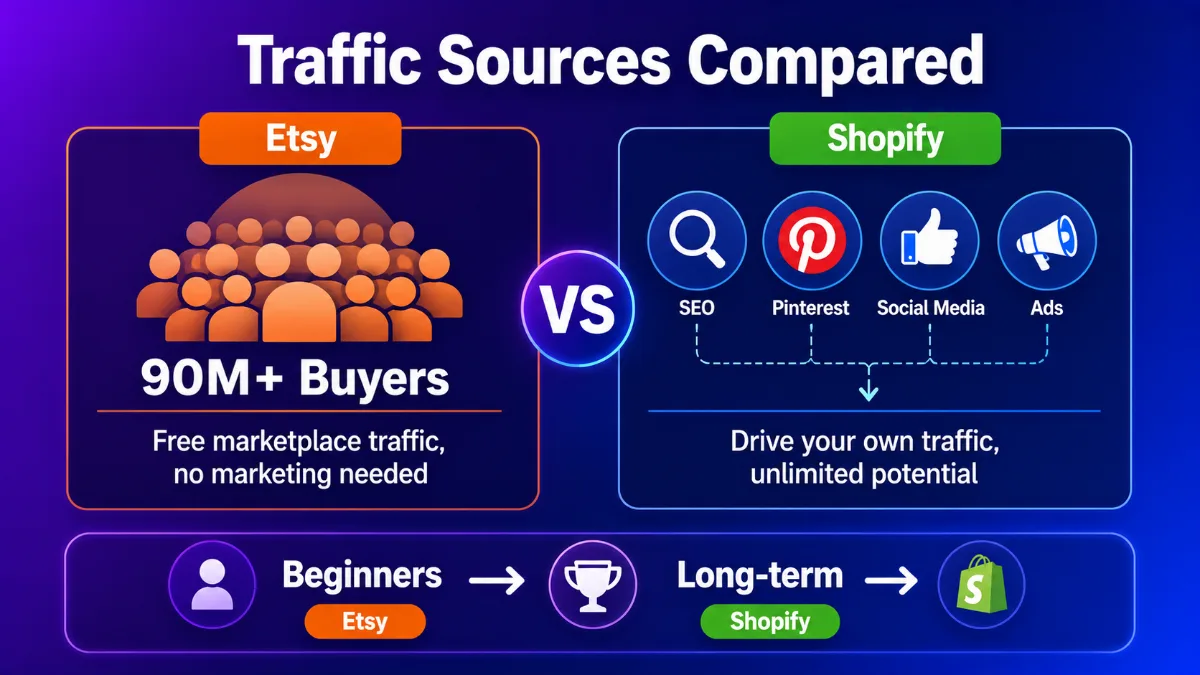
This is the single biggest difference between the two platforms.
Etsy: Free Marketplace Traffic
Etsy has over 90 million active buyers searching for products daily. When you list a product and optimize it for Etsy's search algorithm, buyers can find you immediately — without you spending a dime on marketing.
- Pros: Free traffic, immediate visibility, no marketing skills required
- Cons: Competition within Etsy, platform owns the traffic, algorithm changes affect you
Shopify: Drive Your Own Traffic
Shopify has zero built-in traffic. Your store is invisible until you drive visitors to it through:
-
SEO — optimizing for Google search (long-term, free, compounds)
-
Pinterest — visual search engine, long-lifes pins
-
Social media — Instagram, TikTok, Facebook
-
Paid ads — Facebook, Google Shopping
-
Email marketing — once you build a list
-
Pros: Full control over traffic sources, unlimited growth potential, you own the audience
-
Cons: Takes time (3–6 months), requires marketing skills, no instant visibility
The Verdict
Etsy wins for beginners who want traffic without marketing skills. Shopify wins for long-term growth because you own and control your traffic sources.
Winner: Depends on your stage. Etsy for beginners, Shopify for serious sellers.
Factor 3: Fees and Profit Margins
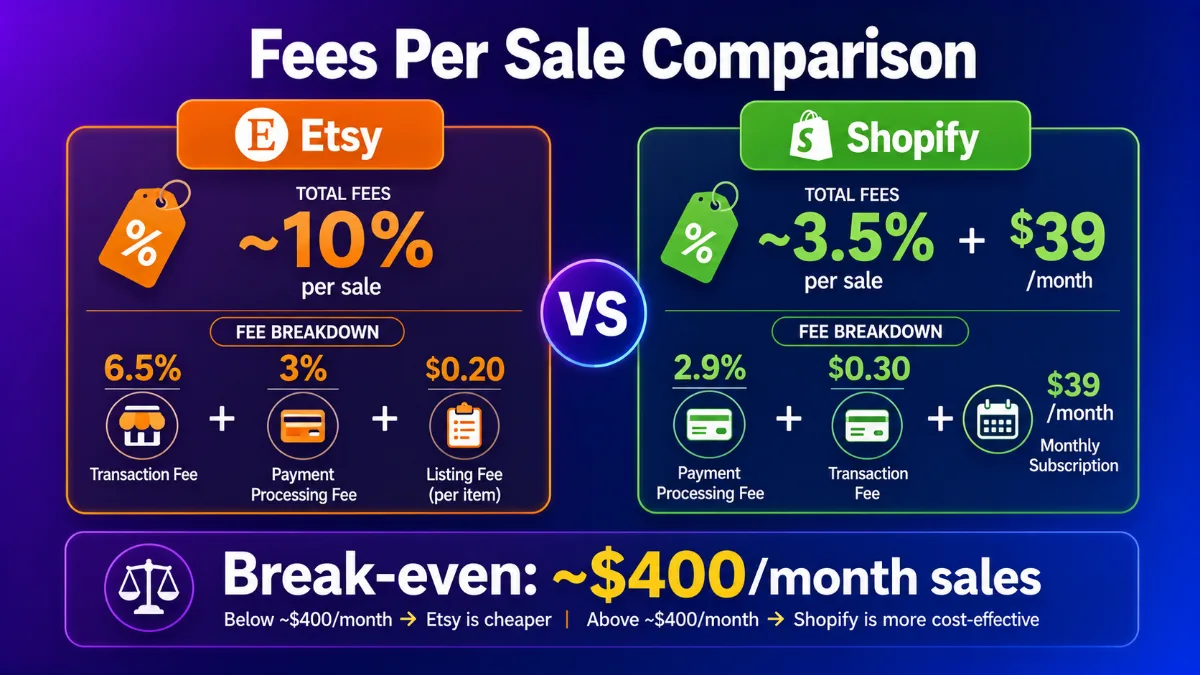
Etsy Fees (per sale)
- 6.5% transaction fee
- 3% payment processing + $0.25 per transaction
- $0.20 listing renewal when item sells
- Total per sale on a $50 product: ~$5.20 (roughly 10.4%)
Shopify Fees (per sale)
- 2.9% + $0.30 payment processing (Shopify Payments on Basic plan)
- 0% transaction fee with Shopify Payments
- Monthly subscription: $39/month (sunk cost regardless of sales)
- Total per sale on a $50 product: ~$1.75 (roughly 3.5%)
The Math
At low sales volume, Etsy is cheaper because you pay nothing until you sell. At higher volume, Shopify becomes cheaper per sale — but the $39/month subscription means you need roughly 35+ sales/month for the math to flip in Shopify's favor.
Break-even point: If you sell more than ~$400/month in product revenue, Shopify's per-sale savings start offsetting the monthly fee.
The Verdict
Etsy is cheaper at low volume. Shopify is cheaper at high volume.
Winner: Tie (depends on your sales volume)
Factor 4: Branding and Control
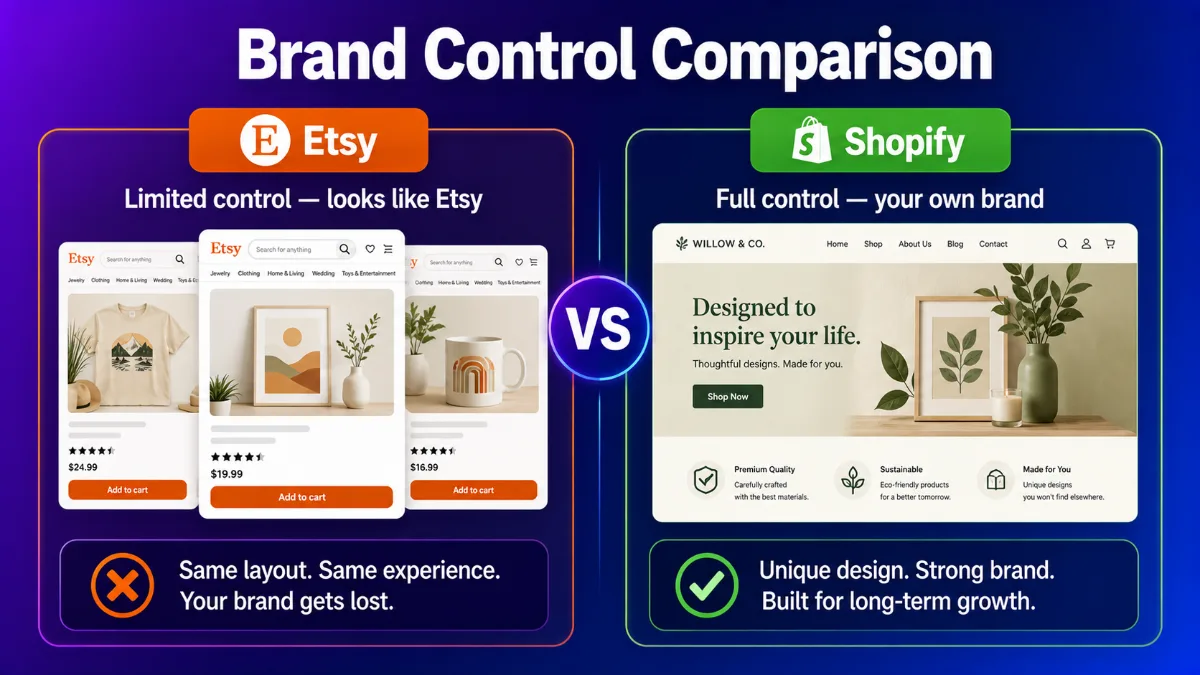
Etsy: Limited Branding
- Your store lives within Etsy's design framework
- Limited customization (banner, icon, about section)
- All stores "look like Etsy"
- Etsy controls the checkout experience
- Etsy may show competitor products on your listings ("Similar items on Etsy")
Shopify: Full Brand Control
- Your own domain (yourbrand.com)
- Complete control over design, layout, and colors
- Custom checkout experience
- Full control over promotions and discounts
- No competitor products shown alongside yours
- Build a real brand identity
The Verdict
Shopify wins decisively on branding. If you want to build a recognizable brand that customers remember and return to, Shopify is the only real choice.
Winner: Shopify
Factor 5: Customer Ownership
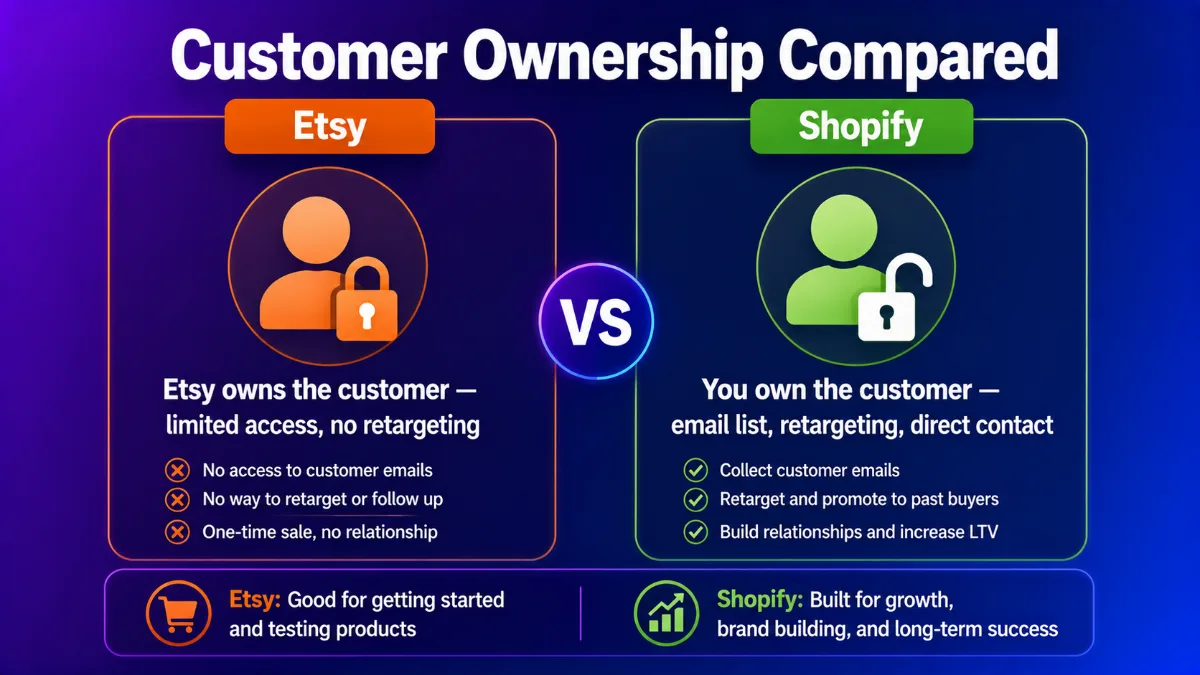
Etsy: Platform Owns the Customer
- Etsy controls customer communication
- Limited email access (you can message buyers but can't add them to email lists without consent)
- No retargeting or remarketing tools
- Repeat customers find you through Etsy, not directly
- If Etsy suspends your shop, you lose everything
Shopify: You Own the Customer
- Full access to customer emails
- Build your own email list (30–40% of revenue for established brands)
- Retarget customers with ads
- Direct communication without platform restrictions
- Your store, your rules — no one can shut you down
The Verdict
Shopify wins decisively. Customer ownership is one of the most valuable long-term assets you can build. Etsy's limitations here are a significant strategic disadvantage.
Winner: Shopify
Factor 6: Scalability
Etsy Scalability
- Easy to list products (but listing fees add up)
- Limited by Etsy's search algorithm and traffic
- Etsy's audience is fixed — you can't expand beyond it
- Risk of account suspension (policy violations, IP complaints)
- Growth plateaus as you max out Etsy's organic reach
Shopify Scalability
- Unlimited products
- Unlimited traffic growth (SEO, ads, social, email)
- Expand to additional sales channels (Amazon, eBay, Facebook Shop)
- Add advanced features through apps
- Build a real business asset (Shopify stores can be sold for 2–5x annual revenue)
The Verdict
Shopify is far more scalable. Etsy has a ceiling; Shopify doesn't.
Winner: Shopify
The Verdict: Which Is Better for POD?
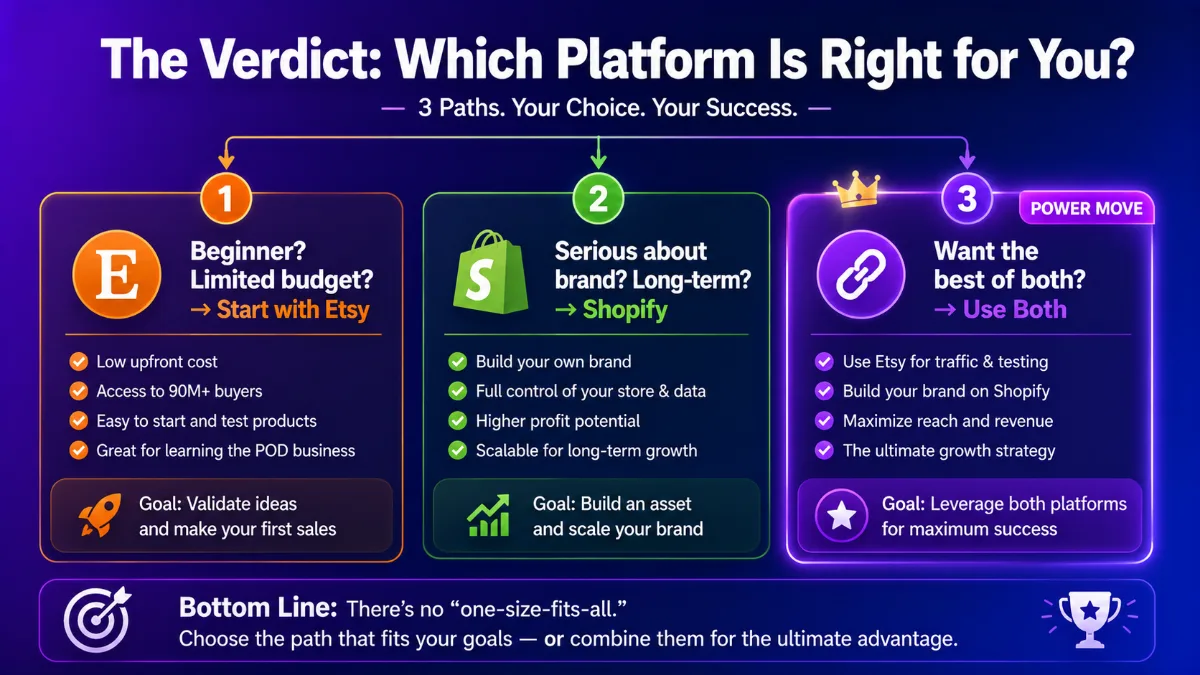
The Honest Answer: It Depends on Your Stage
Choose Etsy if:
- You're a beginner with limited budget ($0–$100)
- You have no marketing experience
- You want to validate your niche before investing heavily
- You want free traffic immediately
- You're testing whether POD is right for you
Choose Shopify if:
- You're serious about building a long-term brand
- You have $500+ budget for setup and marketing
- You're willing to learn SEO and marketing
- You want to own your customer data
- You plan to scale beyond what Etsy can offer
The Power Move: Use Both
Here's what many successful POD sellers actually do: they use both platforms.
- Etsy for marketplace traffic, niche validation, and early sales
- Shopify for brand building, email list ownership, and long-term growth
Start on Etsy to learn the ropes, validate your niche, and generate initial revenue. Once you've found what sells, build a Shopify store and drive your own traffic — while keeping your Etsy shop running for passive marketplace sales.
This dual-platform approach gives you the best of both worlds: free traffic from Etsy and full brand control from Shopify.
Head-to-Head Summary
| Factor | Winner | Notes |
|---|---|---|
| Startup cost | Etsy | Near-zero vs. $39/month |
| Traffic (beginner) | Etsy | Free marketplace traffic |
| Traffic (long-term) | Shopify | Own your traffic sources |
| Fees at low volume | Etsy | Pay only when you sell |
| Fees at high volume | Shopify | Lower per-sale fees |
| Branding | Shopify | Full control |
| Customer ownership | Shopify | Build real assets |
| Scalability | Shopify | No ceiling |
| Overall for beginners | Etsy | Easier start |
| Overall for serious sellers | Shopify | Better long-term |
Your Decision Framework
Ask yourself these questions:
- What's my budget? Under $100 → start with Etsy. $500+ → Shopify is viable.
- Do I have marketing skills? No → start with Etsy. Yes → Shopify lets you leverage them.
- Am I testing or committing? Testing → Etsy. Committing → Shopify (or both).
- Do I want to build a brand? Just selling → Etsy. Building a brand → Shopify.
- What's my timeline? Need sales now → Etsy. Building for 2+ years → Shopify.
The right answer isn't one or the other — it's "the right platform for where I am right now."
Frequently Asked Questions
Is Etsy or Shopify better for print on demand beginners? Etsy is better for POD beginners because it provides free marketplace traffic with 90+ million active buyers. You don't need marketing skills or a large budget to get started. Shopify requires you to drive your own traffic, which takes time and marketing knowledge.
Is Shopify worth it for print on demand? Yes, Shopify is worth it for serious POD sellers who want to build a long-term brand. You get full control over branding, own your customer data, and have unlimited scalability. The $39/month cost is justified once you're generating consistent sales and want to grow beyond Etsy's marketplace.
Can I use both Etsy and Shopify for POD? Yes, many successful POD sellers use both platforms. Start with Etsy for marketplace traffic and validation, then add Shopify for brand building and email list ownership. Keep both running — Etsy for passive marketplace sales, Shopify for your core brand.
Which has lower fees: Etsy or Shopify? Etsy has lower fees at low sales volume because you only pay when you sell. Shopify has lower per-sale fees (~3.5% vs. ~10%) but charges $39/month regardless of sales. Shopify becomes cheaper once you're selling ~$400+/month.
Do I need Shopify if I already have an Etsy shop? Not immediately, but adding Shopify gives you significant advantages: full brand control, customer email ownership, unlimited scalability, and the ability to build a sellable business asset. Many sellers start on Etsy and add Shopify once they've validated their niche.
Which platform is better for SEO: Etsy or Shopify? Shopify is better for long-term SEO because you can optimize for Google search and build organic traffic that compounds over time. Etsy has its own search algorithm that gives you visibility within the platform, but you don't own that traffic and can't take it with you.
Ready to start? Whether you choose Etsy, Shopify, or both — you'll need a reliable POD supplier. Create your free Yoycol account and access 1,600+ products →
This guide is part of our complete store setup series. For detailed setup guides, see our Etsy setup guide and Shopify setup guide.