Here's one of the most common questions in the POD world: can you sublimate on cotton?
The short answer: not directly. Traditional sublimation doesn't work on 100% cotton fabric. But that doesn't mean you can't achieve vibrant, durable prints on cotton — you just need to understand the science and use the right techniques.
For POD sellers, understanding sublimation on cotton is critical:
- Cotton is popular — customers love the feel of cotton
- Sublimation limitations — traditional sublimation only works on polyester
- Alternative methods — there are workarounds and alternatives
- Product selection — knowing what works prevents customer complaints
- Quality control — understanding fabric composition ensures quality
This guide covers everything you need to know about sublimation on cotton: why traditional sublimation doesn't work, alternative methods, products that work best, and how to achieve vibrant prints on cotton fabric.
If you're new to sublimation, our sublimation on polyester guide covers the basics. And if you want to understand fabric choices, check our best fabric for sublimation guide.
Why Traditional Sublimation Doesn't Work on Cotton
To understand why sublimation doesn't work on cotton, you need to understand the science behind the process.
The Science of Sublimation
Sublimation is a chemical process where:
- Sublimation inks are printed onto special transfer paper
- Heat and pressure are applied (typically 380-400°F for 45-60 seconds)
- Ink converts from solid to gas (sublimation)
- Gas bonds with polyester fibers at a molecular level
- Result: Permanent, vibrant, full-color print
Why Cotton Is a Problem
Cotton is a natural fiber with different chemical properties than polyester:
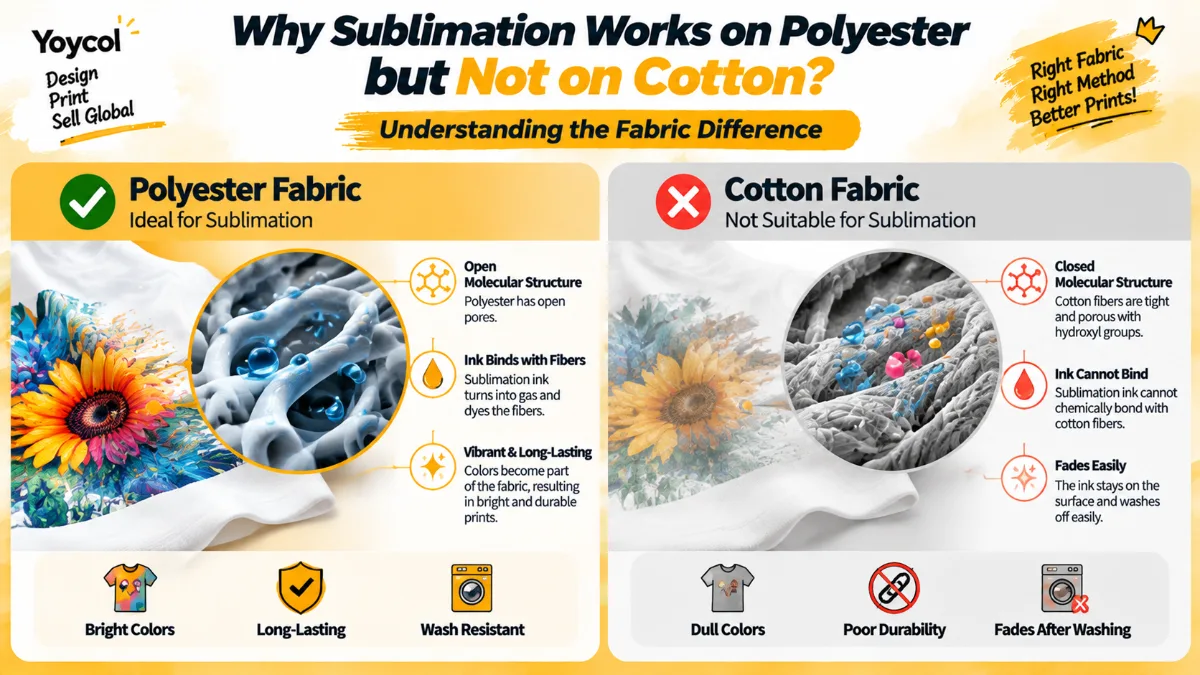
Polyester (works with sublimation):
- Synthetic fiber made from petroleum
- Has open molecular structure when heated
- Sublimation ink bonds permanently with fibers
- Result: Vibrant, durable prints
Cotton (doesn't work with traditional sublimation):
- Natural fiber made from cellulose
- Has closed molecular structure
- Sublimation ink cannot bond with fibers
- Result: Faded, washed-out prints that fade after washing
The reality: Sublimation ink only bonds with polyester or polymer-coated surfaces. On 100% cotton, the ink sits on top of the fabric and washes out quickly.
Can You Sublimate on Cotton at All?
Here's where it gets interesting. While traditional sublimation doesn't work on 100% cotton, there are several workarounds:
Method #1: Cotton-Polyester Blends
How it works: Use fabric that's a blend of cotton and polyester
Best results: 65% polyester / 35% cotton blend or higher polyester content
Pros:
- Maintains cotton feel
- Sublimation works on polyester portion
- More vibrant than 100% cotton
Cons:
- Colors are less vibrant than 100% polyester
- May have vintage/distressed look
- Not as durable as 100% polyester
Method #2: Sublimation Spray / Coating
How it works: Apply a polyester coating spray to cotton fabric before sublimation
Pros:
- Allows sublimation on 100% cotton
- Creates polymer coating for ink to bond with
Cons:
- Adds extra step and cost
- Coating may affect fabric feel
- Durability concerns after washing
- Not widely used in POD
Price point: Additional $1-$3 per garment for spray
Method #3: Sublimation Vinyl / HTV
How it works: Print design on sublimation vinyl, then heat press onto cotton
Pros:
- Works on 100% cotton
- Vibrant colors
- Durable if applied correctly
Cons:
- Extra production step
- Vinyl has a "feel" on fabric
- More expensive than direct sublimation
- Not true sublimation
Price point: Additional $2-$5 per garment for vinyl
Method #4: Alternative Printing Methods
Instead of sublimation, use printing methods designed for cotton:
DTG (Direct-to-Garment):
- Prints directly on cotton fabric
- Vibrant colors on light garments
- Works on 100% cotton
- More expensive than sublimation
Screen Printing:
- Traditional method for cotton
- Cost-effective for bulk orders
- Durable, long-lasting
- Limited colors (each color adds cost)
Heat Transfer Paper:
- Print on special transfer paper
- Heat press onto cotton
- Works on light and dark garments
- Less durable than DTG
Best Products for Sublimation on Cotton
If you want to sell cotton-look products with sublimation prints, here are your best options:
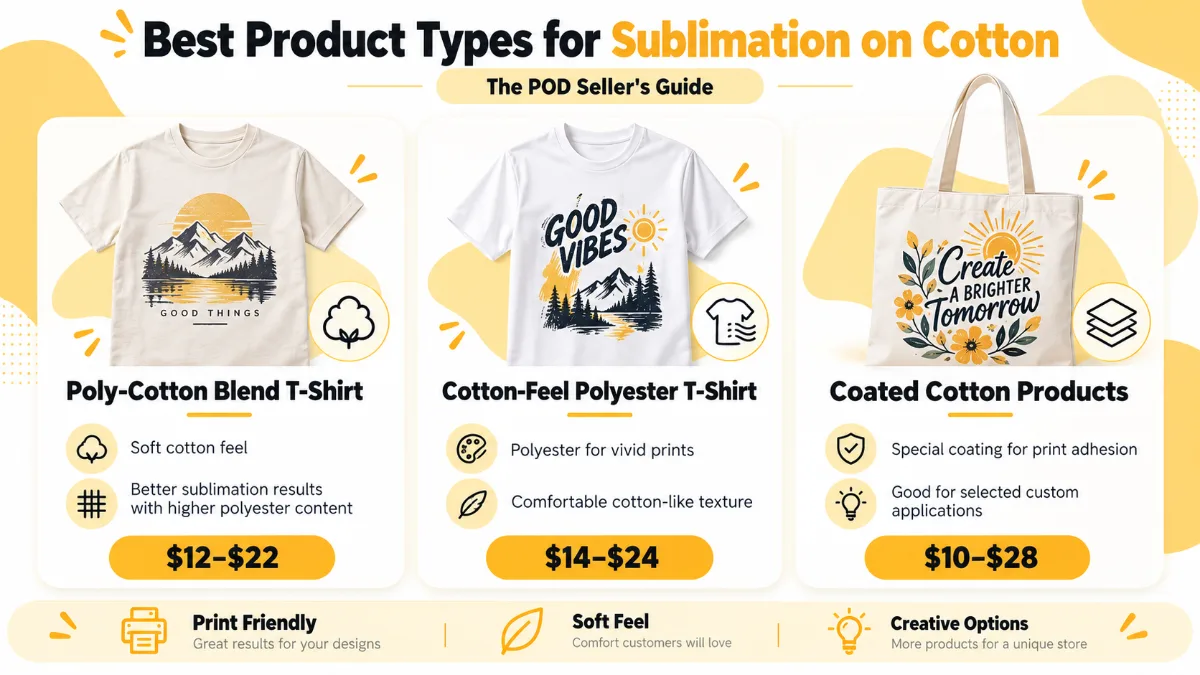
1. Cotton-Polyester Blend T-Shirts
Recommended blend: 65% polyester / 35% cotton or 50/50 blend
Pros:
- Soft, cotton-like feel
- Sublimation works
- Vintage/distressed look is trendy
Cons:
- Colors not as vibrant as 100% polyester
- May shrink differently
Price point: $15-$25 retail
2. Polyester T-Shirts with Cotton Feel
Recommended: 100% polyester with soft, cotton-like finish
Pros:
- Full sublimation compatibility
- Vibrant colors
- Soft feel
Cons:
- Some customers prefer natural fibers
- May feel "synthetic"
Price point: $20-$35 retail
3. Sublimation-Coated Cotton Products
Recommended: Cotton products with polyester coating
Pros:
- Cotton feel with sublimation compatibility
- Unique product offering
Cons:
- Limited product availability
- Coating may affect durability
Price point: $25-$40 retail
Alternative Methods for Cotton Products
If you want to sell 100% cotton products, here are the best alternatives to sublimation:
DTG (Direct-to-Garment) Printing
- Best for: 100% cotton, vibrant colors, small orders
- Pros: Works directly on cotton; vibrant, photo-quality prints; no minimum orders; soft feel
- Cons: More expensive than sublimation; slower production; works best on light garments
- Price point: $25-$45 retail
Screen Printing
- Best for: Bulk orders, simple designs, 100% cotton
- Pros: Cost-effective for bulk; durable, long-lasting; works on any fabric
- Cons: Setup costs for each design; limited colors (each color adds cost); not cost-effective for small orders
- Price point: $20-$40 retail (for bulk orders)
Heat Transfer Paper
- Best for: Small orders, complex designs, cotton
- Pros: Works on cotton; can print complex designs; cost-effective for small orders
- Cons: Less durable than DTG or screen printing; may feel stiff; fades over time
- Price point: $20-$35 retail
Frequently Asked Questions
Can you sublimate on 100% cotton? No, traditional sublimation doesn't work on 100% cotton. The ink cannot bond with cotton fibers. You need polyester or a polyester coating for sublimation to work.
What's the best cotton-polyester blend for sublimation? 65% polyester / 35% cotton or higher polyester content works best. The higher the polyester content, the more vibrant the colors.
Does sublimation spray work on cotton? Yes, sublimation spray creates a polyester coating on cotton that allows sublimation. However, it adds cost and may affect fabric feel and durability.
What's the difference between sublimation on polyester vs. cotton? On polyester, sublimation creates vibrant, durable prints. On cotton, traditional sublimation doesn't work. You need blends, coatings, or alternative methods.
Can I use DTG instead of sublimation for cotton? Yes, DTG (Direct-to-Garment) printing works directly on cotton and produces vibrant, photo-quality prints. It's more expensive than sublimation but ideal for cotton.
Is screen printing better than sublimation for cotton? Screen printing is designed for cotton and produces durable, long-lasting prints. It's cost-effective for bulk orders but not for small quantities.
What's the best printing method for 100% cotton? DTG printing is best for small orders and complex designs. Screen printing is best for bulk orders. Heat transfer paper works for small orders but is less durable.
Can I sublimate on cotton-polyester blends? Yes, cotton-polyester blends work with sublimation. The higher the polyester content, the more vibrant the colors. 65/35 or 50/50 blends are common.
Does sublimation vinyl work on cotton? Yes, you can print on sublimation vinyl and heat press it onto cotton. However, it's an extra step and the vinyl has a noticeable feel on the fabric.
What POD products work best for cotton customers? Use DTG printing for 100% cotton products, or offer cotton-polyester blend products that work with sublimation. Be transparent about fabric content and printing method.
Sublimation on cotton is not possible with traditional methods, but you have alternatives — cotton-polyester blends, sublimation sprays, DTG printing, and screen printing.
Understanding these limitations and alternatives helps you choose the right products and printing methods for your POD business.
Ready to start selling sublimation products? Browse Yoycol's sublimation collection →
This guide is part of our sublimation and design series. Explore our sublimation on polyester guide, best fabric for sublimation guide, or learn what is all-over-print.