The print-on-demand industry is entering a new phase. It is no longer just about low inventory, fast customization, and easy store setup. In 2026, the stronger advantage comes from turning trends into products faster, presenting products in ways both shoppers and search engines can understand, and matching fulfillment speed to the expectations of modern ecommerce. This shift is being shaped by Google’s latest shopping and search updates, the continued growth of ecommerce, and rising demand around major cultural and seasonal moments.
Why 2026 Feels Different for POD Sellers
Google’s shopping ecosystem is becoming more data-driven and more AI-assisted. According to Google, the Shopping Graph now contains more than 50 billion product listings, and more than 2 billion of those listings are refreshed every hour. Google has also said AI in Search is driving more queries and higher-quality clicks. For POD sellers, that means discoverability is increasingly tied to product data quality, image quality, and the overall usefulness of the product page, not just keyword coverage.
At the same time, Google’s Search guidance remains clear: content should be helpful, reliable, and people-first. Google also states that AI-generated content is not a problem by itself; what matters is whether the content is useful and created for people rather than primarily for rankings. That is especially important for POD brands, where repetitive product copy and generic AI text can make stores feel interchangeable.
For product pages specifically, Google recommends using Product structured data so product information can appear more richly in Search, including Google Images and Google Lens. This can surface details like price, availability, ratings, and shipping information directly in search results. For POD businesses with many SKUs, that makes product data structure a growth lever, not just a technical detail.
The Ecommerce Market Is Still Expanding
The broader ecommerce backdrop is still favorable. The U.S. Census Bureau reported that 2025 U.S. ecommerce sales were estimated at $1.2337 trillion, up 5.4% from 2024, and ecommerce accounted for 16.4% of total retail sales for the year. In the fourth quarter of 2025, ecommerce sales were also growing faster than overall retail sales. That matters for POD because it confirms that online demand is still expanding, even as competition rises.
Third-party market researchers also continue to project strong POD growth. Grand View Research estimates the global print-on-demand market at $10.78 billion in 2025, with continued rapid growth expected through 2033. Forecasts vary by source, but the direction is consistent: personalized, on-demand ecommerce remains a high-growth category.
The New Customer Journey Is Better for POD Than It Looks
Google’s recent consumer research describes today’s path to purchase through four overlapping behaviors: streaming, scrolling, searching, and shopping. In other words, customers no longer move in a neat funnel. They might discover a style in a video, search for it later, compare options through Google, and finally buy through a marketplace, social platform, or brand site.
That is good news for POD sellers. POD products naturally fit visual discovery and trend-led shopping. But it also means the winning product is not just the one with the best design. It is the one supported by a stronger content package: clear titles, persuasive selling points, realistic mockups or lifestyle images, accurate material details, clean sizing information, and trustworthy fulfillment messaging. This is an inference based on Google’s product-data guidance and its 4S consumer framework.
Two Trend Windows POD Sellers Should Watch Closely
1. America250 and Commemorative Merchandise
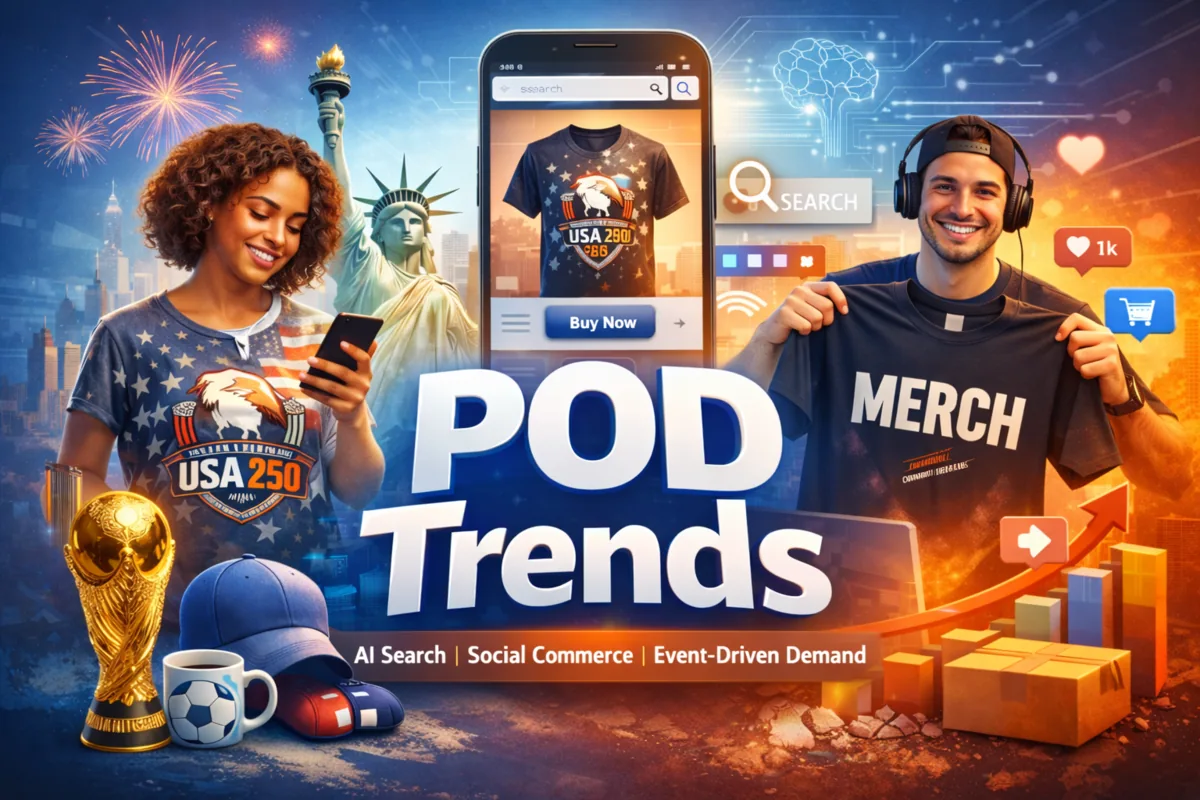
On July 4, 2026, the United States will commemorate the 250th anniversary of the signing of the Declaration of Independence. America250 describes this as a national, multi-year commemoration. For POD sellers, this creates a clear merchandising window for patriotic collections, event apparel, drinkware, gifts, headwear, and community or family reunion items.
The opportunity is not only in flag-inspired designs. It is also in products built around celebration, gathering, travel, gifting, and local pride. The strongest sellers will likely be the ones that feel wearable and giftable, not just seasonal. That is an inference, but it follows the way official commemorative programs are positioned and merchandised.
2. FIFA World Cup 2026 and Host-City Energy
Official FIFA channels are already merchandising the 2026 World Cup through host-city collections, including caps, T-shirts, hoodies, posters, scarves, and bottles. That is a strong signal that city-based pride, fan identity, and event-led collectible merchandise will be highly visible as the tournament approaches.
For POD sellers, that does not mean copying official assets. It means building adjacent demand: watch-party apparel, city-inspired color stories, travel designs, fan gathering products, and team-spirit collections that avoid licensing risk. In practical terms, this favors sellers who can move quickly across multiple formats, especially apparel, hats, accessories, and drinkware. This is an inference based on the product categories already visible in official merchandise assortments.
Social Commerce and Creator-Led Sales Will Keep Growing
YouTube’s 2025 Shopping report analyzed the top 5,000 most-purchased products in the first half of 2025 and the top 1,000 videos by transaction on tagged products in a 60-day period. That matters because it shows large platforms are treating content and commerce as a connected system, not separate channels.
For POD, creator commerce is a natural fit. Creators do not need inventory to launch themed merchandise. Brands do not need long development cycles to test a collection. A design concept can become a wearable product line quickly, then be validated through content performance. This is where POD has an edge over traditional inventory-heavy merchandising. That conclusion is an inference supported by the broader social-shopping direction shown in YouTube’s report and Google’s 4S consumer model.
What This Means for POD Platforms in 2026
For POD platforms and sellers, the next stage of growth will likely depend on four things.
1. Sell use cases, not just products
Homepage messaging should move beyond “what we print” and answer “what you can sell, where you can sell it, and why now.” Collections tied to fast-growing opportunities like U.S.-made quick-turn products, creator merch, sports-inspired drops, commemorative collections, and giftable seasonal items are easier for buyers to understand and act on.
2. Build product pages for both conversion and search
Better product data, structured attributes, realistic images, fulfillment clarity, and stronger page usefulness will matter more as AI-assisted search becomes more prominent. Google’s guidance makes this direction very clear.
3. Create content that can actually support buying decisions
Instead of publishing thin general-interest SEO articles, POD brands should create content that helps users act: what to sell for America250, which products fit fast-turn platforms, how to turn one design into a collection, or how to choose between DTG, DTF, sublimation, and embroidery for different selling goals. That aligns much more closely with Google’s helpful-content guidance.
4. Turn speed into a product advantage
In trend-driven ecommerce, speed is not just a fulfillment metric. It is part of the offer. The brands that win will often be the ones that can move from trend insight to product concept, to publish-ready visuals, to live listings, to reliable fulfillment with less friction. This is an inference, but it is consistent with the growth of AI shopping, social commerce, and event-driven demand.
Final Thoughts
2026 is shaping up to be a strong year for POD businesses that can connect product creation, product storytelling, and product discovery. Ecommerce is still growing. Google is making product data and content quality more important. Consumers are moving fluidly between content and commerce. And major public moments like America250 and the 2026 World Cup are opening up new merchandising windows.
For POD sellers, the opportunity is not just to print more products. It is to build better product systems: faster trend response, stronger visual presentation, clearer product data, and more useful content. The stores that do that well will be in a better position to capture demand across search, social, and direct ecommerce in 2026.
Ready to launch your next custom product collection? Explore more print-on-demand solutions at Yoycol: https://www.yoycol.com/