Print on demand or dropshipping? It's one of the most common questions new e-commerce sellers ask — and one of the most poorly answered online. Most "vs" articles either oversimplify ("just pick one!") or are written by people selling you a course on the model they recommend.
Let's cut through the noise. Both models are legitimate, both can be profitable, and both have real trade-offs that matter. The right choice depends on your situation — your budget, your skills, your goals, and how much risk you're willing to take.
In this guide, we'll compare print on demand and dropshipping head-to-head across every factor that matters: startup cost, profit margins, risk, scalability, and long-term potential. By the end, you'll know exactly which model fits you better.
For the broader context of how POD income works, our complete guide to making money with print on demand covers the full model.
First: What's the Actual Difference?
Many people confuse POD and dropshipping because they share the same fulfillment structure: you don't hold inventory, and the supplier ships directly to your customer.
But there's one fundamental difference that changes everything:
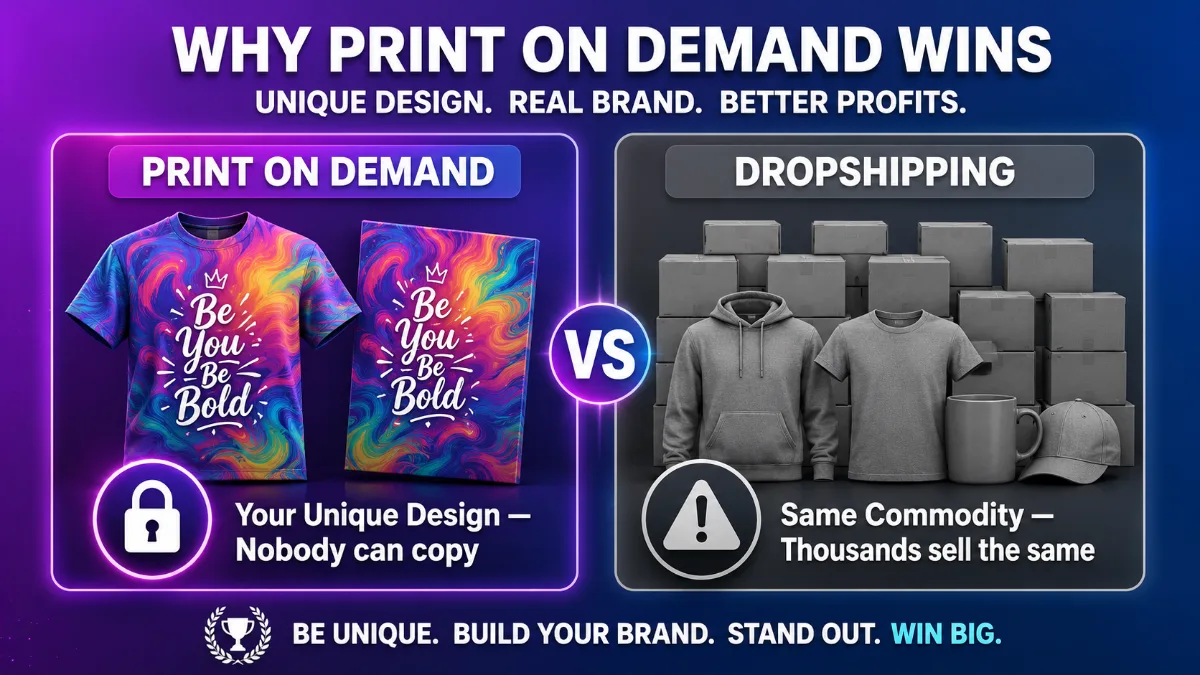
Dropshipping (generic): You sell products sourced from a supplier — typically AliExpress, CJ Dropshipping, or similar marketplaces. Thousands of other sellers have access to the exact same products. Your product is a commodity.
Print on Demand: You sell products with your own unique designs. Nobody else can sell the same product because the design is yours. Your product is differentiated.
That single difference — commodity vs. unique — cascades into almost every other difference between the two models: pricing power, competition, margins, and long-term viability.
Here's a quick snapshot before we dive deep:
| Factor | Print on Demand | Dropshipping |
|---|---|---|
| Your product | Unique (your designs) | Commodity (same as everyone) |
| Inventory risk | None | None (typically) |
| Startup cost | $0–$500 | $500–$2,000+ |
| Profit per sale | $10–$40 | $5–$20 |
| Competition | Medium (niche-dependent) | Very high (same products) |
| Scalability | High | High |
| Long-term moat | Your brand + designs | None (anyone can copy) |
Factor 1: Startup Cost
One of the biggest selling points of both models is low startup cost — but POD wins here.
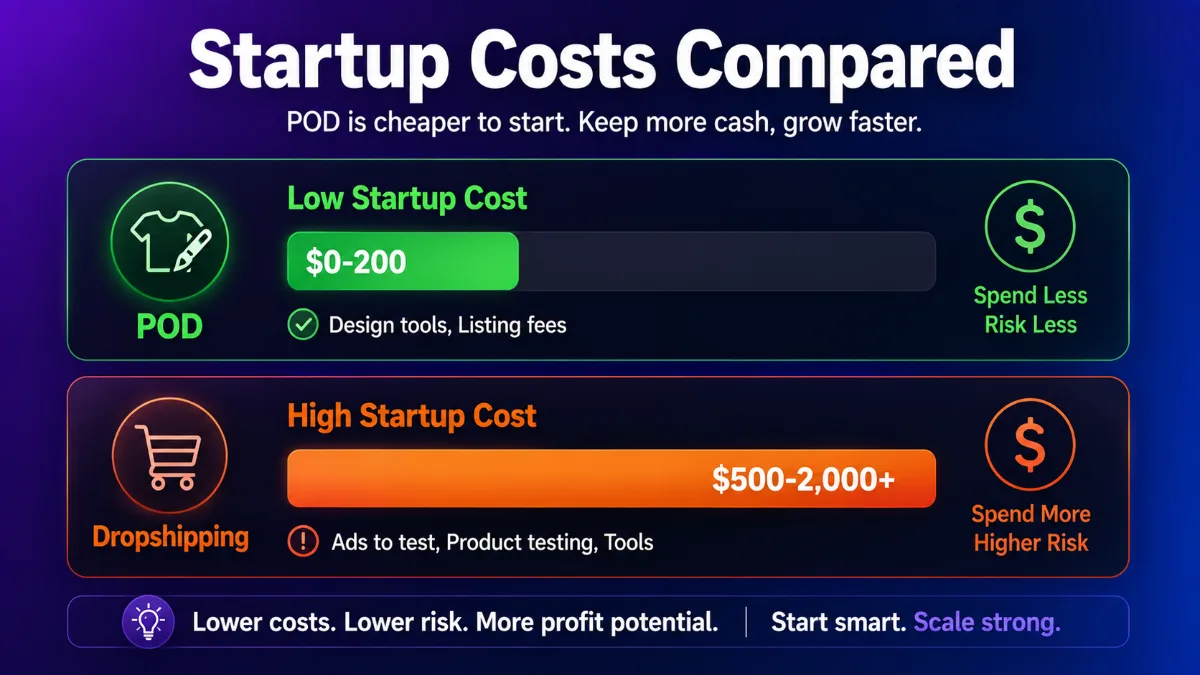
Print on Demand Startup Costs
- Supplier account: Free (Yoycol, Printful, Printify, etc.)
- Design tools: Free (Canva, AI tools) or $13/month (Canva Pro)
- Marketplace listings: $0.20/listing on Etsy (very cheap)
- Shopify store: ~$39/month (optional)
- Samples: $20–$30 per product (recommended but optional)
Total: $0–$200 to get started meaningfully.
Dropshipping Startup Costs
- Supplier account: Free–$30/month
- Shopify store: ~$39/month (usually required)
- Product testing: $50–$200 (you must test products before selling)
- Ads to test products: $200–$1,000+ (Facebook/TikTok ads to find winners)
- Tools: $30–$100/month (product research, order fulfillment automation)
Total: $500–$2,000+ before you know if you have a winning product.
Winner: Print on Demand. POD lets you test with near-zero financial risk. Dropshipping requires meaningful ad spend just to find products that sell.
Factor 2: Profit Margins and Per-Sale Profit
This is where the money actually matters.
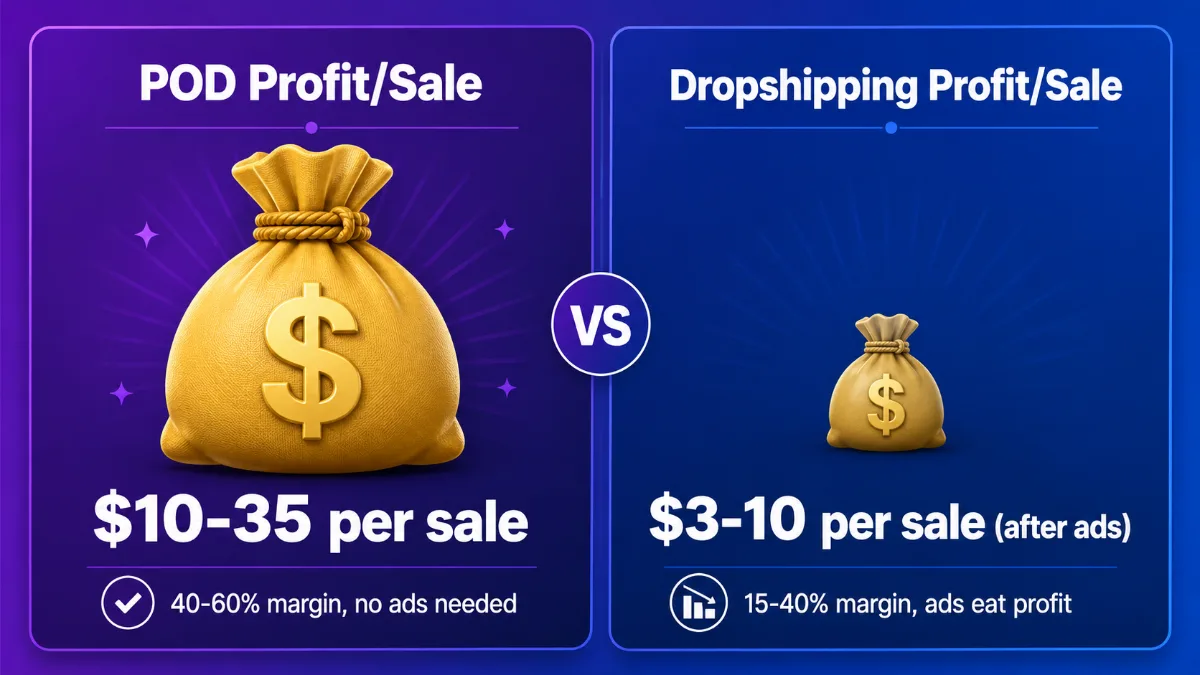
Print on Demand Margins
Typical POD margins: 40–60% gross, with $10–$40 profit per sale depending on product. AOP products (hoodies, blankets, leggings) deliver the highest dollar profit — up to $35+ per sale. If you want to understand the math behind these numbers, our POD profit margins guide breaks it all down.
Dropshipping Margins
Typical dropshipping margins: 15–40% gross, with $5–$20 profit per sale. Margins are squeezed by:
- Heavy competition on the same products (race to the bottom on price)
- Ad spend (which eats into margin — often 30–50% of revenue goes to ads)
- Supplier price fluctuations
- Refund/return rates (higher than POD because quality is inconsistent)
The Real Comparison
After ads, a typical dropshipping profit per sale is often $3–$10. A typical POD profit per sale (with free organic traffic) is $10–$35.
This is the single biggest financial difference between the models. POD sellers often keep more of what they sell because they don't need paid ads to drive traffic, and their unique products command premium prices.
Winner: Print on Demand for per-sale profit, especially when you factor in ad dependency.
Factor 3: Competition and Saturation
This is where dropshipping hurts most.
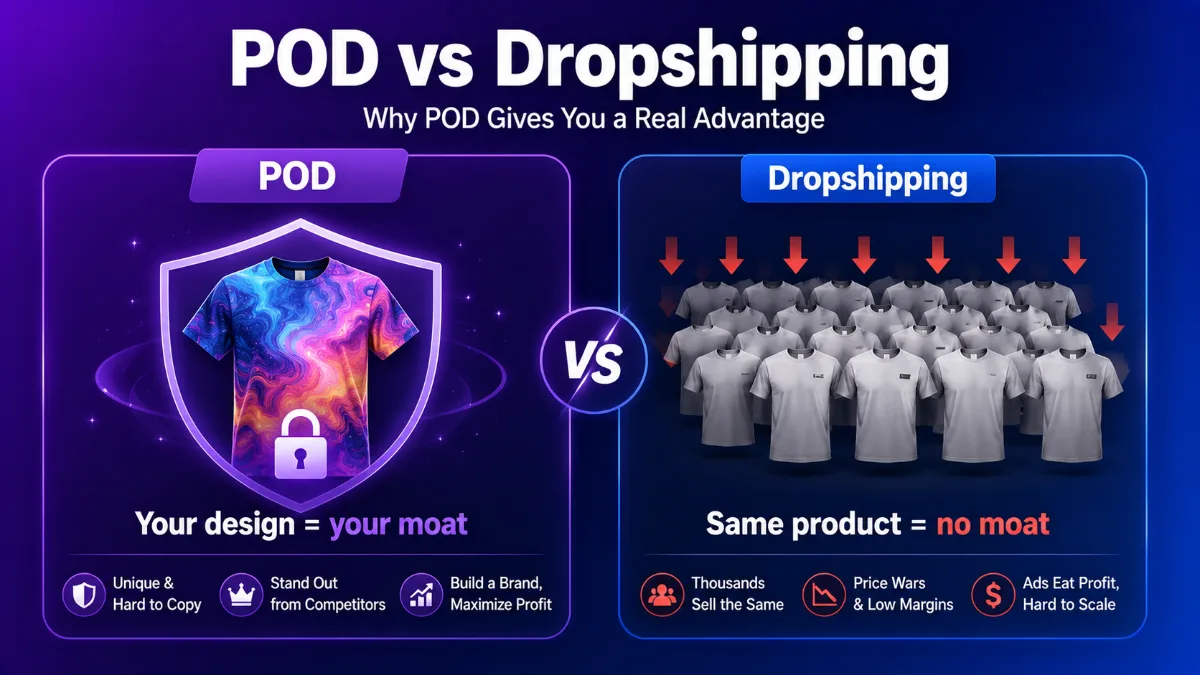
Dropshipping Competition
When you find a winning product through dropshipping, here's what happens within days:
- Other sellers discover the same product (via spy tools, TikTok, etc.)
- They replicate your store and ads
- The product floods the market
- Prices drop, ad costs rise, the "winning" product stops working
This cycle is brutal and fast. Many dropshippers are constantly hunting for new winners because the old ones get saturated within weeks.
POD Competition
When you sell a unique design, nobody can copy your product (without stealing your intellectual property, which is enforceable). Even if someone tries a similar concept, your specific design, niche angle, and brand positioning are yours alone.
POD still has competition — especially in generic niches — but the nature of competition is different. You're competing on design quality and niche fit, not on the same commodity product.
Winner: Print on Demand. Your designs are your moat. Dropshipping has no moat.
Factor 4: Product Quality and Control
Dropshipping Quality
You're at the mercy of your supplier — and when you're sourcing from AliExpress or similar marketplaces, quality is inconsistent. One order looks great, the next has a defect. Returns and complaints are common.
The only way to manage this is to order samples of every product, which adds time and cost.
POD Quality
Quality is more consistent because the supplier prints on demand to a standardized process. Reputable POD platforms (like Yoycol, Printful) maintain quality control because their business depends on it.
You still should order samples before marketing heavily, but surprises are rarer than with dropshipping.
Winner: Print on Demand for consistency, though both benefit from sample ordering.
Factor 5: Shipping Times
This is where dropshipping has the edge — sometimes.
Dropshipping Shipping
- Fast suppliers (US/EU based): 3–7 days
- China-based suppliers: 10–20 days (AliExpress standard)
- You choose the supplier — so you can optimize for speed
POD Shipping
- US/EU production (Printful, etc.): 3–7 days production + 2–5 days shipping
- China-based production (Yoycol, JetPrint, etc.): 3–7 days production + 7–15 days shipping
POD takes slightly longer because the product is made after you order — cut, printed, sewn, and shipped. AOP products specifically take a bit longer than DTG because of the cut-and-sew process. If you're curious about how all-over-print works, the process explains the extra time.
Winner: Depends on supplier choice. Both can be fast or slow. POD's made-to-order nature adds a small delay, but good suppliers minimize it.
Factor 6: Scalability and Long-Term Viability
Dropshipping Longevity
Dropshipping stores are often short-lived. A winning product works for weeks or months, then dies. You're constantly hunting for new winners. Building a real brand is hard because you have no control over the product itself.
Many dropshippers burn out after 1–2 years of this cycle.
POD Longevity
POD sellers build catalogs that compound over time. A design that sells today will still sell in 2 years. Your listings, reviews, and SEO all build on each other.
You can build a real brand around your designs and niche. Repeat customers, email lists, and brand loyalty are all achievable with POD in ways they're not with commodity dropshipping.
For sellers interested in premium products with stronger margins, our best-selling AOP products guide shows which items have the highest long-term earning potential.
Winner: Print on Demand. POD builds assets (catalog, brand, reviews) that compound. Dropshipping starts from zero repeatedly.
The Big Question: Which Makes More Money?
Let's get to the headline answer.
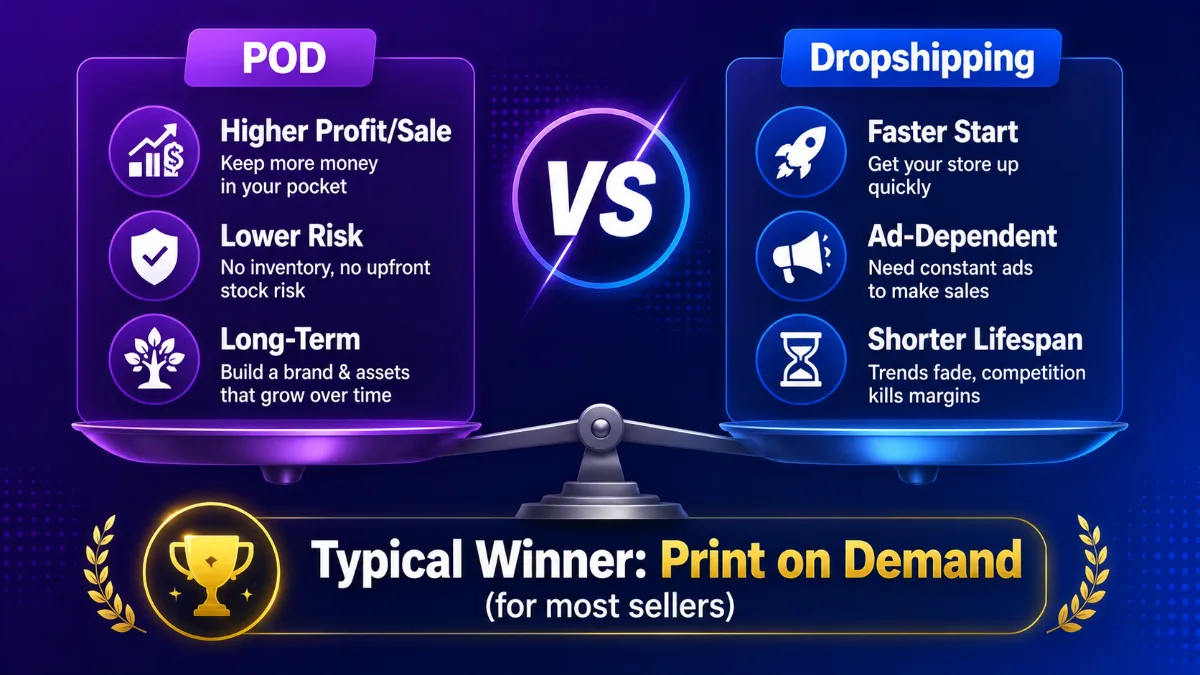
Short Answer: It depends on your skills and situation.
The Typical Winner: Print on Demand
For most people — especially beginners, side hustlers, and creators — POD is the more profitable long-term choice because:
- Higher per-sale profit ($10–$35 vs. $3–$10 after ads)
- Zero or minimal ad spend required (organic traffic via SEO)
- Unique products = less competition
- Catalogs compound over time (not cycle-and-burn)
- Lower startup risk
When Dropshipping Can Make More
Dropshipping can outperform POD in specific scenarios:
- You have strong paid ad skills. If you're great at Facebook/TikTok ads, you can scale a winning dropshipping product to $10K–$100K/month faster than POD (though with more risk and shorter lifespan).
- You have capital to test. $5,000–$10,000 in testing budget gives you the runway to find multiple winners.
- You want to sell non-apparel products. Dropshipping covers home goods, gadgets, and products POD can't produce.
- You want speed. Finding a winner in 2 weeks (with ad spend) beats the 3–6 month POD ramp.
The reality: The median POD seller earns more than the median dropshipper because the median dropshipper loses money on failed tests. The top 1% of dropshippers (skilled advertisers with capital) earn more than the top 1% of POD sellers. But getting to that top 1% is much harder.
Which Model Should You Choose?
Use this framework to decide:
Choose Print on Demand if:
- You have limited startup budget ($0–$500)
- You want to build a sustainable, long-term business
- You're willing to invest time in SEO and design
- You want to sell unique products you control
- You prefer lower risk
- You're building around a niche or passion
Choose Dropshipping if:
- You have $2,000+ to test products
- You're skilled at paid advertising (or want to learn)
- You want fast feedback (weeks, not months)
- You're selling non-apparel products POD can't cover
- You're okay with the cycle-and-hunt lifestyle
Choose Both: Some successful sellers run both — POD for their core brand and catalog, dropshipping for trend-jacking and product testing. It's not either/or.
The Truth Nobody Tells You
Here's what most "vs" articles don't say:
Neither model is "easy money." Both require real effort, learning, and persistence. The people who succeed in either model treat it as a business — not a shortcut.
The real question isn't "POD vs dropshipping" — it's "which model fits my situation, skills, and goals?"
If you're creative, patient, and want to build something that lasts, POD is probably your answer. If you're analytical, well-capitalized, and want fast feedback, dropshipping might fit better.
Either way, pick one and commit. Spreading effort across both models while learning is a recipe for succeeding at neither.
Ready to start with print on demand? Create your free Yoycol account and browse 1,600+ unique AOP products →
Frequently Asked Questions
Is print on demand the same as dropshipping? No, though they share the same fulfillment structure (no inventory, supplier ships directly). The key difference: with POD, you sell unique products with your own designs that nobody else can replicate. With traditional dropshipping, you sell commodity products that thousands of other sellers also offer.
Which is more profitable: print on demand or dropshipping? For most sellers, print on demand is more profitable due to higher per-sale margins ($10–$35 vs. $3–$10 after ads), lower competition on unique designs, and the ability to build a catalog that compounds over time. Top 1% dropshippers with strong ad skills can earn more, but the median POD seller outearns the median dropshipper.
Is print on demand easier than dropshipping? POD is easier to start (lower cost, less upfront risk) but requires patience (months to build a profitable catalog). Dropshipping has a steeper upfront learning curve and higher cost (ads, testing) but provides faster feedback. "Easier" depends on your skills and patience.
Can I do both print on demand and dropshipping? Yes. Many sellers run both — POD as their core brand and catalog, dropshipping for trend-jacking or testing new product categories. However, beginners should focus on one model until they're profitable before expanding.
Do I need ads for print on demand? No. One of POD's biggest advantages over dropshipping is the ability to drive traffic through free SEO (Etsy, Shopify, Pinterest) rather than paid ads. Many profitable POD sellers have never run an ad. Dropshipping typically requires paid ads to find and scale winners.
What's the biggest risk with each model? Dropshipping's biggest risk is financial: you can spend hundreds or thousands on ads testing products that don't work. POD's biggest risk is time: you can invest months building a catalog before seeing meaningful income. Both models reward persistence, but the type of patience required is different.
This guide is part of our series on making money with print on demand. Explore our other guides on POD income, margins, and product selection.