If you’ve been watching TikTok lately, you’ve probably noticed something changing.
It’s no longer just creators posting content or people scrolling for entertainment. More and more, it feels like a place where products are discovered, tested, and even sold within minutes.
At the same time, print-on-demand hasn’t disappeared — it’s quietly becoming one of the easiest ways for individuals and small brands to turn ideas into real products without taking on inventory risk.
But here’s the catch.
What worked even a year ago doesn’t really work the same way anymore. Uploading designs and waiting for traffic isn’t enough, and traditional “store-first” thinking is starting to feel outdated in a content-driven platform like TikTok.
So instead of overthinking strategies or following outdated advice, it makes more sense to look at what people are actually doing right now — the kind of content that’s getting attention, the products that are being tested, and how sellers are adapting in real time.
TikTok isn’t just “traffic” anymore
If you’ve been in e-commerce for a while, you probably still think of TikTok as a traffic source — something you use to push people to your website or store.
That used to be true.
But right now, especially going into 2026, TikTok has quietly turned into something much bigger. It’s not just where people discover products — it’s where they decide to buy, compare options, and even build trust with a brand, all in the same place.
You’ll notice this if you scroll for just a few minutes. People aren’t clicking out as much anymore. They’re watching, judging, and buying directly inside the app. That means your content isn’t just “content” — it’s your storefront, your product page, and your ad all combined.
And that shift is exactly why print-on-demand is working again — just in a very different way than before.
Why a lot of POD sellers are stuck right now
If you spend time in Reddit communities or seller groups, you’ll see a pattern that’s honestly hard to ignore.
People are putting in effort — uploading products, tweaking listings, even running ads — but nothing is really moving.
It’s not because POD is dead. It’s because the way most people are doing it hasn’t caught up with how platforms work now.
A lot of stores still feel like catalogs. Too many products, no clear direction, no story behind anything. When a customer lands on that, there’s no reason to care.
At the same time, there’s also a big disconnect between content and product. People are still treating TikTok like a place to “promote” something, instead of a place to make the product feel real.
And then there’s the speed issue. This one comes up a lot more than people admit. If your supplier takes too long, it doesn’t just affect delivery — it affects conversion, reviews, and even how confident you are pushing the product in the first place.
What’s actually working on TikTok right now
The interesting part is that what’s working isn’t complicated — it’s just different.
You’ll notice that the products doing well right now don’t scream for attention. They feel more personal, more natural, almost like something someone would actually wear every day.
Instead of loud graphics, you’re seeing softer tones, cleaner designs, and more emotion-driven ideas. Things like couple shirts, niche hobbies, small identity-based messages — stuff that makes someone feel like “this is for me,” not just “this looks cool.”
And the content around these products feels just as important as the design itself.
It’s not polished ads. It’s not over-produced videos.
It’s people showing:
how they came up with a design
testing what sells
packing orders
or even just talking about why they started
That kind of content doesn’t feel like marketing — and that’s exactly why it works.
Timing matters more than people think
One thing that keeps coming up in seller discussions is how fast trends move now.
Something can go from unknown to saturated in a matter of weeks. Not months — weeks.
That means if you’re waiting until a niche “looks proven,” you’re already late.
What’s working better is catching patterns early. Not necessarily chasing trends blindly, but noticing shifts in what people are reacting to.
For example, right now there’s a strong move toward:
retro-inspired visuals
local or cultural identity
small community-driven ideas
And TikTok amplifies those trends incredibly fast. Once something starts working, it spreads quickly — but it also burns out just as fast.
So speed isn’t just about fulfillment. It’s about how quickly you can test and react.
The part no one talks about: fulfillment
This is probably the least “exciting” part of POD, but it’s becoming one of the most important.
Customers today expect things to move quickly. Not Amazon-fast necessarily, but fast enough to feel reliable.
If your shipping takes too long, it creates hesitation before the purchase even happens. People might not say it out loud, but they feel it.
And platforms are starting to care more about this too. Late deliveries, inconsistent tracking, or unreliable logistics can quietly hurt your store performance over time.
That’s why more sellers are shifting their mindset here. Instead of just looking for the cheapest option, they’re looking for something more stable — something they can actually build on.
Having access to production in both the US and China, combined with reliable carriers like DHL, FedEx, or USPS, makes a big difference in how predictable your business feels.
It’s not just about getting the product out. It’s about knowing what’s going to happen after someone clicks “buy.”
A simpler way to approach POD in 2026
If you strip everything down, the setup that’s working right now is actually pretty simple.
Instead of launching dozens of products, people are starting smaller. A few focused designs, tied to a specific niche, with content built around them.
They’re not trying to guess what will work — they’re testing quickly, watching what people respond to, and adjusting from there.
The supplier side of things plays into this more than people expect. When you can produce one piece at a time, without worrying about inventory, it gives you the freedom to experiment.
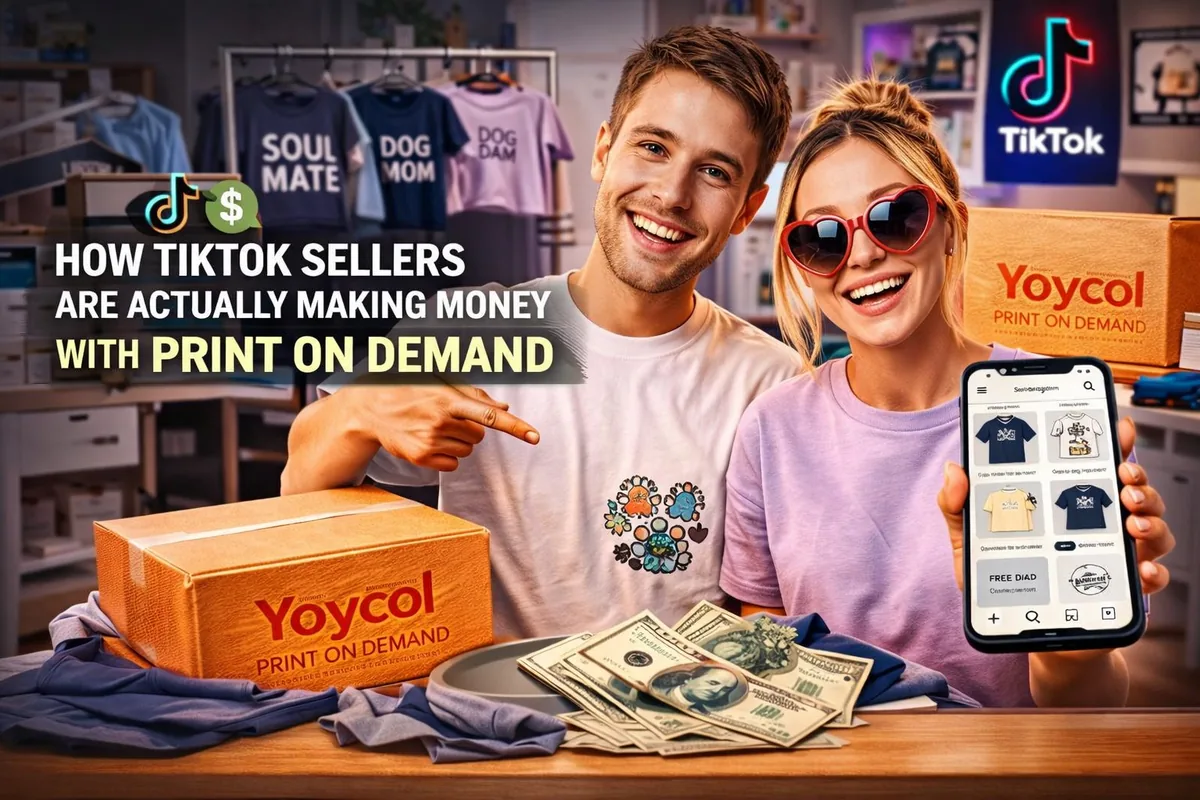
That’s where platforms like Yoycol come in for a lot of sellers. Being able to run small tests, sync orders automatically, and rely on stable logistics makes it easier to focus on what actually drives growth — content and positioning.
And that’s really the shift.
Where the opportunity is right now
Print-on-demand hasn’t gone away. If anything, it’s become more relevant — just more competitive and more refined.
What’s changing is who wins.
It’s no longer the people uploading the most products or running the most ads.
It’s the people who:
understand a niche
create content that feels real
move quickly
and build something that actually connects
TikTok has made it possible to start faster than ever. But it also made it harder to hide behind generic products.
Final thought
If you’re thinking about starting (or restarting) in POD, this is probably the most important thing to keep in mind:
You don’t need a perfect store.
You don’t need a big budget.
But you do need:
something that feels real and a system that lets you move fast
Because right now, the biggest advantage isn’t design or ads.
It’s momentum.
👉 You can explore customizable products here: https://www.yoycol.com/