Customer Loyalty Lesson

Customer Loyalty Lesson

  No matter you are running an online store or opening a brick-and-mortar shop, the old marketing adage holds true. Drawing a new customer is much harder than retaining an existing one.

  According to marketing statistics, the probability of selling to an existing customer is between 60% and 70%, but selling to a new customer is only between 5% and 20%.

   In this article, we will go through the basics of customer loyalty, look at why it’s important, how to measure customer loyalty and learn some ways to build your customer loyalty.

What is customer loyalty?

  Customer loyalty is a customer’s willingness to return to a company to make a repeat purchase of products or services. The behavior is based on the happy experience they’ve had in the past. 

  However, customer loyalty isn't just one thing. It’s a result of multiple positive interactions that build up a feeling of trust over time. So, it’s an ongoing emotional relationship between customer and business, that requires constant care and nurture.

Why is customer loyalty important?

  Customer loyalty plays an important role in fueling your success and driving your business forward. There are two reasons.

  Firstly, it’s always more expensive to attract new customers than to connect with existing ones. You have to spend time and money finding them and figuring out what they will be interested in. But you already know your existing customers and have an ongoing conversation with them.

  Secondly, buyers who always return to you could bring higher and more consistent profits. Research shows that returning customers spend 67% more than new customers. And as the internet has dramatically changed the business landscape, the trust in companies has eroded - 65% customers do not trust advertisements. Today, 81% of customers trust recommendations from family and friends over those from companies. While you loyal customers, who gain happy experience from you, are more likely to recommend you to others. 

  What’s more, as you have a loyal customer base, it’s easier for you to use up-selling and cross-selling to increase your profits further. 

How to measure customer loyalty?

  Although loyalty is an emotion that seems a little tricky to measure, there still exist some metrics that you can use to gather data and make visible insights. The metrics include customer feedback, repeat rates, churn rates, etc.

  • Customer Feedback

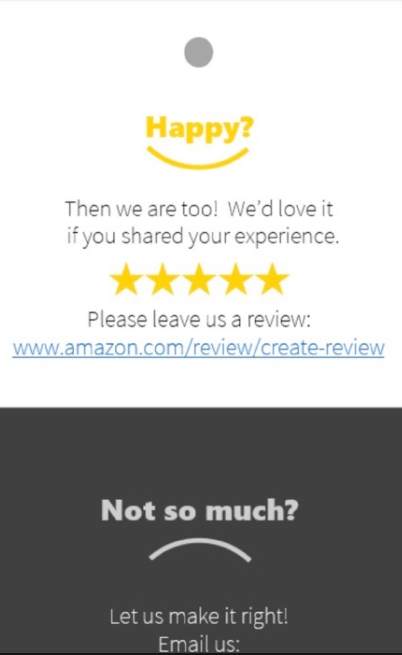
  When it comes to customer feedback, you could gather them in two ways. First, collect data from your existing customer reviews, which should go without saying. While another one is that you could set questionnaires on your website, whether it’s a popup or a button after a finished order. You could let customers rank your business from 1 to 5. 
   Amazon is a good example. You only need to select the number of stars and if you are not satisfied, you could contact the support team immediately. 

  • Repeat Rate

  Repeat rate is the percentage of customers that come back to buy your product or service. This can also be referred to as customer retention rate (CRR). The higher the percentage, the better it is.

 To measure CRR, simply take the number of customers you have at the start (S), at the end (E), and customers gained during the period you’re measuring (N). Here’s the Calculation formula.

CRR = ((E-N)/S) x 100

  If you have 500 customers in the beginning, and you lose 50 after one month, but gain 30 customers. So  you have 480 customers in the end, then,

CRR=((480-30)/500) x 100 =90%

  You could use rate and find out your loyal customers and study their shopping habits in different periods. Then you could know when to send promotions or reminders. In theory, they may make a purchase after push.

  • Churn Rate

  The percentage of your customers that cancel your product or service or do not renew their subscriptions  is your churn rate. Regardless of your monthly revenue, if your churn rate is high then you have a lot of customers canceling or stopping their payments which could allude to a much larger problem.

   When analyzing your churn rate, view it through the lens of customer satisfaction. Try to uncover why customers are leaving with a cancelation survey or request a one-on-one interview. You may have to provide an incentive to get more information from a canceling customer, but it may be worth it in some cases.

  As you have known the basics of customer loyalty, how could you build your customer loyalty?

1. Communicate your values

  Apart from quality and service that could also be provided by others, one important reason that your customers come back is your business value, which creates unique experience and builds customer trust in you.

Write an About us page

  An About us page gives online shoppers insight into your business and the people behind it. This can include how your business starts, what’s your brand value, how your business develops, etc.

  About us page is like a story of your brand. People like stories. It makes people have more real feelings about you as if they are communicating with shop owners in real life, then trust arises. Besides, if they agree with your business ideals, they are more likely to stick with you.

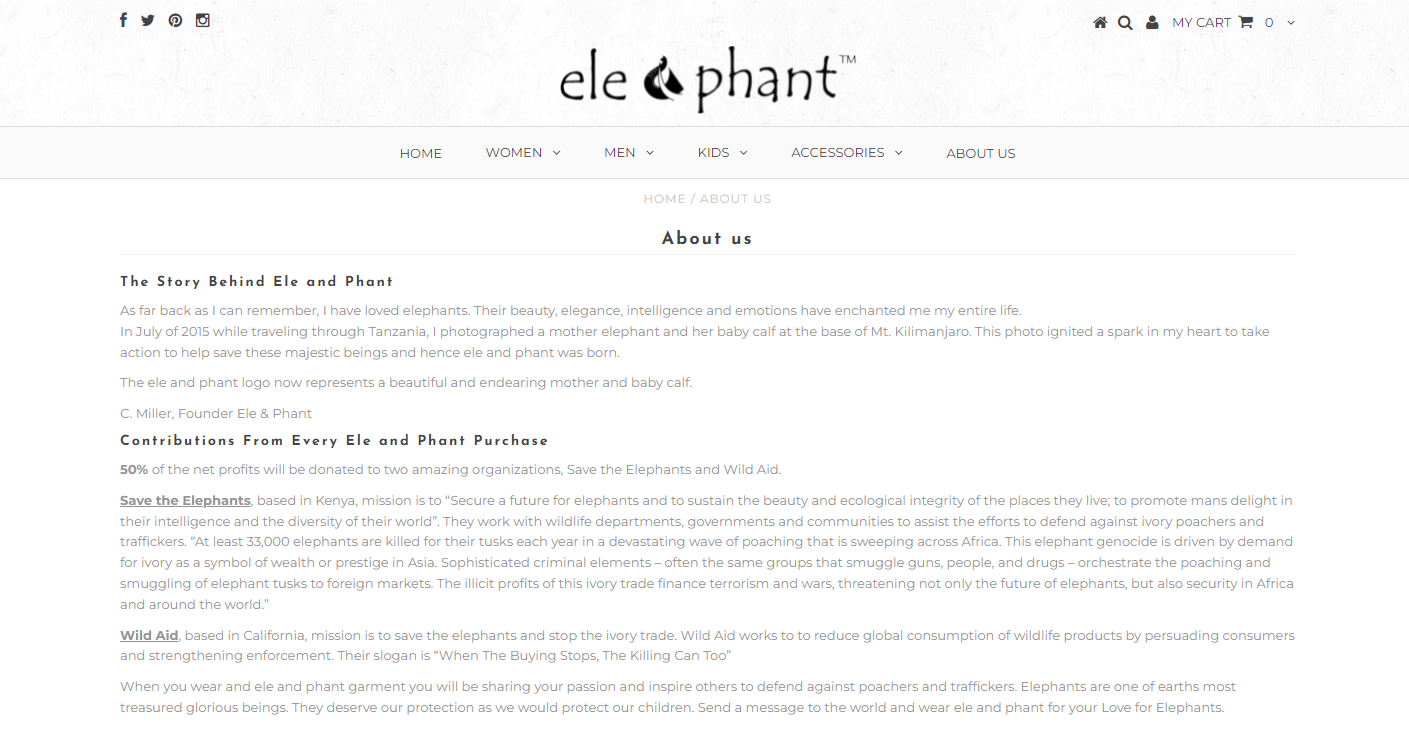
   For instance, Ele and Phant is built by Sarah Salbu who witnessed how ivory and poaching trade is putting elephants in serious danger in a travel through Tanzania. The brand’s goal is to protect elephants. So their About us page shows that their net profits would be donated to two organizations to help elephants. 

Send personalized emails

  Traditional emails that could be sent to everyone lose attracts to customers. They do not feel being treated and thus do not want to click the ‘Buy Now’ button. There are some tips for you.

  A classic one is adding customer name in the beginning. It makes email feel more personal and can increase transaction rate by 6 times. Sending customers greetings on birthday or the day they become members is also helpful. 

  Another way to make emails more personal is sharing your brand story. Don’t rush to sell. Let customers know you first. No one would be reassured and impetuous to pay money to an absolute stranger. It helps to bring your communication with customers to a deeper level.

 Have a social presence

  Social media is quickly becoming the go-to method for customers to communicate directly with a brand through direct messaging or even calling them out with an @ mention. Therefore, social media become important platforms to deliver brand value, apart from official website.

  You can share your brand in many ways, like videos of how products are made, interviews of your team, showcases of your factory, etc. Being open about your business practices is s a great way to encourage a positive customer-brand relationship. And one more thing you need to pay attention to is response efficiency. When people are interested in your topic and leave inquiries, reply as soon as you can. A quick response shows to the public that you are an accessible brand and value each customer. 

2. Gain trust and credibility

  There are several ways to gain customer trust. Let’s focus on the two basics in business - product itself and customer service.

  Deliver expected product quality

  Among all the tricks, the essential lies in product itself. No customer will make repeat purchase if your product is different from what they get.

  To avoid this, make sure your product photos are as close to reality as possible and accurately describe your product to set your customer expectations. Include the following:

  • Display product on models and its flat effect
  • Add value (e.g why your product is great)
  • All the relevant information (the price, color range, size, availability, shipping, etc.

  If you integrate your store with POD suppliers like Yoycol, you could rewrite the product detail page to match your needs. And to be confident with the quality, you’d better make a sample order for yourself before selling. Then you could know some subtle differences and adjust accordingly.

  Have clear store policies

  When choosing brand, you must be curious about fulfillment, shipping, return, etc. Store policies create a sense of security for customers when they’re buying something from you, especially since they can’t try on the product beforehand. And among all policies, return policy is the most important. People will avoid stores without it. Having clear description of return condition and compensation helps you build customer trust.

  Provide reliable support

  In the future, the core of business competition tends to be the service competition. Good experience could turn your one-time consumer into a repeat consumer. Here are some aspects that need attention.

  • Clear and comprehensive help center
  • Respond quickly
  • Be helpful and friendly
  • Reply to all reviews - especially the bad ones

3. Reward Loyalty

  Reward loyalty can appear in various forms. Personalized coupons, affiliate members, birthday deals...you get the idea.

  Here are some things you could do to increase customer loyalty.

  Set up a customer loyalty program

  A customer loyalty program is an extra perk you can give to your most frequent customers. By giving some kind of reward, you make them feel good about purchasing and motivate them to stick around you. 

  The extra perk could be free shipping, coupon, birthday deal, free sample, etc. Or you could refer to what a coffee shop does, whereby customers buy a certain number of drinks to earn a free one, consider giving them a head start. You could give customers the first two punches on the digital card for free. It’s incentive for them to finish it.

  Except offering rewards when purchasing, loyalty program ideas include referring new customers, following social media, or subscribing to your blog.

  Make sure your program is easy to anticipate. The more complex it is, the less interest your customers will have.

  Personalize your orders

  Even some small, delicate things could impress your consumers. It can be something that adds value to the product, like adding anti-friction patches for high heel shoes. Or it can be something that adds value to your brand, like a thank you note and brand logo stickers. People like giveaways. The special experience when customers open a brightly colored box with unexpected free samples will become an amazing moment in your customer service.

4. Gather feedback

  With advertisements lingering around us every day, people gradually reduce trust in ads and by contrast tend to trust recommendations from consumers, friends and families.

  Ask for reviews

  Encouraging your customers to leave feedback shows your resolution to serve better. 

 There are many ways to ask for reviews, but it’s most effective when done immediately following an interaction with a customer. Make any feedback request quick and simple to complete so that they’ll be more likely to share their thoughts. 

  Encourage user-generated content

  User-generated content is any type of content created by your customers. From social media posts to testimonials and comments, UGC provides extra social proof reassuring potential customers that it’s a good idea to buy from you. 

  You can ask customers to share pictures or videos of your products on social media and invite them to tag you or add hashtags as well, by giving coupons, samples, etc.

Conclusion

   We hope this lesson could let you have a deeper understanding of customer loyalty and how to conduct it. If you are able to connect with people on a deeper level, you exceed most business owners. And now POD business will give you a full place to show yourself.

  If  you are interested in our business blog, you can also join our groups,  where shares sales guides, first-hand news on Yoycol, other POD business owners thoughts and...