All-over-print or DTG? If you're starting a print-on-demand store — or expanding an existing one — this is one of the first decisions you'll face. Both methods can produce great products, but they serve completely different purposes.
Pick the wrong one, and you'll end up with products that don't match your niche, higher costs than expected, or customers disappointed by print quality. Pick the right one, and you'll have products that sell themselves.
In this guide, we'll break down exactly how all-over-print and DTG differ — across design freedom, fabric compatibility, cost, durability, and profit potential — so you can choose the method that fits your store.
If you're new to AOP itself, our complete guide to all-over-print covers everything from how the process works to which products sell best.
The Short Answer
Before we dive into the details, here's the quick version:
-
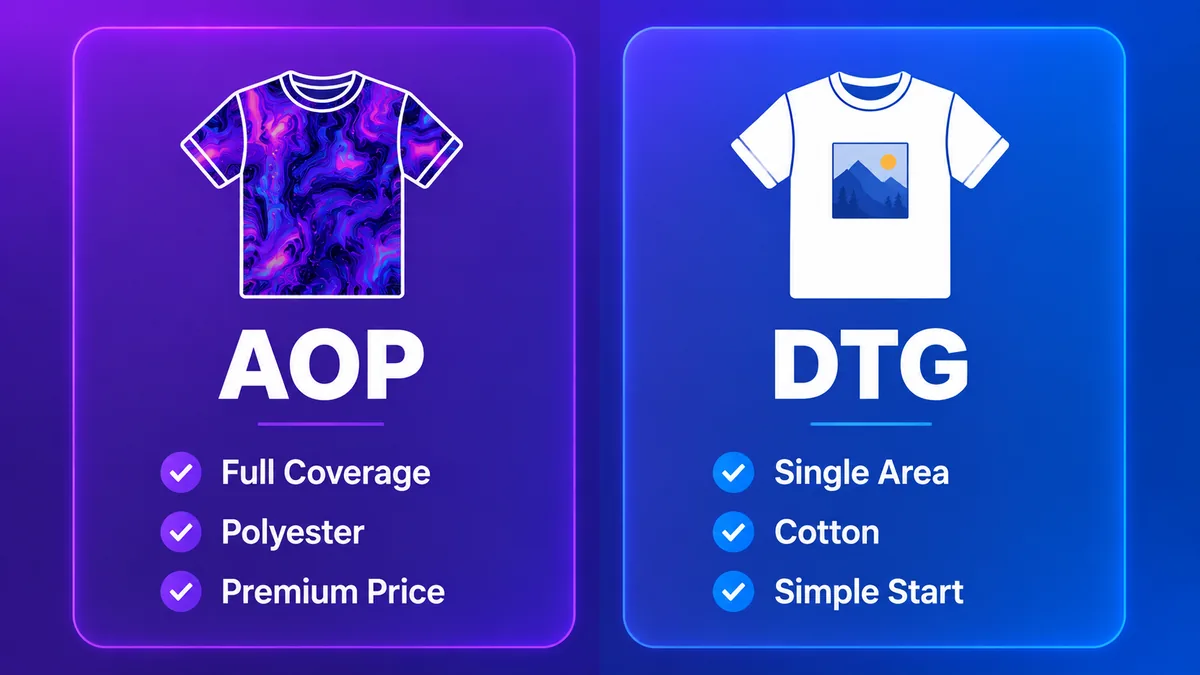
All-over-print (AOP) covers an entire garment — front, back, sleeves, seams — with one continuous design. It uses polyester fabric and dye-sublimation. It's best for bold, full-coverage patterns that command premium prices.
-
DTG (direct-to-garment) prints a design onto one area of a finished garment, usually the chest or back. It uses cotton fabric and inkjet-style printing. It's best for detailed, single-placement graphics on everyday basics.
They're not really competitors — they're different tools for different jobs. But knowing when to reach for each one is what separates profitable POD stores from the rest.
What Is All-Over-Print (AOP)?
All-over-print means exactly what it sounds like: the design covers all over the product, edge to edge, with no blank areas.
The process works differently from most printing methods you've probably seen. Instead of printing onto a finished shirt, AOP prints your design onto large rolls of polyester fabric using dye-sublimation — heat turns the ink into gas, which bonds permanently into the fabric fibers. The printed fabric is then cut into pattern pieces and sewn together into the finished product. This is called the cut-and-sew process.
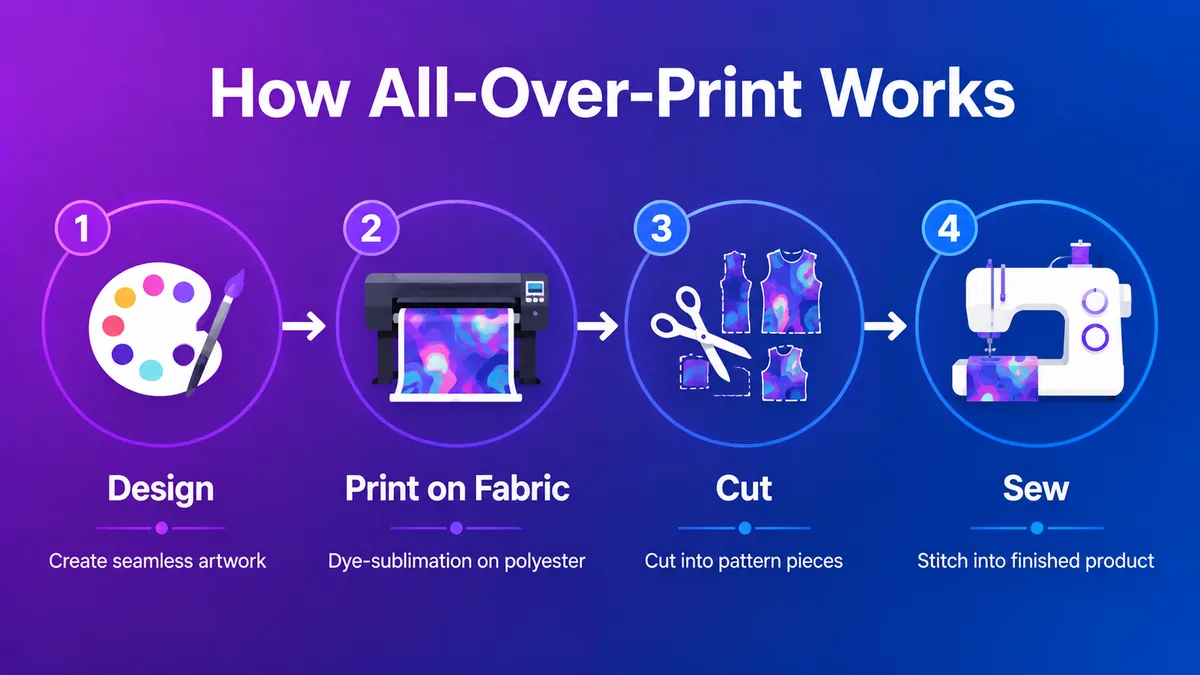
The result? A garment where the pattern wraps around the shoulders, flows down the sleeves, covers the hood, and continues across every seam. No blank spots, no edges where the design "stops."
If you want to understand every detail of how AOP works — including the science behind dye-sublimation — our beginner's guide to all-over-print walks through the full process step by step.
Because AOP relies on cut-and-sew production, it's almost exclusively paired with print-on-demand fulfillment. Products are made one at a time, only after a customer orders — no inventory required.
What Is DTG (Direct-to-Garment)?
DTG works like a giant inkjet printer for clothes. A finished, pre-made garment — usually a cotton T-shirt or hoodie — is loaded onto a flat platen, and the printer sprays water-based ink directly onto the fabric surface.
The key advantage: DTG can reproduce incredibly detailed, photo-quality images with unlimited colors, gradients, and fine lines. If you've ever seen a T-shirt with a realistic portrait or a complex illustration printed on the chest, it was probably DTG.
DTG works best on 100% cotton or high-cotton blends. The water-based inks bond well with natural fibers but struggle on polyester and synthetics. On dark garments, a white ink underbase is applied first so colors show up vividly — which adds cost and time per unit.
Unlike AOP, DTG prints onto a finished garment. There's no cutting, no sewing, no assembly. You take a blank tee off the shelf and print on it. This makes it fast, simple, and accessible.
AOP vs DTG: Full Comparison
Now let's put them side by side across every factor that matters for your store.
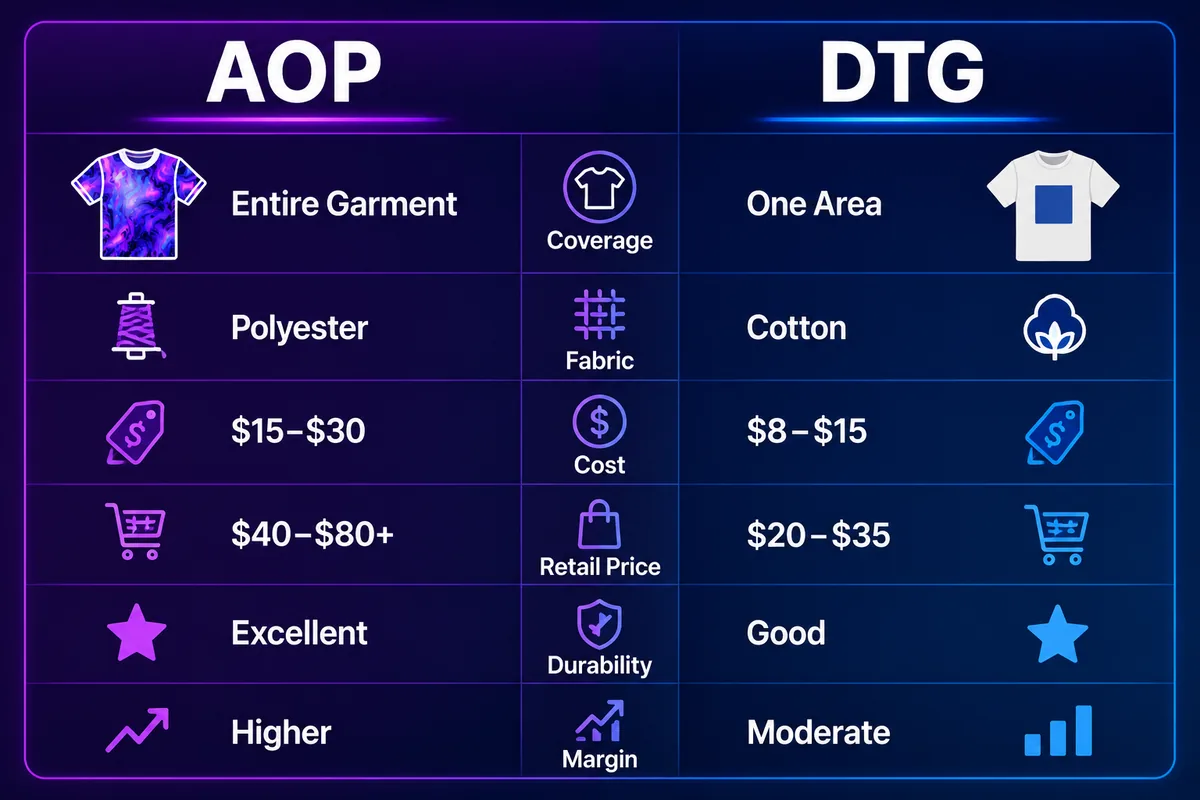
|
Factor |
All-Over-Print (AOP) |
DTG (Direct-to-Garment) |
|---|---|---|
|
Print coverage |
Entire garment, edge to edge |
One flat area (chest, back, etc.) |
|
How it works |
Print on fabric → cut → sew (cut-and-sew) |
Print directly onto finished garment |
|
Best fabric |
Polyester |
Cotton |
|
Design complexity |
Unlimited colors, full coverage |
Unlimited colors, single area |
|
Cost per unit |
Higher ($15–$30+ base) |
Lower ($8–$15 base) |
|
Retail price potential |
Higher ($40–$80+ for hoodies) |
Moderate ($20–$35 for tees) |
|
Profit margin |
Higher per product |
Moderate per product |
|
Minimum order |
None (great for POD) |
None (great for POD) |
|
Durability |
Excellent — dye bonds into fibers |
Good — print sits on surface |
|
Design difficulty |
Higher — need seamless, full-coverage art |
Lower — one rectangular design |
|
Best products |
Hoodies, leggings, activewear, backpacks |
T-shirts, tote bags, cotton basics |
Let's break down the most important differences.
Design Freedom
AOP wins on impact. DTG wins on simplicity.
With AOP, your canvas is the entire product. You can wrap a galaxy around a hoodie, cover leggings in a floral pattern, or put an abstract design across every inch of a backpack. The result looks like a designer product, not a printed tee.
With DTG, your canvas is one flat rectangle on a pre-made garment. This is perfect for a bold graphic, a detailed illustration, or a photo — but the rest of the garment stays blank.
Think of it this way: AOP is a full-body tattoo for your product. DTG is a carefully placed piece of art on a clean canvas.
Fabric Compatibility
This is where the two methods barely overlap:
-
AOP needs polyester. Dye-sublimation only bonds with synthetic fibers. The result is vibrant, permanent color that won't crack, peel, or fade — but it means your products will be polyester-based.
-
DTG needs cotton. Water-based inks bond with natural fibers. The soft hand-feel of a cotton tee is something many customers specifically look for.
This means your choice often comes down to what your customers want to wear. Selling activewear, swimwear, or performance gear? AOP is your method. Selling everyday casual tees? DTG fits better.
Cost and Profit Margins
AOP has a higher base cost per product — the cut-and-sew process is more involved than a simple direct print. But AOP products also sell at significantly higher price points.
Here's a typical scenario:
-
A DTG-printed cotton tee might cost you $10 to produce and sell for $25. Margin: $15.
-
An AOP hoodie might cost you $22 to produce and sell for $55. Margin: $33.
AOP products feel premium, and customers expect to pay more for them. If you want a deeper understanding of how to set the right price — and keep your margins healthy — this complete guide to pricing POD products covers the full framework.
For sellers focused on profitability, AOP almost always wins the per-product margin battle.
Print Quality and Durability
AOP's dye-sublimation process bonds ink into the fabric fibers. The result is a print that becomes part of the fabric itself — you can't feel it on the surface, and it won't crack, peel, or fade, even after dozens of washes.
DTG prints sit on top of the fabric. Modern DTG machines produce excellent results, and the prints feel soft on light garments. On dark garments (which need a white underbase), the print can feel slightly thicker. Over many washes, DTG prints can show gradual fading — though proper curing minimizes this significantly.
Verdict: AOP wins on long-term durability. DTG wins on detail reproduction for single-area designs.
Design Difficulty
This is where DTG has a clear advantage for beginners.
With DTG, you create one rectangular design — the same skill as making a poster or a social media graphic. If you can use Canva or Photoshop, you can make a DTG-ready design.
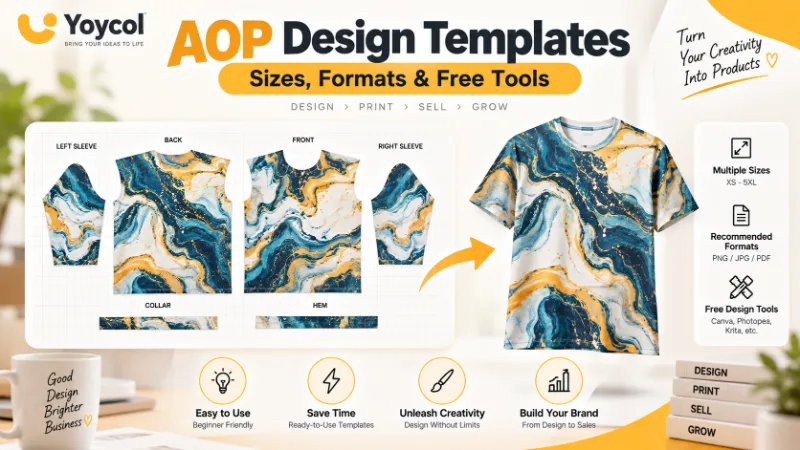
With AOP, you need to create seamless, full-coverage artwork that maps correctly across an entire garment template — front panel, back panel, sleeves, and seams all need to align. It's more complex, and getting it right requires understanding the product template.
Tools like Yoycol's free 3D mockup generator help here — you can preview exactly how your pattern wraps around the product before you commit to selling it.
When to Choose AOP
AOP is the better choice when:
-
Your niche demands bold, full-coverage patterns — galaxy prints, florals, abstract art, streetwear graphics.
-
You're selling products where full coverage is the selling point: hoodies, leggings, swim trunks, backpacks, socks, activewear.
-
You want higher per-product margins and less competition — most POD sellers stick to basic DTG tees.
-
Your customers value premium, statement products over basic everyday wear.
-
You're building a brand around a visual style or aesthetic that needs edge-to-edge design.
Certain niches are especially strong fits for AOP. Pet-themed products, for example, perform incredibly well with full-coverage patterns — if you're exploring that market, this guide to the pet niche in POD covers why it's the #1 niche right now.
When to Choose DTG
DTG is the better choice when:
-
Your designs are detailed, single-area graphics — illustrations, text-based designs, photos, logos.
-
You're selling cotton basics — T-shirts, tank tops, lightweight hoodies.
-
Your audience specifically wants soft, comfortable cotton garments.
-
You're just starting out and want the simplest possible workflow.
-
Your niche works with a "design on a shirt" format — think funny quotes, minimalist graphics, or niche-specific illustrations.
Can You Use Both?
Here's something successful POD sellers often do: they use both methods to build a diverse catalog.
Imagine a pet-themed store:
-
DTG cotton tees with cute pet illustrations on the chest → affordable everyday wear, $25 price point.
-
AOP hoodies with a full-coverage paw-print pattern → premium statement pieces, $55 price point.
-
AOP leggings covered in a pet breed pattern → activewear that stands out, $40 price point.
This approach lets you serve multiple customer needs and price points from a single brand. If you're planning to sell AOP products on Shopify specifically, this complete AOP-on-Shopify guide walks through the full setup.
You don't have to choose one or the other. You just have to know which tool fits each product.
How to Start Selling AOP Products (Without Equipment or Inventory)
If AOP sounds like the right fit for your store, the good news is you don't need a $50,000 sublimation printer or a warehouse full of fabric. Print-on-demand platforms handle everything — printing, cutting, sewing, and shipping — so you can focus on creating designs and building your brand.
Yoycol is built for all-over-print. Here's what you get:
-
1,600+ AOP products — hoodies, tees, leggings, bags, swimwear, and more
-
Free 3D design tools to preview your full-coverage patterns on real product mockups
-
No minimum orders — sell one product at a time
-
Global dropshipping — we print and ship directly to your customers
Ready to create your first all-over-print product? Start for free with Yoycol →
Frequently Asked Questions
What's the main difference between all-over-print and DTG?
The main difference is coverage. All-over-print covers the entire garment — front, back, sleeves, and seams — with one continuous design using dye-sublimation on polyester fabric. DTG prints a design onto one area of a finished garment, usually cotton, using inkjet-style printing.
Is all-over-print more expensive than DTG?
AOP has a higher cost per unit because of the cut-and-sew production process. However, AOP products typically sell at much higher retail prices, which often results in better profit margins per product compared to DTG.
Can DTG print on polyester?
DTG works best on cotton and struggles with polyester or high-polyester blends. If you need to print on polyester — which is required for all-over-print — dye-sublimation (the method behind AOP) is the right choice.
Which printing method is more durable?
AOP is more durable. The dye-sublimation process bonds ink directly into the fabric fibers, so the print won't crack, peel, or fade over time. DTG prints sit on the fabric surface and may show gradual fading after many washes, though modern DTG technology has improved durability significantly.
Can I use both AOP and DTG in my store?
Absolutely. Many successful POD sellers use DTG for cotton basics (tees with simple graphics) and AOP for premium products (hoodies, leggings, and backpacks with full-coverage patterns). This lets you serve different customer needs and price points from one store.
Is AOP or DTG better for print-on-demand?
Both work well for print-on-demand since neither requires minimum orders. AOP tends to generate higher per-product margins and faces less competition, making it a strong choice for sellers who want to stand out. DTG is simpler to start with and better suited for cotton basics.
Want to explore more? Read our complete All-Over-Print guide for everything on designing, choosing products, and scaling your AOP store.