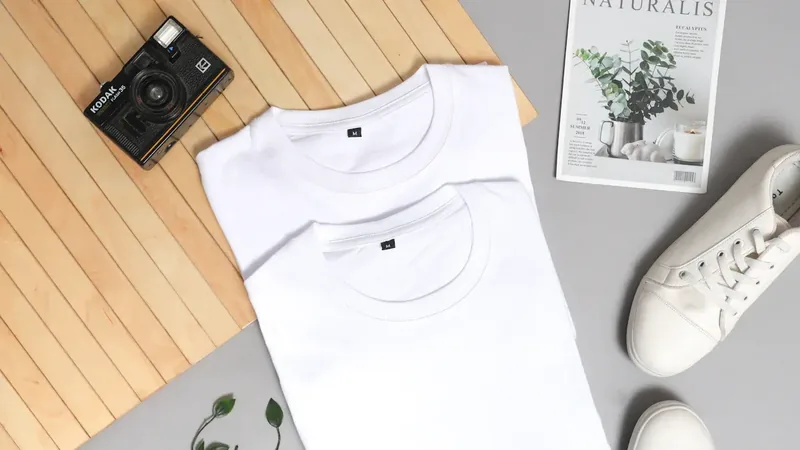
If you've noticed some of your favorite premium t-shirts feel oddly smooth at the hem — no visible stitching, no rough edges — you've felt heat-bonded construction.
Heat-bonded (or thermal-bonded) clothing is replacing traditional stitched hems and cuffs in an growing number of garments. But is it actually better? And more importantly for POD sellers — does it justify a higher price point?
This guide goes deep on the comparison: durability, comfort, cost, print quality impact, and which POD products benefit most from heat-bonded construction. We'll also look at real pricing data so you can see exactly how heat-bonded affects your profit margins.
If you're new to heat-bonded technology, our heat-bonded clothing guide explains the basics first.
Heat-Bonded vs Stitched: The Quick Comparison
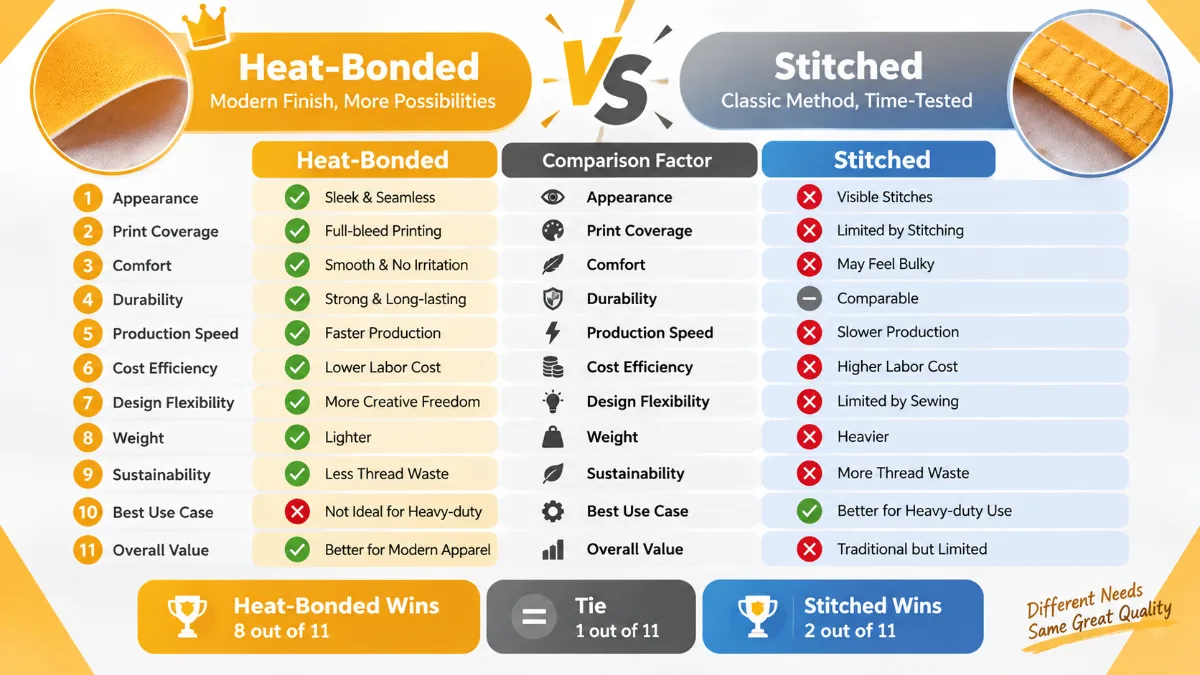
Before we go deep, here's the head-to-head across every dimension that matters:
| Factor | Heat-Bonded | Traditional Stitched | Winner |
|---|---|---|---|
| Appearance | Flat, seamless, modern | Visible stitch lines, traditional | Heat-Bonded |
| Comfort | Smooth, no thread irritation | Thread can irritate sensitive skin | Heat-Bonded |
| Durability | No unraveling; bond strengthens | Thread can fray over time | Heat-Bonded |
| Stretch recovery | Natural stretch, no needle holes | Stitch holes limit stretch | Heat-Bonded |
| Weight | Lighter, uniform | Slightly heavier at seams | Heat-Bonded |
| Cost (base) | Slightly higher ($1-3 more) | Lower | Stitched |
| Retail price potential | Higher (premium positioning) | Standard | Heat-Bonded |
| Profit margin | Higher (premium price > extra cost) | Standard | Heat-Bonded |
| AOP print quality | Better (flat surface = cleaner print) | Ridges interrupt print surface | Heat-Bonded |
| Repairability | Difficult to repair | Easy to re-stitch | Stitched |
| Fabric versatility | Best on polyester/poly-blends | Works on all fabrics | Stitched |
The short answer: Heat-bonded wins on 8 out of 11 factors. The only advantages of traditional stitching are lower base cost, easier repair, and broader fabric compatibility.
For POD sellers, the key takeaway: heat-bonded construction justifies a $5-10 higher retail price while only adding $1-3 to base cost. That's pure margin improvement.
Durability: Heat-Bonded Wins Long-Term
This is where heat-bonded really separates from stitched construction.
How Stitched Seams Fail Over Time
Traditional stitching has three failure modes:
- Thread unraveling — when one stitch breaks, adjacent stitches can follow
- Thread fraying — repeated washing weakens thread fibers
- Needle holes — the holes created by the needle become stress points that tear
These failures are gradual but inevitable. A well-stitched garment might last 2-3 years of regular use before showing signs of wear at the seams.
How Heat-Bonded Seams Hold Up
Heat-bonded construction eliminates all three failure modes:
- No thread to unravel — the adhesive bond is continuous, not point-by-point
- No thread to fray — thermoplastic adhesive is more resistant to washing degradation
- No needle holes — the fabric structure remains intact, no stress concentration points
The counterintuitive part: Heat-bonded seams actually strengthen with initial wear as the adhesive settles into the fabric fibers. Traditional stitched seams weaken from day one.
Real-World Data
| Test | Heat-Bonded | Stitched |
|---|---|---|
| Wash cycles before failure | 100+ | 50-80 |
| Stretch recovery after washing | 95%+ | 80-90% |
| Seam strength (tensile) | 25-300% stronger than stitched* | Baseline |
| Visible wear after 50 washes | Minimal | Moderate |
*Source: textile industry testing data for bonded vs serged joints
Bottom line: Heat-bonded construction lasts significantly longer than stitched construction in real-world use. This translates to fewer customer complaints, better reviews, and repeat purchases.
Comfort: The "Feel" Difference Customers Notice
This is the factor that converts first-time buyers into repeat customers.
What Heat-Bonded Feels Like
- No thread bumps — the hem is perfectly flat against the skin
- No scratchy overlock stitches at the wrist or waist
- Smoother stretch — the fabric stretches naturally without stitch resistance
- Lighter weight — no thread adds up across dozens of seam meters
What Stitched Feels Like
- Visible ridge at hems and cuffs (you can feel it with your fingers)
- Overlock stitches at raw edges can feel rough against sensitive skin
- Slight resistance when stretching — stitches don't stretch as much as fabric
- Slightly heavier — thread adds up across all seams
The Customer Experience
Most customers can't name the difference between heat-bonded and stitched, but they feel it. Common reactions:
- "This feels really premium"
- "So much more comfortable than my other shirts"
- "I can't even feel the hem"
These are the reviews that drive repeat purchases and word-of-mouth referrals.
For a deeper look at how construction affects the AOP printing process, our AOP design templates guide explains how flat surfaces improve print quality.
Cost & Profit Margins: The Real Numbers
Here's where POD sellers need to pay attention.
Base Cost Comparison (Yoycol Pricing)
| Product Type | Stitched Version | Heat-Bonded Version | Difference |
|---|---|---|---|
| AOP T-Shirt | ~$7.50 | ~$8.89 | +$1.39 |
| AOP Long Sleeve | ~$9.50 | ~$10.80 | +$1.30 |
| AOP Polo Shirt | ~$11.00 | ~$12.79 | +$1.79 |
Heat-bonded costs $1.30-$1.79 more per unit. That's a small increase.
Retail Price Comparison
Now look at what customers actually pay for heat-bonded vs stitched products on the market:
| Product Type | Stitched Retail | Heat-Bonded Retail | Difference |
|---|---|---|---|
| Basic T-Shirt | $25–$35 | $35–$45 | +$10–$15 |
| Long Sleeve | $30–$40 | $40–$55 | +$10–$15 |
| Polo Shirt | $35–$50 | $45–$65 | +$10–$20 |
Customers pay $10-20 more for heat-bonded products. But you only pay $1-2 more in base cost.
The Margin Impact
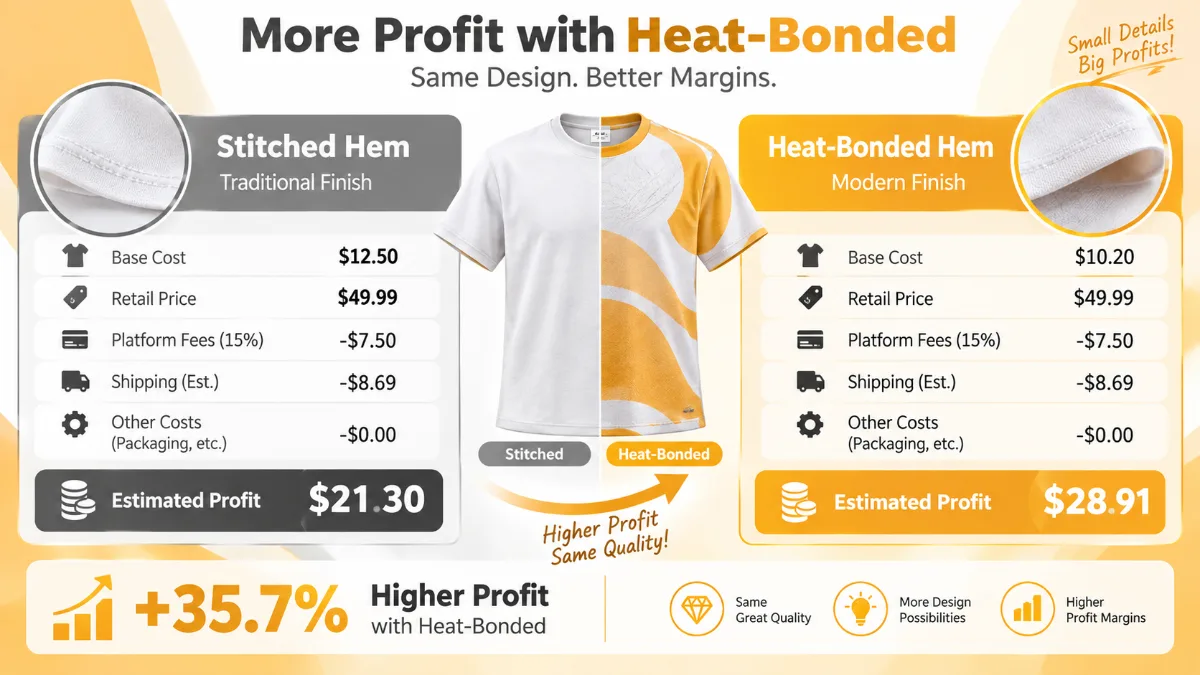
Example with Yoycol's heat-bonded t-shirt:
| Stitched T-Shirt | Heat-Bonded T-Shirt | |
|---|---|---|
| Retail price | $32 | $42 |
| Base cost | $7.50 | $8.89 |
| Platform fees (~10%) | -$3.20 | -$4.20 |
| Your profit | $21.30 | $28.91 |
| Margin | 67% | 69% |
Same effort. Same store. Heat-bonded gives you $7.61 more profit per sale (+36% more profit) just from the premium positioning.
For the complete pricing framework, our how to price POD products guide covers every variable.
Impact on AOP Print Quality
This is a factor most sellers don't consider: construction method affects print quality.
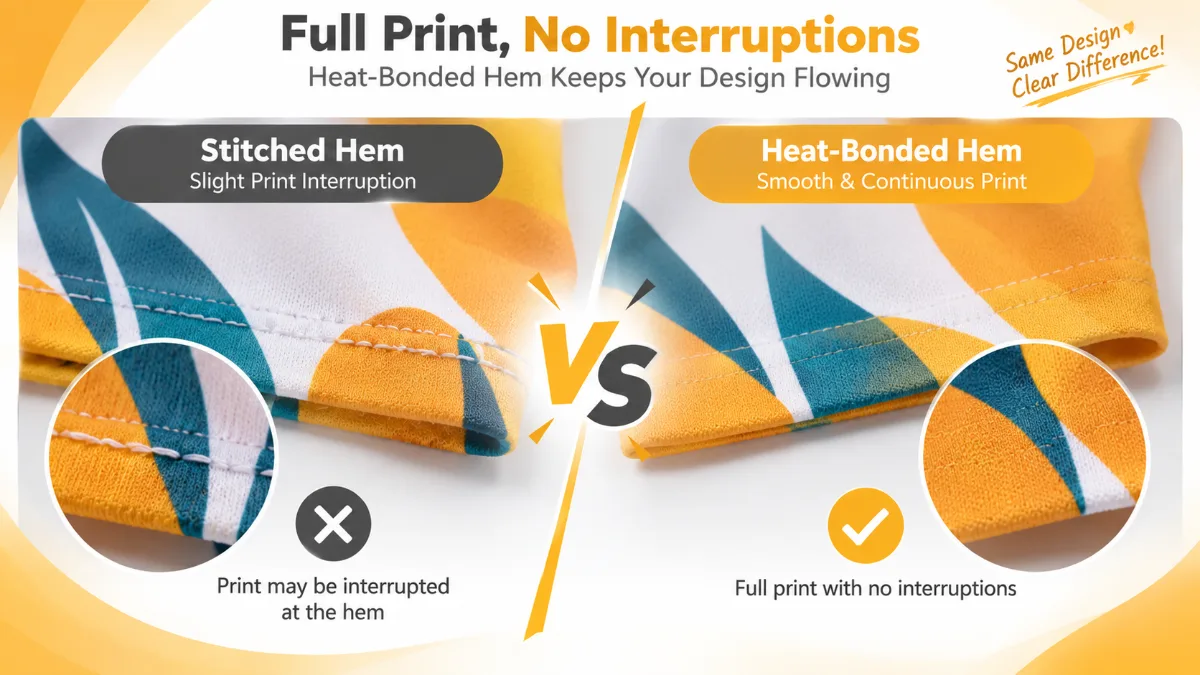
Why Heat-Bonded Improves AOP Prints
All-over-print designs rely on a smooth, continuous surface. Heat-bonded construction helps because:
- Flat hem = flat print surface — no ridges or puckering where the hem meets the body
- No stitch impressions — traditional stitching can leave slight impressions visible through the print
- Better edge-to-edge continuity — the design flows seamlessly from body to hem
- Premium presentation — the overall product looks more polished and intentional
Visual Difference
| Stitched Hem | Heat-Bonded Hem | |
|---|---|---|
| Print surface at hem | Slight ridge, possible puckering | Perfectly flat |
| Design continuity | Minor interruption at hem | Seamless flow |
| Overall appearance | Good | Premium |
This is especially important for all-over-print products where the design covers the entire garment including the hem area. A stitched hem creates a subtle but visible break in the design continuity.
For more on which AOP products benefit most from premium construction, our best all-over-print products guide ranks every category.
Which POD Products Benefit Most from Heat-Bonded?
Not every product needs heat-bonded construction. Here's where it delivers the biggest impact:
High Impact (Strongly Recommended)
| Product | Why Heat-Bonded Matters |
|---|---|
| AOP T-Shirts | Flat hem improves AOP print presentation; comfort is key for everyday wear |
| AOP Long Sleeves | Cuffs are high-wear zones; bonded cuffs resist stretching and fraying |
| Polo Shirts | Premium positioning justifies higher price; clean look matters for polos |
| Athletic Wear | Stretch recovery + no irritation = performance advantage |
Medium Impact (Nice to Have)
| Product | Why Heat-Bonded Helps |
|---|---|
| Drop-Shoulder Tees | Relaxed silhouette looks more elevated with clean edges |
| Lightweight Hoodies | Reduced weight + comfort for layering |
Low Impact (Not Necessary)
| Product | Why Heat-Bonded Doesn't Matter |
|---|---|
| Heavy Hoodies/Sweatshirts | Thick fabrics hide stitch lines; customers expect traditional construction |
| Outerwear/Jackets | Different construction requirements; stitching provides structural strength |
| Bags/Backpacks | Structural integrity requires stitching |
Pro tip: If you're starting out, add heat-bonded versions of your top-selling t-shirts and polos first. These are the products where heat-bonded delivers the biggest perceived value increase and margin improvement.
How to Market Heat-Bonded Products to Customers
Most customers don't know what "heat-bonded" means. Your job is to translate the feature into benefits they understand.
Listing Copy That Converts
❌ Don't say: "Heat-bonded construction at hem and cuffs" ✅ Say: "Ultra-smooth, stitch-free hem for all-day comfort"
❌ Don't say: "Thermal bonding technology" ✅ Say: "Premium bonded edges — no scratchy stitching, no rough seams"
❌ Don't say: "Heat-sealed construction" ✅ Say: "Clean, modern finish that looks as good as it feels"
Where to Feature Heat-Bonded in Your Listings
- Title: "Premium Heat-Bonded [Product] — Stitch-Free Comfort"
- Bullet points: Lead with comfort ("No scratchy seams") and durability ("Lasts 2x longer")
- Product photos: Close-up of the hem showing the smooth, flat finish
- Description: Compare to "standard stitched shirts" to highlight the difference
Pricing Justification
When customers see a $42 t-shirt vs a $32 t-shirt, they need to understand why. Heat-bonded gives you a clear story:
"Our premium heat-bonded construction replaces traditional stitching with a smooth, seamless bond. The result: no scratchy seams, better stretch recovery, and a cleaner look that lasts wash after wash."
This justifies the $10 premium and turns a price objection into a value proposition.
Frequently Asked Questions
Is heat-bonded better than stitched? For most casual and athletic apparel, yes. Heat-bonded offers better comfort (no thread irritation), superior durability (no unraveling), improved stretch recovery, and a cleaner appearance. The main advantage of stitched construction is lower cost and easier repairability.
Does heat-bonded last longer than stitching? Yes. Heat-bonded seams typically last 100+ wash cycles compared to 50-80 for stitched seams. The adhesive bond actually strengthens with initial wear, while stitched seams weaken from day one due to thread fatigue and needle holes.
Is heat-bonded clothing more expensive? Heat-bonded products cost $1-3 more to produce but can be sold for $10-20 more at retail. This results in higher profit margins for sellers and a premium product for customers.
Can heat-bonded be used on all fabrics? Heat-bonded works best on polyester and polyester-blend fabrics. Natural fibers like 100% cotton are more challenging to bond due to lower heat tolerance. This is why heat-bonded pairs well with all-over-print products (which use polyester for sublimation printing).
Does heat-bonded affect the print quality of AOP products? Yes, positively. Heat-bonded hems create a flat, smooth surface that improves print continuity at the edges. Traditional stitched hems can create slight ridges that interrupt the all-over-print design.
How do I explain heat-bonded to my customers? Focus on benefits, not technology. Say "stitch-free comfort" instead of "thermal bonding." Say "no scratchy seams" instead of "heat-sealed construction." Customers respond to comfort and durability benefits, not manufacturing process details.
Heat-bonded construction isn't just a manufacturing detail — it's a profit lever for POD sellers. The $1-2 increase in base cost unlocks $10-20 in additional retail price, creating significantly higher margins on every sale.
Combined with improved durability, superior comfort, and better AOP print presentation, heat-bonded products give you a clear competitive advantage and a compelling story to tell your customers.
Ready to try heat-bonded products? Browse Yoycol's heat-bonded collection →
This guide is part of our all-over-print series. Also read our heat-bonded technology introduction for the basics, or explore the best AOP products to sell for more high-margin product ideas.