If you sell print-on-demand products, you've probably seen two printing methods mentioned everywhere: sublimation and DTG (Direct-to-Garment).
But what's the actual difference? Which one produces better quality? Which lasts longer? And most importantly for POD sellers — which one makes you more money?
This guide breaks down the two most common POD printing methods across every dimension that matters: print quality, durability, cost, product compatibility, and which method works best for all-over-print (AOP) products.
If you're new to all-over-print and want to understand the product category first, our what is all-over-print guide covers the basics. And if you're curious about how AOP compares to DTG as a coverage area, our AOP vs DTG guide explains that difference.
How Each Method Works
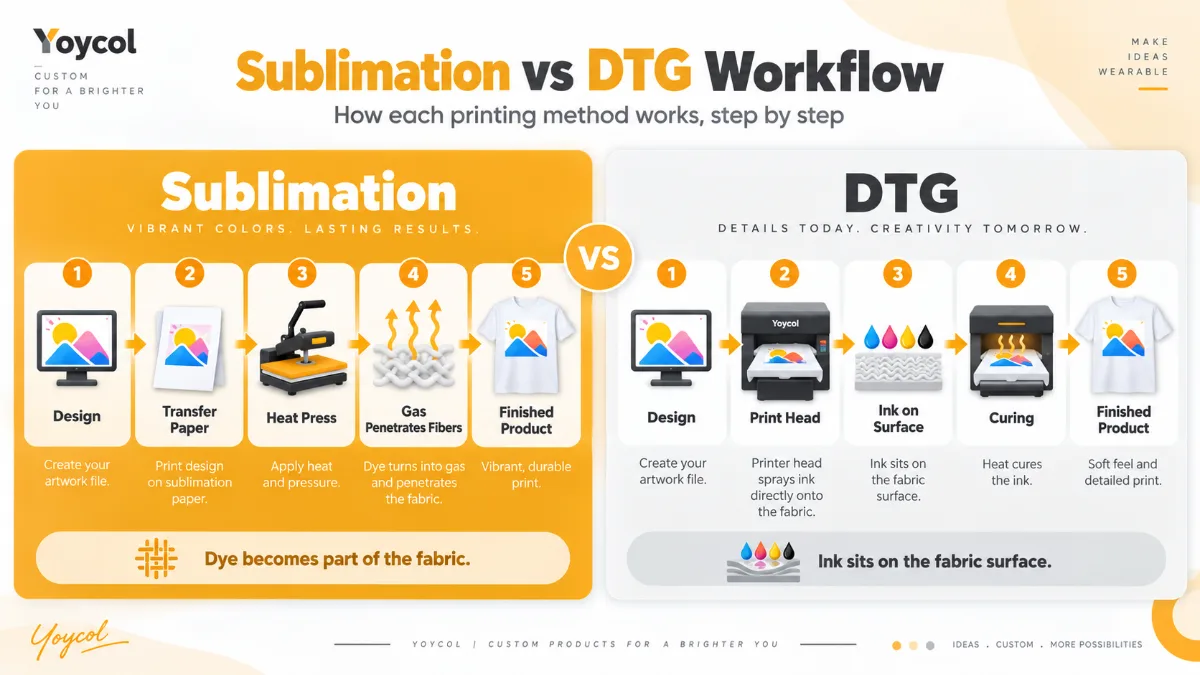
Before comparing results, let's understand what's physically happening in each process.
Sublimation Printing (Dye Sublimation)
- Your design is printed onto special transfer paper using sublimation ink
- The transfer paper is placed against the fabric
- A heat press applies high temperature (380-400°F) and pressure
- The sublimation ink turns from solid to gas (skipping the liquid phase — hence "sublimation")
- The gas penetrates the polyester fibers and bonds permanently
- Result: the ink becomes part of the fabric, not sitting on top of it
Key characteristic: The design is IN the fabric, not ON the fabric. You can't feel it with your fingers.
DTG Printing (Direct-to-Garment)
- Your design is sent directly from a computer to a specialized inkjet printer
- The printer sprays water-based ink directly onto the garment surface
- The ink sits ON TOP of the fabric fibers
- The garment goes through a curing process (heat tunnel or flash dryer) to set the ink
- Result: the design is a layer ON the fabric surface
Key characteristic: The design is ON the fabric, like a very high-quality sticker. You can feel a slight texture.
Head-to-Head Comparison
Here's how they stack up across every dimension that matters for POD sellers:
| Factor | Sublimation | DTG | Winner |
|---|---|---|---|
| Print quality | Vibrant, photorealistic, seamless | High quality, slight texture | Sublimation |
| Durability | Excellent — ink is IN the fabric | Good — can crack/fade over time | Sublimation |
| Feel | Zero hand-feel, soft | Slight texture on dark garments | Sublimation |
| Color range | Unlimited (full CMYK+) | Full CMYK, limited on darks | Tie |
| Dark garments | Cannot print on dark fabrics | Excellent on dark fabrics | DTG |
| Fabric compatibility | Polyester only (80%+ required) | Cotton, blends, various fabrics | DTG |
| All-over-print | ✅ The standard method | ❌ Not practical for full coverage | Sublimation |
| Small detail | Very good, slight blur possible | Excellent, razor-sharp text | DTG |
| Setup cost | Lower (~$1K equipment) | Higher (~$3K+ equipment) | Sublimation |
| Per-unit cost | Lower for AOP, higher for spot | Higher for AOP, lower for spot | Depends |
| Wash durability | 100+ washes without fading | 50-80 washes before noticeable fade | Sublimation |
| Environmental impact | Less water, no wastewater | Water-based ink, some wastewater | Sublimation |
The short version: Sublimation wins on quality, durability, feel, and AOP. DTG wins on fabric versatility and dark garment printing. For POD sellers focused on all-over-print products, sublimation is the clear choice.
Print Quality: Sublimation Wins
This is where sublimation really separates from DTG.
Why Sublimation Looks Better
- No texture — because the ink is IN the fabric, there's zero "hand feel." Run your fingers across a sublimation print and you can't tell where the design is.
- Seamless coverage — sublimation can print edge-to-edge with no visible borders, making it perfect for all-over-print.
- Photographic quality — sublimation handles gradients, shadows, and photo-realistic images better than DTG.
- Vibrant colors — sublimation inks produce more saturated, vivid colors because they bond directly with the polyester fibers.
Where DTG Falls Short
- Slight texture — you can feel DTG prints, especially on dark garments where a white underbase is needed.
- Not ideal for full coverage — DTG printers have a fixed print area (usually the front or back panel). True all-over-print isn't possible.
- Color limitations on darks — printing on dark garments requires a white underbase, which can slightly mute colors.
Bottom line: For visual quality and premium feel, sublimation is the superior method. This is why premium AOP products almost exclusively use sublimation.
Durability: Sublimation Lasts Significantly Longer
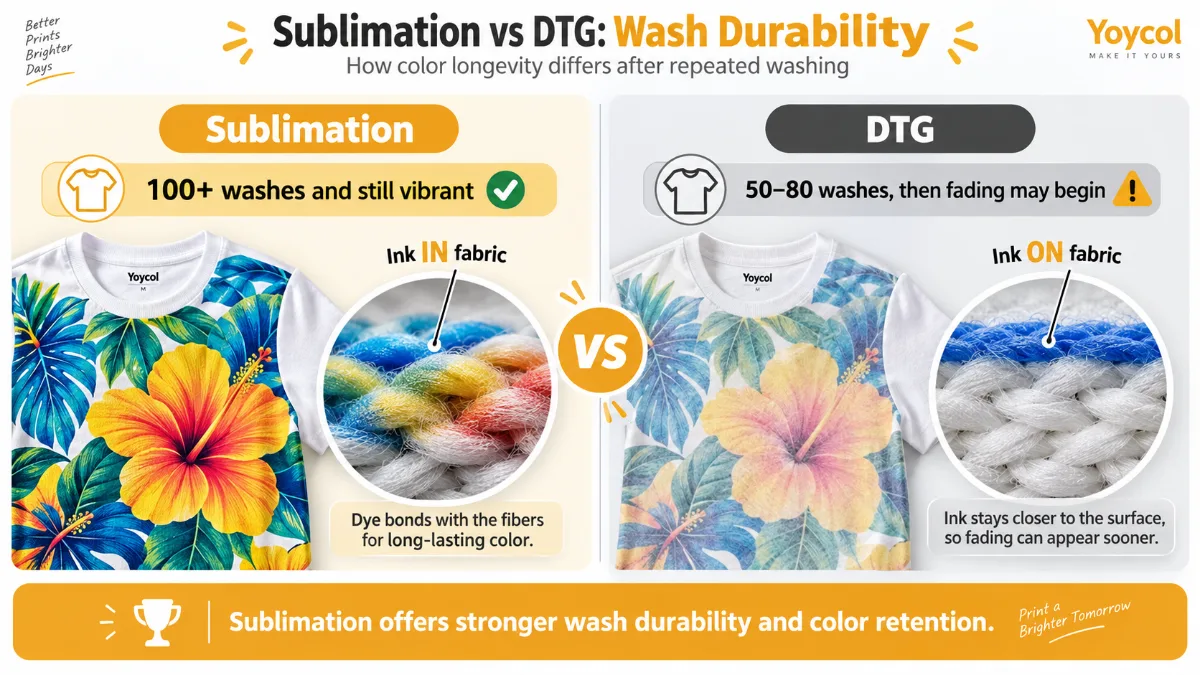
This is a critical factor for customer satisfaction and repeat purchases.
Sublimation Durability
Because sublimation ink becomes part of the fabric:
- Won't crack or peel — there's no layer to separate from the fabric
- Won't fade significantly — the ink is protected inside the fibers
- Survives 100+ washes without noticeable quality loss
- Resists UV fading better than surface-level prints
- Stretch-safe — the design stretches with the fabric without damage
DTG Durability
Because DTG ink sits on the fabric surface:
- Can crack over time — especially on areas that flex (collars, cuffs)
- Gradual fading — after 50-80 washes, colors begin to noticeably fade
- Peeling risk — lower quality DTG prints can peel at the edges
- Wash temperature matters — hot water accelerates fading
Real-World Test Results
| Test | Sublimation | DTG |
|---|---|---|
| Wash cycles before visible fade | 100+ | 50-80 |
| Stretch test (100 cycles) | No damage | Minor cracking possible |
| UV exposure (6 months) | Minimal fading | Noticeable fading |
| Abrasion resistance | Excellent | Good |
For POD sellers, durability directly impacts reviews, returns, and repeat purchases. Sublimation products generate fewer complaints and more positive reviews.
Cost Analysis: Which Is Cheaper?
The answer depends on what you're printing.
For All-Over-Print Products
| Cost Factor | Sublimation | DTG |
|---|---|---|
| Per-unit cost (AOP hoodie) | $14-19 | Not practical |
| Per-unit cost (AOP t-shirt) | $6-9 | Not practical |
| Setup per design | Low (transfer paper) | Low (digital file) |
| Winner for AOP | ✅ Sublimation | ❌ DTG can't do AOP |
For Spot Prints (Front/Back Only)
| Cost Factor | Sublimation | DTG |
|---|---|---|
| Per-unit cost (cotton tee) | Not ideal | $5-8 |
| Per-unit cost (dark garment) | Not possible | $6-10 |
| Setup per design | Low | Low |
| Winner for spot prints | ❌ Limited to polyester | ✅ DTG more versatile |
The Margin Impact for POD Sellers
If you're selling AOP products (which is where the highest margins are), sublimation is the only practical option. Here's what this means for your business:
| Product | Method | Base Cost | Retail Price | Profit |
|---|---|---|---|---|
| AOP Hoodie | Sublimation | $18.90 | $60 | $35+ |
| Cotton T-Shirt (spot) | DTG | $8.00 | $30 | $17+ |
| AOP Leggings | Sublimation | $10.80 | $45 | $28+ |
AOP products using sublimation consistently generate higher profit per sale than DTG spot prints. This is why POD sellers focused on margins gravitate toward sublimation-based AOP products.
For a complete pricing framework, our how to price POD products guide covers every variable.
Fabric Compatibility: DTG Is More Versatile
This is DTG's biggest advantage.
Sublimation Fabric Requirements
- Must be polyester (80%+ polyester for best results)
- Must be light-colored (white or pastels — dark fabrics block the sublimation)
- Cannot print on: 100% cotton, dark garments, non-polyester blends
DTG Fabric Compatibility
- Works on cotton (100% cotton, cotton blends)
- Works on dark fabrics (black, navy, etc.) with white underbase
- Works on various materials (linen, bamboo, some synthetics)
What this means for POD sellers:
- If you sell AOP products → sublimation (polyester is standard for AOP)
- If you sell cotton t-shirts → DTG
- If you sell dark-colored garments → DTG
- If you sell both → you need a supplier that offers both methods
Yoycol primarily uses sublimation for their AOP products, which is why their AOP catalog has 900+ items all with vibrant, edge-to-edge prints. For DTG products, suppliers like Printful and Printify offer cotton t-shirts and dark garments.
Which Method Is Best for All-Over-Print?
This isn't even close. Sublimation is THE method for all-over-print.
Here's why DTG can't compete for AOP:
| AOP Requirement | Sublimation | DTG |
|---|---|---|
| Edge-to-edge coverage | ✅ Full coverage, seamless | ❌ Limited print area |
| Seam-to-seam printing | ✅ Prints on flat fabric before sewing | ❌ Can't print on assembled garments |
| Polyester compatibility | ✅ Designed for polyester | ⚠️ Works but not optimal |
| Vibrant, full-color | ✅ Photographic quality | ⚠️ Good but not seamless |
| Cost at scale | ✅ Efficient for full coverage | ❌ Expensive for large areas |
| Wrinkle/fold resistance | ✅ Ink is in the fabric | ❌ Surface ink can crack at folds |
Every major AOP POD product — hoodies, leggings, blankets, backpacks, swimwear — uses sublimation printing. It's not just the better option; it's the only practical option for true all-over-print.
For more on which AOP products are most profitable, our best all-over-print products guide ranks every category.
How to Choose: Decision Framework for POD Sellers
Use this framework to decide which method your products should use:
Choose Sublimation When:
- ✅ You sell all-over-print products (hoodies, leggings, blankets, bags)
- ✅ Your products are polyester or poly-blend
- ✅ You want maximum durability and wash resistance
- ✅ You want premium feel (no texture, soft hand)
- ✅ You sell light-colored garments
- ✅ Profit margins are your top priority
Choose DTG When:
- ✅ You sell cotton t-shirts or cotton-blend products
- ✅ You need dark-colored garments (black, navy, dark grey)
- ✅ You sell spot prints (front chest design, back print)
- ✅ You need razor-sharp text or very fine detail
- ✅ You want maximum fabric versatility
The Smart Strategy: Use Both
Most successful POD sellers don't choose one — they use both:
- Sublimation for AOP products → highest margins, best quality
- DTG for cotton/spot products → maximum versatility, dark garments
Suppliers like Yoycol specialize in sublimation-based AOP products (900+ items). If you also need DTG cotton products, you can add a second supplier or choose a platform that offers both.
For a complete comparison of POD suppliers and their printing methods, our best AOP POD companies guide ranks every major platform.
Frequently Asked Questions
Is sublimation better than DTG? For all-over-print and polyester products, yes. Sublimation produces more vibrant colors, superior durability (100+ washes vs 50-80), zero hand-feel, and seamless edge-to-edge coverage. For cotton and dark garments, DTG is the better choice.
Can DTG do all-over-print? Not practically. DTG printers have a fixed print area (typically the front or back panel of a garment). True all-over-print requires printing on flat fabric before it's cut and sewn — which is exactly what sublimation does.
Why does sublimation only work on polyester? Sublimation ink bonds at the molecular level with polyester fibers. Natural fibers like cotton don't have the molecular structure to accept sublimation ink. You need at least 80% polyester content for good results.
Does sublimation printing feel different from DTG? Yes. Sublimation has zero hand-feel — you can't feel the design because the ink is inside the fabric fibers. DTG has a slight texture because the ink sits on the fabric surface. For premium products, sublimation feels significantly better.
Which printing method lasts longer? Sublimation lasts significantly longer. Sublimation prints survive 100+ wash cycles without noticeable fading because the ink is bonded inside the fibers. DTG prints typically show noticeable fading after 50-80 washes because the surface ink gradually breaks down.
Which is more profitable for POD sellers? Sublimation-based AOP products generate higher profit per sale. An AOP hoodie using sublimation costs ~$18 to produce and sells for $55-65 ($35+ profit). A DTG cotton t-shirt costs ~$8 to produce and sells for $25-35 ($17+ profit). Higher margins make sublimation/AOP more profitable per transaction.
The choice between sublimation and DTG isn't about which is universally "better" — it's about which is better for your specific products.
For all-over-print sellers, sublimation is the clear winner: superior quality, longer durability, better margins, and it's the only practical method for true AOP products.
For cotton t-shirt sellers or those who need dark garments, DTG offers the versatility you need.
The smartest approach? Use both. Sublimation for your high-margin AOP products. DTG for your cotton and dark garment offerings. Most successful POD sellers operate this way.
Ready to start selling sublimation-printed AOP products? Browse Yoycol's 900+ AOP products →
This guide is part of our all-over-print series. Learn about the difference between AOP and DTG coverage or explore AOP design templates for creating sublimation-ready files.